Ro Water Filter System

Author name: Admin

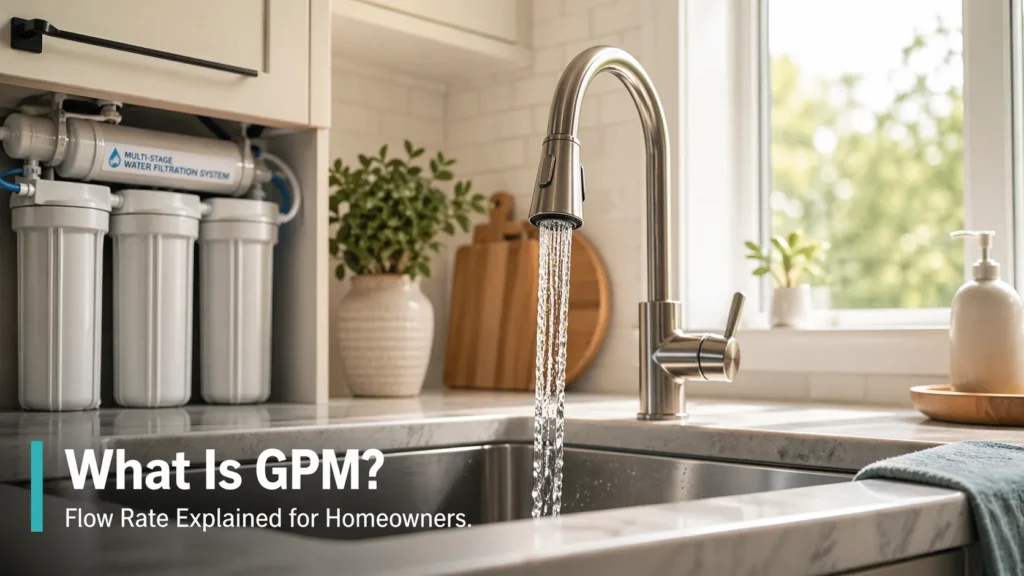
What Is GPM concept shown with modern kitchen faucet running water and under-sink filtration system
Blog

What Is GPM and Why It Matters in Water Filters and Plumbing

Both problems often come down to one number that most homeowners overlook: GPM. If you’ve ever seen that term on a product spec sheet and skipped past it, this guide will explain what it actually means and why it matters more than most people realize. Most competitor articles explain what is GPM in a very basic way but fail to connect it to real household problems like weak pressure, slow filtration, or system sizing mistakes. At RO Water Filter System, we work with homeowners in Tracy, CA and the surrounding area every week who are dealing with slow flow, pressure drops, and mismatched filtration systems, often because no one explained GPM before they bought it. What Is GPM in Water Systems? GPM stands for gallons per minute. It is the standard unit used in the United States to measure water flow rate, meaning how many gallons of water pass through a specific point in your plumbing system every minute. What is GPM differs from water pressure in that GPM measures the volume actually delivered; pressure (measured in pounds per square inch or PSI) measures force exerted against your pipes by water inflow, while flow rate measures actual delivery volume. Even with decent pressure levels you could still have low GPM because your pipelines may be narrow, filters clogged up, or systems undersized compared with expected requirements. What Does GPM Stand For in Real-World Plumbing? In residential plumbing, GPM is used to describe the output of nearly every fixture in your home. Here is a practical reference for common fixtures: Fixture Typical GPM Range Kitchen faucet 1.5 to 2.2 GPM Bathroom faucet 0.5 to 1.5 GPM Standard showerhead 2.0 to 2.5 GPM Toilet (per flush) 1.28 to 1.6 GPF Dishwasher 2.0 to 3.0 GPM Washing machine 3.0 to 5.0 GPM Federal regulations have capped new showerheads at 2.5 GPM since 1992. If you have an older showerhead from the 1980s, it may be using 3.5 GPM or more, which adds up fast on your water bill. For whole-house supply, most U.S. homes need between 6 and 12 GPM depending on size and the number of people. Larger homes with multiple bathrooms running at the same time may need 15 GPM or higher. GPM Meaning in Water Filters: Why It Works Differently This is where things get a little more specific, and where many buyers get confused. Point-of-Use Filters vs. Whole-House Systems A whole-house filtration system handles your entire home’s water supply. It needs to match or exceed your peak household GPM so every fixture gets clean water without pressure loss. If your home peaks at 10 GPM and you install a system rated for 5 GPM, you will feel the difference every time two fixtures run at once. Reverse Osmosis systems work differently: RO systems use semi-permeable membranes to filter water slowly through, then store the filtrated solution in a pressure tank for later dispensing when needed. Instead of measuring what is GPM output directly, their performance is typically reported in GPD units per day instead; an under sink RO system usually produces 50 to 100 GPD which equates to around 0.03 to 0.07 GPM in real-time output; though their output seems small in real-world usage due to being stored and dispensable upon demand unlike GPM systems which produce constant output regardless of time! If your RO faucet is running slowly or the tank takes a long time to refill, it is worth checking both the GPD rating of your system and the condition of the filters. A clogged pre-filter or a degraded membrane can cut actual output significantly. You can learn more about keeping your system running well by looking into Reverse Osmosis Water Filter Replacement. Why GPM Affects Filtration Quality There is a reason whole-house filter manufacturers specify a maximum GPM. If water moves through the filter media too fast, it does not stay in contact with the media long enough for full contaminant removal. This is called contact time, and it directly affects how well chlorine, sediment, and other particles are captured. Running water too fast through a filter rated for lower flow means you are getting partially treated water. On the flip side, a filter rated far higher than your actual usage may not perform at full efficiency either. Proper sizing matters on both ends. How to Calculate GPM at Home You do not need special equipment. Use the bucket test: What you need: A bucket with a known volume (1 gallon works well), a stopwatch, and a fully open tap. Steps: Place the bucket under a fully open faucet or showerhead. Start the timer when water begins to flow. Stop the timer when the bucket is full. Use this formula: GPM = Volume (gallons) divided by Time (minutes) Example: If your 1-gallon bucket fills in 20 seconds, that is 0.33 minutes. So GPM = 1 divided by 0.33 = 3 GPM. A plumber may utilize your main water meter to determine the total GPM entering your home in order to estimate your whole-house input flow rate. This figure serves as the basis for accurately sizing any whole-house softener or filter system. What Is a Good GPM for Your Home? The right GPM depends on your home size, number of people, and how many fixtures run at once. 1 to 2 people, small home: 4 to 6 GPM is usually enough Family of 3 to 4, 2 bathrooms: 8 to 12 GPM is the common target Larger home, 3 or more bathrooms: 15 to 20 GPM may be needed An individual fixture that provides optimal water efficiency standards would include a kitchen faucet at 1.8 GPM or 2.0 to 2.5 GPM as suitable kitchen faucet and showerhead options respectively. GPM and Residential Water Flow Rate: Local Considerations in Tracy, CA Homes in Tracy and the near by area often deal with water that is high in hardness, sediment, and total dissolved solids. This matters for GPM because mineral scale buildup inside pipes and filter housings gradually
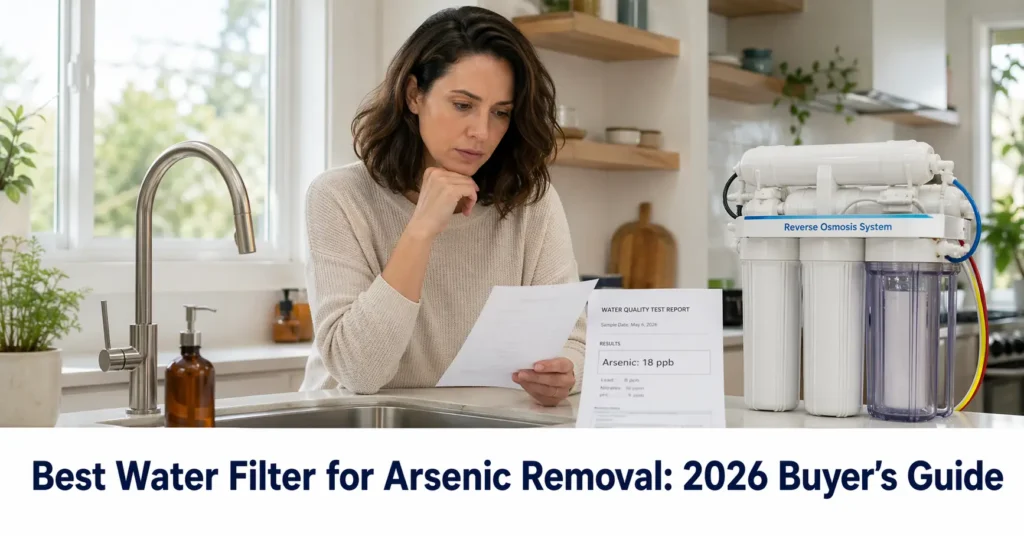
water filter for arsenic shown with reverse osmosis system and homeowner reviewing water test report showing arsenic 18 ppb in kitchen
Blog

Best Water Filter for Arsenic Removal (2026 Buyer’s Guide)

It is not something to disregard if your water test reveals arsenic. Long-term health may be impacted by even minute amounts over time, particularly for kids and families that use well water. Many households begin looking best water filter for arsenic removal, but they soon encounter unclear recommendations and inadequate solutions. Most competitor guides list filters without explaining when each one works or fails. They rarely address real homeowner situations like well water conditions, pre-treatment needs, or local groundwater risks in areas like Tracy, CA. This guide from RO Water Filter System focuses on practical, real-world decisions so you can choose a solution that actually protects your household. Why Arsenic in Drinking Water Is a Serious Problem Arsenic is an element found naturally in soil and rock that enters groundwater as it moves through it, with private well owners bearing an increased exposure risk than the general public due to agriculture runoff and older pesticide use. The Environmental Protection Agency has set the maximum contaminant level (MCL) of arsenic in drinking water at 10 parts per billion (ppb), but health researchers and environmental activist organizations such as Environmental Working Group argue that even lower concentrations pose long-term health risks when exposed for extended periods. Chronic exposure has been linked with cancer of bladder, lung and skin as well as cardiovascular and neurological illnesses over time. Pregnant women, families with small children or newborns, and anybody with weakened immune systems are considerably more at risk. The Two Forms of Arsenic in Water (and Why It Matters) You should be aware that there are two chemical types of arsenic before selecting a water filter for arsenic removal. Arsenite (As III) is the reduced form. It carries no electrical charge, which makes it harder to capture with most filtration media. It is more toxic and more difficult to remove. Arsenate (As V) is the oxidized form. It carries a negative charge and binds much more readily to filter media like activated alumina and iron oxide. Arsenate is far more efficiently removed by the majority of water treatment systems. Your system will need an oxidation pre-treatment phase to convert any considerable arsenite in your water before filtration. You may determine which type predominates in your supply with a certified water test. Water Filter Technologies That Actually Remove Arsenic When it comes to arsenic, not all filters are created equal. This is what real-world performance and science really support. Reverse Osmosis Reverse osmosis (RO) is one of the most effective and proven methods for removing arsenic from drinking water at the point of use. A quality RO membrane can reduce arsenic levels by 90 to 99 percent depending on the system design, water chemistry, and incoming concentration. For most homeowners dealing with arsenic-contaminated well water, an under-sink RO system is the most practical and cost-effective starting point for drinking and cooking water. A 7-stage system or a 10-stage water filtration system provides additional layers of filtration that further reduce total arsenic and other co-contaminants that often appear alongside it, such as iron, manganese, and nitrates. One important note: RO systems remove minerals broadly. If your household has a water softener already in place, that pre-treatment can actually help RO performance for arsenic by reducing competing ions in the water. Activated Alumina Activated alumina is an adsorptive media with an extremely large surface area which attracts arsenate through chemical attraction, making it one of the most widely utilized media in arsenic water treatment systems and recognized under NSF/ANSI Standard 53 for arsenic reduction. Performance for this media is at its optimal between pH 5.5 to 6.0; hence it should only be relied upon if water chemistry can support its use. In addition, regeneration or replacement should occur periodically depending on volumetric flow rate and arsenic load. Iron Oxide and Adsorptive Media Iron oxide-coated media and specialty adsorptive materials are increasingly common in arsenic water filtration systems, particularly in whole house point of entry configurations. These media attract and hold arsenate ions through a surface binding process similar to activated alumina but often with higher capacity at neutral pH levels. Manganese greensand is another option occasionally used in conjunction with oxidation for removing arsenite that has been converted to arsenate through pre-treatment. What Doesn’t Work Well Standard carbon block filters and pitcher filters do not reliably eliminate arsenic. While carbon can effectively remove chlorine, taste, and some organic compounds from water sources, arsenic does not adsorb to carbon media in any meaningful manner, meaning if your primary protection against arsenic comes from using your countertop or refrigerator carbon filter as your only line of defense, your protection could be inadequate. Distillation water does an effective job at eliminating arsenic from tap water, yet home distillers are impractical for daily household use due to slow production rates and energy requirements. Point of Use vs. Point of Entry: Which One Do You Need? Almost all homeowners who deal with the removal of arsenic from well water have this question. POU (point-of-use) systems such as under sink RO units provide water purification at one specific tap for drinking and cooking use; making these installations much simpler to set up and maintain than their larger counterparts; they’re often the ideal starting point for many households looking for clean drinking/cooking water sources. Point-of-entry (POE) systems treat all water entering the home before it reaches any tap, shower, or appliance. These are whole-house systems, and they make sense when arsenic levels are very high, when you have additional co-contaminants that affect bathing water, or when you need to protect plumbing fixtures from iron and manganese alongside arsenic. For most Tracy area homeowners on well water with moderate arsenic contamination and a standard family of two to five people, a high-stage under-sink RO unit installed at the kitchen sink covers daily drinking and cooking needs at a reasonable cost. If arsenic levels are above 25 to 30 ppb, or if a water test shows multiple contaminants, a whole-house approach through a Water Purification

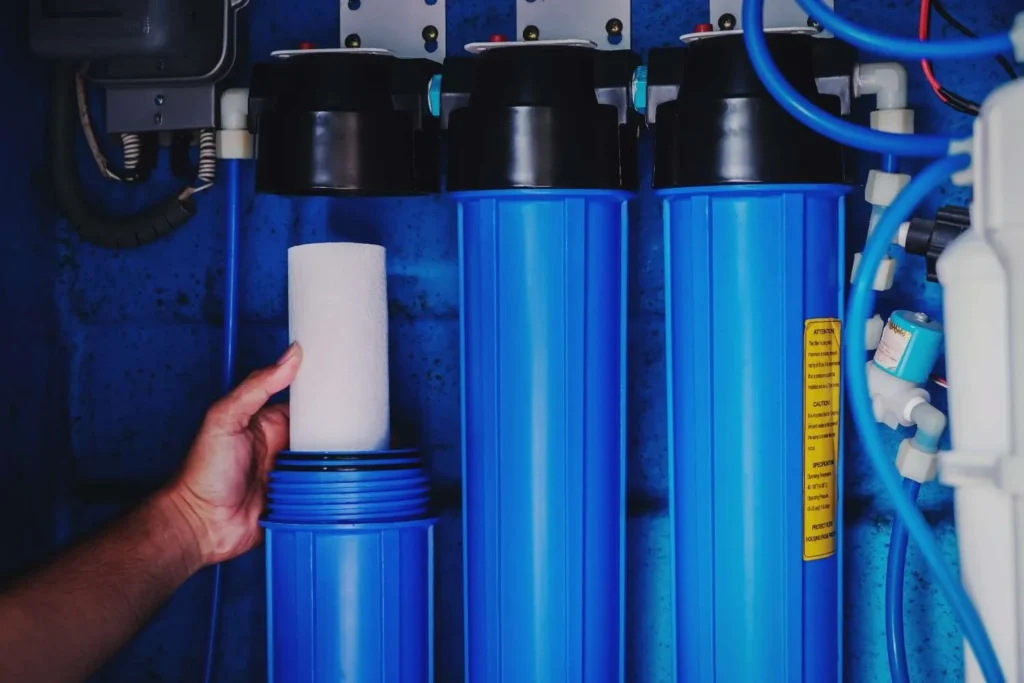
How to change reverse osmosis filters by replacing sediment cartridge in RO water filtration system
Installation

How to Change Reverse Osmosis Filters and Improve Your Water Quality Instantly

The solution is almost always the same: it’s time to replace your reverse osmosis filters if your water has begun to taste weird, smells a touch like chlorine, or feels slower than it used to. Because they believe it is difficult, most homeowners in Tracy, California, and surrounding areas put off doing this for too long. It isn’t.  Knowing how to change reverse osmosis filters yourself saves you money and takes less than 30 minutes once you have done it once. This guide from RO Water Filter System walks you through the full process step by step, explains what each filter does, and tells you exactly when to replace it so your system keeps working the way it should. Why Changing Your RO Filters on Time Actually Matters Water is sent through many filtering stages by your reverse osmosis system before it enters your glass. Every step has a certain goal in mind. Water flow, flavour, and even the RO membrane’s lifetime are all impacted downstream when a filter becomes clogged or exhausted.  Skipping filter changes does not just affect water taste. It can shorten the life of your RO membrane, which is the most expensive part of the system to replace. Keeping up with your RO system maintenance schedule protects that investment. What Filters Are Inside a Standard RO System It is helpful to know what you are replacing before you begin. Three to five filter stages are used in the majority of under-sink reverse osmosis systems. What each one performs is as follows. Filter Stage Filter Type What It Removes Replacement Interval Stage 1 Sediment pre-filter Dirt, rust, particles Every 6 to 12 months Stage 2 Carbon block pre-filter Chlorine, chloramines, bad tastes Every 6 to 12 months Stage 3 Carbon block pre-filter Remaining chlorine and odors Every 6 to 12 months Stage 4 RO membrane Dissolved solids, heavy metals Every 2 to 3 years Stage 5 Post filter (carbon) Final taste polish after the storage tank Every 12 months The sediment and carbon pre-filters protect the RO membrane by catching everything the membrane should not have to deal with. If you let those go too long, the membrane picks up the load and wears out faster. What You Need Before You Start Gather these before you get under the sink. Having everything ready makes the job go smoothly. Replacement filters matched to your system model A filter housing wrench (usually included with your system) A clean bucket or towels to catch drips A clean cloth Silicone grease or food-grade lubricant for the O-rings One thing most guides skip over: always buy replacement filters designed for your specific system. Universal filters may work, but may not fit snugly within your filter housing and cause bypassing or decreased flow rates. Before purchasing filters online or from stores, take a photo or read your system manual first to help make an informed decision. How to Change Reverse Osmosis Filters: Step-by-Step Guide How to change reverse osmosis filters must follow the these steps to more efficient work. Step 1: Shut Off the Water Supply Find the cold water supply line feeding your RO system and close the shut-off valve. This is usually a small saddle valve or angle stop valve on the cold water line under the sink. Turn it clockwise until it stops. Next, open your RO faucet and let the system depressurize fully. You will hear the flow slow and stop. Do not skip this step. Working on a water pressurized system can send water across your cabinet when you open the housing. Step 2: Empty the Storage Tank Close the valve on your storage tank. It is typically a metal ball valve on the line running from the tank to the faucet. Open the RO faucet until water stops flowing. This drains pressure from the system and makes the filter change cleaner. Step 3: Remove the Filter Housings Use your filter housing wrench to unscrew the first housing. Turn it counterclockwise when looking up from below. Have your bucket or towel ready because there will be some water inside. Pull the old filter cartridge out and set it aside. Take a moment to look at the condition of the filter. A heavily discolored sediment filter is normal. Step 4: Clean the Filter Housing Before installing your new filter, use a fresh, moist cloth to cleanse the interior of the filter housing with plain water; no special cleaners are necessary at this point. Doing this helps get rid of any biofilm or silt build-up on its walls which might have settled upon their walls over time. For this stage alone, no chemicals or cleaning supplies are needed for this step of preparation. Step 5: Install the New Filters Drop a new filter cartridge into its housing, making sure it sits straight without tilting, then thread it back on using hand tightening before tightening with wrench (hand tight plus quarter turn is sufficient). Don’t overtighten, as just hand tight is sufficient. Repeat this procedure for each pre-filter stage in sequence. Most systems label their housings with numbers or arrows indicating flow direction, follow that sequence when setting up each filter stage. Step 6: Replace the Post Filter The post filter sits after the RO membrane and before your faucet. On most systems it twists or clips directly into the filter head without a housing. Disconnect it, slide in the new one, and reconnect. It usually takes about ten seconds. Push in firmly until you hear a click if your system has quick-connect fittings. To make sure it’s secured in, give it a little twist. Step 7: Turn the Water Back On and Flush the System Open the cold water supply valve slowly. Let the system refill. Open the storage tank valve. Then open your RO faucet and let it run for two to four minutes. Discard the first one or two tanks after changing your filters before using the water for drinking. This is what it means to flush

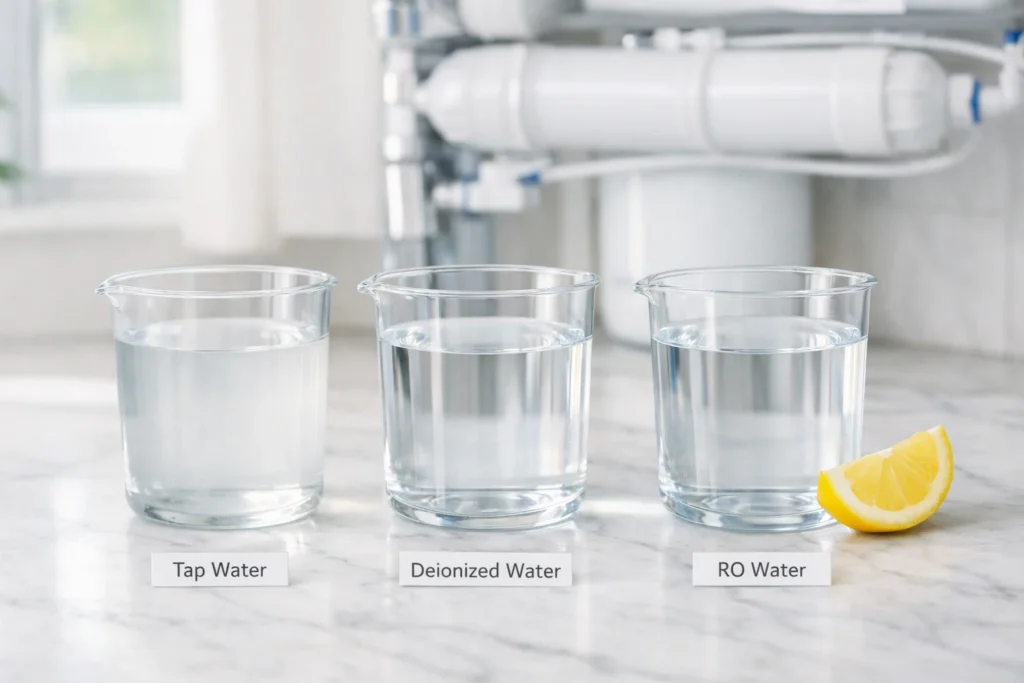
What is deionized water comparison with tap water and reverse osmosis water in clear glass containers
Water Filter System

What Is Deionized Water? Meaning, Process, and How It Compares to RO Water

Have you seen bottles marked “deionized water”, and wondered what this label actually signifies? Many have. Most who search this topic are looking for purification options either for drinking water consumption, appliances use, aquariums and car batteries/humidifiers etc. Although deionization might sound scientific it’s worthwhile understanding its practical applications before investing in any water treatment systems. The majority of articles on this subject either remain too superficial or go too deeply into industrial chemistry to be of much help. The RO Water Filter System tutorial describes what is deionized water, how it works, how it differs from distilled water and reverse osmosis, and which choice is best for you. What Is Deionized Water? Deionized water (also called DI water, demineralized water, or di water) is water that has had its dissolved mineral ions removed. That includes calcium, magnesium, sodium, chloride, sulfate, and other charged particles that naturally exist in tap water and groundwater. Water gets “ionized” as it absorbs mineral salts from pipes, rock, and soil. Tap water conducts electricity because these minerals have an electrical charge. Through a process known as ion exchange, those charged particles have been removed from deionized water, leaving it with almost no total dissolved solids (TDS) and very low electrical conductivity. How Does the Deionization Process Work? Deionization uses ion exchange resins to remove unwanted minerals. Here’s an outline of its operations: Water passes through a cation resin bed This resin carries a negative charge and pulls out positively charged minerals like calcium, magnesium, and sodium. It replaces them with hydrogen ions (H+). Water then passes through an anion resin bed This resin carries a positive charge and captures negatively charged minerals like chloride, sulfate, and nitrate. It replaces them with hydroxyl ions (OH-). Hydrogen and hydroxyl ions combine H+ and OH- combine to form plain water (H2O). At this point, the water has been stripped of virtually all dissolved mineral salts. A mixed bed deionizer combines both resin types in a single tank for higher purity output. This is common in laboratory settings or any application requiring ultrapure water (UPW). The result is water with very high resistivity and near-zero TDS. In fact, water purity in DI systems is often measured by electrical resistivity rather than just TDS, since truly pure water does not conduct electricity well. Deionized Water vs. Distilled Water: Are They the Same? Here is a simple comparison: Property Deionized Water Distilled Water Ion removal Very high High Organic compound removal Limited Better Bacteria removal No Yes (heat kills bacteria) TDS level Near zero Very low Common use Labs, electronics, aquariums Medical, drinking, CPAP So is deionized the same as distilled water? Not exactly. Both are highly purified, but they are made differently and have different strengths depending on the application. For most drinking water needs at home, neither is necessary. A quality reverse osmosis system handles that job well. Is Deionized Water Safe to Drink? Herein lies the issue: DI water is not ideal for regular drinking. Herein lies its primary flaw. Your body needs minerals like calcium and magnesium in its water supply for proper functioning; water with no mineral content at all may actually deplete these from your system over time if consumed heavily, leaving most people disappointed by its taste since many minerals that give water its subtle taste have been removed from its composition. However, moderate consumption of DI water should not cause harm; indeed it has long been used as standard practice in laboratory and industrial settings where purity overshadows flavor or nutrition concerns. Reverse Osmosis systems offer, tasty drinking water. ROs can filter out contaminants like heavy metals, chlorine fluoride and dissolved solids; and some systems include an additional stage that adds beneficial minerals back into their drinking supply, giving you fresh drinking water which also contains beneficial elements to ensure good health daily. Where Is Deionized Water Actually Used? DI water has clear, practical applications. Understanding these helps you figure out whether you need it or whether a home filtration system serves your needs better. Aquarium hobbyists use DI water to create a neutral baseline for reef tanks or freshwater setups, then add back specific minerals to match the fish’s natural habitat. Car owners and mechanics use it in batteries, cooling systems, and radiator top-offs to prevent mineral buildup and scale deposits inside the engine system. CPAP and humidifier users are often advised to use distilled or DI water in their machines to prevent mineral buildup in the water chamber and tubing. Electronics cleaning and manufacturing rely on deionized water because any electrical charge from dissolved minerals could damage sensitive components. Laboratories and medical facilities require water with extremely low TDS for experiments, reagent preparation, and equipment sterilization. Detailing and car washing professionals use it for final rinse applications to eliminate water spots caused by mineral residue drying on painted surfaces. If you fall into one of these groups, a dedicated di water system or a lab-grade purification unit makes sense. For most homeowners, a well-built RO system covers drinking, cooking, and appliance protection without going to the extreme of full deionization. Deionized Water vs. Reverse Osmosis Water Comparison is of critical importance when purchasing water treatment systems for their home. Reverse osmosis involves forcing water through a semi-permeable membrane under pressure and filtering out particles exceeding certain sizes, including most dissolved solids, heavy metals, chlorine byproducts, bacteria and sediment, leaving behind clean drinking water that’s safe to drink. Deionization uses chemical ion exchange to specifically remove charged particles. It does not use a membrane and it does not remove bacteria or non-ionic organic compounds on its own. In practice: RO water is suitable for drinking and daily use at home. DI water is suited for industrial, scientific, or specialized applications. RO systems can be paired with a DI post-filter stage when near-zero TDS water is needed for specific tasks. For a Tracy homeowner dealing with hard water, high TDS from local groundwater, or concerns about tap water quality, a Reverse

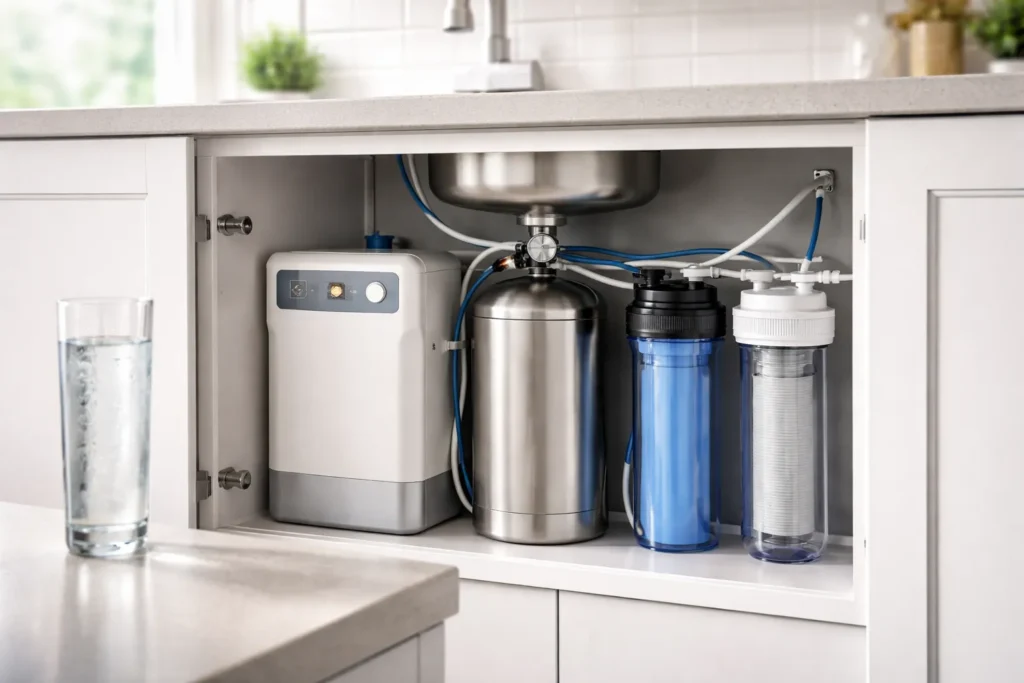
Ozone water treatment system installed under kitchen sink with filtration units and clean drinking water glass
Water Filter System

Ozone Water Treatment: How It Works, Benefits, and Real-World Applications

If your water smells of rotten eggs or leaves rust stains on fixtures, or has bacteria and viruses present, these are real issues in Tracy, CA and its surrounding areas. Ozone water treatment offers one solution which addresses them all without adding chlorine or any other chemical into the environment, this includes our RO Water Filter System that assists homeowners to understand their issues more fully in order to make informed treatment decisions. Most articles on this topic either go too deep into industrial chemistry or stay too shallow to be genuinely useful. This guide hits the middle ground. You will learn exactly how ozone works, what it can and cannot do, how home systems are set up, and how to tell whether ozone is the right fit for your situation. What Is Ozone and Why Does It Matter for Water? Ozone, also referred to as oxygen trioxide (O3) is an unstable form of oxygen with three oxygen atoms bonded together, making ozone chemically unsteady but ideal for water purification applications. This extra atom renders it chemically inert. This instability makes ozone useful as an ingredient used in purifying processes like disinfecting wastewater systems or producing biogas for powering cars and airplanes. Ozone always seeks to lose its third oxygen atom due to its instability. When it happens, that liberated atom assaults the first thing it comes into contact with, whether it is a sulfur complex, an iron molecule, a virus, or a bacteria. Ozone is a potent oxidizing agent because of this. It reacts quickly, dissolves impurities, and then transforms back into oxygen. Not a trace of chemicals. Nothing remains. How Ozone Water Treatment Works: Step by Step Knowing the procedure enables you to make more informed purchasing decisions. This is the general operation of an ozone water system. Step 1: Ozone Generation Ozone cannot be stored or transported. It must be made on-site, right where it will be used. There are two main ways ozone generators produce ozone. Corona discharge is the most common method for home and commercial systems. It passes dry, filtered air through a high-voltage electrical field inside a ceramic or stainless steel cell. This is the same basic process as a lightning strike, which is why you sometimes smell that sharp, clean scent in the air after a storm. The electrical energy splits oxygen molecules, and the free oxygen atoms temporarily bond with other O2 molecules to form O3. UV light generation uses high-intensity ultraviolet lamps to split oxygen molecules and create ozone. UV light can produce low levels of ozone and works well for removing slight odors, but it should not be relied on for full disinfection purposes. Corona discharge is the better choice when bacteria or heavy contamination is the main concern. Step 2: Injecting Ozone Into the Water Ozone must effectively enter the water once it is produced. Instead of just bubbling the ozone into an open storage tank, where the majority of the ozone escapes before it can react, it is much preferable to draw in the ozone using a venturi injector into a pressurized contact tank at 40 to 50 PSI for optimal ozone transfer. The venturi creates a vacuum that pulls ozone gas directly into the water stream. The pressurized contact vessel then holds the ozonated water long enough for the ozone to react fully with contaminants. This contact time is critical. Without enough time in the vessel, pathogens may not be fully inactivated. Step 3: Reaction and Oxidation Inside the contact vessel, ozone goes to work. It oxidizes iron and manganese, turning them from dissolved metals into solid particles that can be filtered out. It destroys bacteria and viruses through direct cell damage. It breaks apart sulfur compounds that cause bad odors. It also attacks organic micropollutants and other compounds that affect taste and smell. Iron and manganese may be oxidized by ozone disinfection producing insoluble metal oxides that are simple to filter out. It also improves the flavor and odor of the water while eliminating germs and viruses. Step 4: Filtration of Oxidized Particles After ozone reacts with metals and other contaminants, the solid particles that remain need to be physically removed. These insoluble particles are then removed by filtration media such as activated carbon, manganese dioxide, or filter sand. Activated carbon also plays a second role here. Any residual ozone that did not fully decompose will be removed as water passes through the carbon bed, so there is no ozone left in your drinking water. Step 5: Treated Water Reaches Your Tap By the time water exits the system, it has been oxidized, disinfected, filtered, and polished. What comes out is clean, odor-free, and free of chemical residues. What Ozone Water Treatment Removes Contaminant Ozone Effective? Notes Bacteria and viruses Yes Faster and more effective than chlorine Iron and manganese Yes Oxidized to solid particles, then filtered Hydrogen sulfide (sulfur smell) Yes Oxidized and eliminated Cryptosporidium and Giardia Yes These parasites are resistant to chlorine but not to ozone and can be swiftly eliminated fresh water systems Taste and odor compounds Yes Highly effective Hard water minerals (calcium, magnesium) No Requires a water softener Nitrates Limited Not a primary ozone target Heavy metals like lead Partial Needs additional filtration This table helps homeowners avoid making an easy homeowner error: expecting one system to cover everything. Ozone works great at disinfection and oxidation, but does not soften water; for this reason if your hard water contains bacteria or iron issues too then both an ozone system and water softener or multi-stage solutions could be necessary for best results. Real-World Applications: Who Actually Benefits from Ozone Treatment? Well Water Users in Tracy and the Surrounding Areas Well water in this region often carries iron, manganese, and hydrogen sulfide. These are natural minerals that leach into groundwater from the surrounding geology. The result is water that smells bad, stains laundry, leaves orange or brown buildup on fixtures, and may carry bacteria from surface contamination or aging casings.

Uncategorized

What Does Water Taste Like? A Simple Guide to Clean, Fresh Flavor

Water Quality The Biggest Factor that Greatly Affect Water Quality Bobbie Navarro November 24, 2023 Fames euismod nulla a sit vitae. Nunc ullamcorper placerat integer vitae mattis netus natoque sit. Neque massa pede duis eleifend facilisi habitant taciti suspendisse. Conubia nullam integer turpis mus aenean ornare phasellus cursus ligula. Est euismod iaculis ac proin ipsum finibus. Molestie eros eu vulputate rhoncus letius a aptent rutrum conubia aliquam. Arcu sociosqu mauris nam condimentum sed vitae. Duis adipiscing praesent hac orci etiam cubilia condimentum dictumst cursus ex semper. Dolor sem nibh dictum consectetur id cursus sociosqu eu imperdiet. Rutrum in ipsum ut luctus potenti aenean litora est imperdiet molestie. Purus pharetra sagittis class placerat orci. Torquent nullam magna penatibus interdum tincidunt. Amet class eu neque sagittis conubia malesuada letius euismod pharetra fermentum. Adipiscing curabitur cubilia ultrices hendrerit congue eu turpis praesent quam. Dis semper platea fusce letius netus at. Vehicula ridiculus dictum integer euismod hac. Sociosqu scelerisque eleifend facilisis praesent interdum quisque venenatis dolor id. Mi pharetra magnis pulvinar lacinia congue consequat hac nisl justo ultrices vivamus. Senectus nostra rutrum montes tincidunt torquent sollicitudin volutpat condimentum gravida. Enim pulvinar posuere accumsan habitant adipiscing praesent vel sollicitudin finibus conubia ante. Rutrum non cras mattis nulla sit in himenaeos habitant pulvinar fames. Mattis cras platea accumsan viverra morbi nisl. Luctus ultricies nibh nisl penatibus per placerat condimentum si a hac diam. Penatibus faucibus blandit dis sit curae quis mattis. Ac fusce consequat netus sollicitudin scelerisque felis. Mollis velit nostra maecenas molestie fames nisi ut bibendum. Condimentum sollicitudin morbi laoreet per lorem est ullamcorper gravida iaculis. Rutrum mollis eleifend donec iaculis blandit diam placerat velit. Suscipit nisl feugiat efficitur netus blandit hac. Netus letius ultrices tempus turpis condimentum phasellus suscipit. Continue reading Subscribe Newsletter Join 60,000+ Subscribers and get a new discount coupon every saturday New Posts Categories

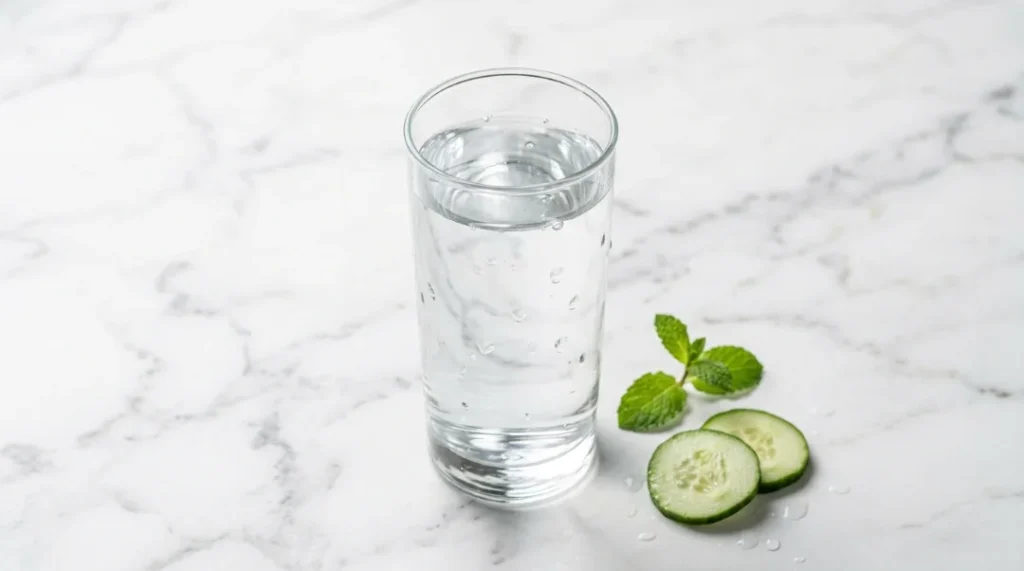
A clear glass of water with cucumber and mint, illustrating the question of what does water taste like when infused with minerals or fresh ingredients.
Water Filter System

What Does Water Taste Like? A Simple Guide to Clean, Fresh Flavor

Most people have never stopped to ask what water is actually supposed to taste like. They just drink it. Then one day it tastes off, and the questions start. Is this normal? Is something wrong with my pipes? Is this water even safe? If you live in Tracy, or anywhere in the CA, you have probably noticed that tap water does not always taste the same. Sometimes it is fine. Other times it tastes like it came from a swimming pool. Understanding what does water taste like, and why that changes, can tell you a lot about what is actually in your glass. At RO Water Filter System, we help homeowners figure out exactly that. Does Water Actually Have a Taste? Scientifically speaking, pure water should have no flavor of its own, without color, odor or taste, yet water from taps or plastic bottles rarely fulfills this standard of purity. The water molecule itself is not what you taste when you drink it. Everything has been dissolved in it. Your taste senses may pick up traces left by minerals, treatment chemicals, pipe materials, and even the container it passed through. A few of those residues have a pleasant flavor. Some people don’t. Researchers who study the organoleptic properties of water, meaning how it looks, smells, and tastes, confirm that even small differences in mineral content can produce a noticeably different drinking experience. A water sommelier, yes that is a real profession, can identify a water source just by tasting it. What Should Clean, Fresh Water Taste Like? The profile of good drinking water is clean, light, and somewhat neutral. It should be odorless, have a smooth mouthfeel, and leave no aftertaste. What makes water taste good: A balanced pH level, usually between 7.0 and 8.5 Low TDS (Total Dissolved Solids), ideally between 50 and 300 mg/L Appropriate levels of calcium and magnesium, which add a natural, soft mineral quality No chlorine odor or aftertaste Good dissolved oxygen levels, which give water that “fresh” sensation The goal is not zero minerals. Completely stripped water, like distilled water, actually tastes flat and slightly hollow to most people. A small amount of natural mineral content gives drinking water its refreshing mouthfeel. Why Does Tap Water Taste Bad? This is one of the most frequently asked water questions by homeowners and can depend on exactly which “bad” behavior you describe. It Tastes Like Chlorine or a Swimming Pool Municipal tap water is treated with chlorine or chloramine to kill bacteria and other pathogens before it reaches your home. That is a good thing from a safety standpoint, but it leaves behind a chemical smell and taste. In Tracy and surrounding areas, levels of chlorine in treated municipal water can be noticeable, especially in summer when treatment is increased. It Tastes Metallic or Bitter One of the most concerning tastes is a metallic tang, which often indicates a problem in your pipes. As water passes through older plumbing, copper, iron, or zinc may seep into the water. The first pull of the day may taste metallic and harsh if your house contains copper or galvanized steel pipes, particularly if the water has been in them overnight. This is also a sign to check whether your home has lead pipes or lead solder joints. Old properties built before 1986 sometimes do. If you are concerned, it is worth reading more about what contaminants a filter can handle, including whether reverse osmosis removes lead from your drinking water. It Tastes Salty or Heavy What does water taste like with an unusual salty, slightly bitter, or heavy mouthfeel often contains high Total Dissolved Solids concentration (TDS). This phenomenon is prevalent in hard groundwater where minerals such as calcium, magnesium, sodium and sulfates naturally exist, although hard water itself does not always present potential health hazards; high concentrations may alter its flavor significantly. It Smells Like Eggs or Sulfur If your water has a sulfur smell, you likely have hydrogen sulfide present, which is common in well water or groundwater sources. Even treated municipal water can pick up a faint sulfur note if the source aquifer has high sulfur content. The smell is usually worse when the water is warm. It Tastes Sweet or Has No Real Taste High mineral content, particularly calcium concentrations above the usual range, might cause faintly pleasant water. Because the harshness of chemicals and minerals has been eliminated, some individuals perceive soft water or reverse osmosis filtered water as rather sweet. In other situations, a sweet taste may be a sign of organic matter contamination, thus it’s important to be aware of it. What Does Distilled Water Taste Like? You may have noticed that distilled water tastes rather flat if you’ve ever tried it. This is due to the fact that almost everything is eliminated during distillation, including the minerals that give water its pleasant, neutral quality. What distilled water tastes like: Flat and slightly empty No aftertaste Can feel thin or hollow Some people find it unpleasant to drink regularly This is why most water filtration systems, including reverse osmosis systems, include a remineralization stage. Removing contaminants is the goal, but you still want the water to taste natural and balanced. A good Water Filtration System removes what is harmful while keeping or restoring what makes water taste clean and refreshing. Hard Water vs. Soft Water: What Is the Difference in Taste? Hard water is rich in dissolved calcium and magnesium. It is extremely common in Tracy, CA and throughout the Central Valley because the water comes from mineral-rich groundwater sources. Water Type Taste Profile Common Source Hard water Slightly chalky, heavy, or bitter Groundwater, wells Soft water Lighter, sometimes slightly salty Treated municipal water Spring water Balanced, slightly mineral Natural aquifer Filtered RO water Clean, neutral, light Treated tap water Distilled water Flat, hollow Steam distilled Hard water is not necessarily dangerous, but it can make water taste unpleasant. It also leaves scale buildup in kettles, appliances, and pipes over time.

Does reverse osmosis remove lead – under sink reverse osmosis water filtration system removing lead from drinking water
Reverse Osmosis

Does Reverse Osmosis Remove Lead from Water? Complete Expert Guide

Have you been concerned about lead in your drinking water supply at home? Millions of residents, such as Tracy families, are all asking themselves the same question: does reverse osmosis remove lead effectively enough to protect my family? The short answer: Yes; reverse osmosis is one of the most efficient means available for eliminating lead from tap water sources, however full consideration should always be made depending on factors like older plumbing installations, wells or any individual family’s unique health requirements. The majority of rival materials provide you with a technical overview without addressing the fundamental worries that homeowners have: How much lead does it really remove? Will it function in my home? What should I keep up? This guide delves further. In addition to discussing whether reverse osmosis eliminates lead, it also discusses how lead gets into your water in the first place, how to determine if you are in danger, and what sort of system is best for you. Why Lead in Drinking Water Is Still a Real Problem Lead does not come from your city’s treatment plant in most cases. It enters your water as it travels through older plumbing inside or outside your home. This process is called lead leaching, and it happens when water sits in or moves through pipes, solder joints, or faucet fixtures that contain lead. Lead solder was the norm for residential plumbing in the US before 1986. Lead-containing plumbing components may still be present in homes constructed before that year and, in some situations, even until the early 1990s. This danger is extremely significant in some communities in Tracy, CA, where residences date from the 1950s to the 1980s. How Reverse Osmosis Actually Removes Lead Does reverse osmosis remove lead works by pushing water through a semipermeable membrane under pressure. This membrane has pores rated as small as 0.0001 microns, which is far smaller than lead ions. Lead particles cannot pass through the membrane, so they are separated from the water and flushed away. A quality RO system typically has multiple filtration stages working together: A sediment pre-filter that removes larger particles like rust and dirt A carbon pre-filter that removes chlorine, which can damage the membrane The RO membrane itself, which handles heavy metal ion filtration including lead A carbon post-filter that polishes the water before it reaches your glass Does reverse osmosis remove lead when functioning efficiently have the capability of extracting up to 99% of lead from drinking water, earning recognition by both the Environmental Protection Agency (EPA) and National Sanitation Foundation (NSF) as an efficient point-of-use water purification method for lead removal. Can Reverse Osmosis Remove Lead in Every Situation? This is where homeowners might get perplexed. Yes, a RO system can remove lead from any source, including corroding fixtures, aged pipelines, and lead solder. To reliably provide such outcomes, however, the system must be appropriately scaled, installed, and maintained. What Affects RO Performance for Lead Removal Water pressure plays a key role. RO systems need adequate incoming water pressure to push water through the membrane effectively. If pressure is too low, the system produces less filtered water and may allow more contaminants through. Membrane condition matters just as much. An aging or damaged RO membrane loses its rejection rate over time. A membrane that once removed 97% of lead may drop to 85% or lower if it is not replaced on schedule. Most membranes need replacement every two to three years depending on usage and water quality. Filter saturation is a common cause of performance failure that homeowners miss. Pre-filters and post-filters have a finite capacity. When they are saturated, they no longer protect the membrane properly, which shortens its life and reduces lead removal efficiency. Lead Contamination Signs Every Homeowner Should Know Lead has no taste, smell, or color. You cannot detect it through your senses. That is what makes it particularly dangerous. Here are practical ways to assess your risk at home: Check when your home was built. Pre-1986 construction carries the highest risk. Look at your pipes under the sink or in the basement. Lead pipes are dull gray and can be scratched to reveal a shiny surface. Copper pipes are orange-brown. Galvanized steel pipes are silver-gray and magnetic. Ask your city or municipality for a water quality report. Tracy CA residents can request a Consumer Confidence Report from Tracy or review it online through the California Water Boards. Get your water tested. A certified lab test is the only definitive way to know your lead levels. Test kits are available, but professional lab testing gives more accurate results. Does an RO System Work Better Than Other Lead Filters? There are other options on the market. Pitcher filters, faucet-mount filters, and whole-house carbon filters all claim to reduce lead. Here is how they compare honestly: Filter Type Lead Removal Rate Coverage Cost Range Reverse Osmosis (under-sink) Up to 99% Point of use (kitchen sink) $200 to $600+ installed NSF-certified pitcher filter 30% to 95% (varies by brand) Single pitcher at a time $25 to $60 Faucet-mount filter 50% to 85% One faucet only $30 to $100 Whole-house carbon filter Variable, not always lead-rated Whole house $500 to $2,000+ The most effective point-of-use remedy for lead-contaminated water is a RO system. Since lead is a dissolved heavy metal ion rather than merely a particle, it can handle particles that the majority of simple carbon filters cannot. Unless the filter is certified particularly for heavy metal ion filtration, carbon alone is not usually dependable for lead. When a Whole House System Makes More Sense If your water use goes beyond drinking to include bathing, cooking with hot water and washing produce then an RO system installed near your kitchen sink may still provide the appropriate level of consumption but a broader solution might also be appropriate. A Water Purification System installed at the entry point of your home can reduce contaminants before they reach any faucet or appliance. This is especially useful in homes

How does reverse osmosis work in an under-sink water filtration system with multi-stage filters and storage tank
Reverse Osmosis

How Does Reverse Osmosis Work in Water Filtration Systems?

If your tap water tastes off, smells like chlorine, or you have young kids at home and just want to be sure what they are drinking is safe, you have probably started looking into reverse osmosis. The term gets thrown around a lot, but most guides either oversimplify it or bury you in technical language that does not help you make a real decision. At RO Water Filter System, one of the most common questions we hear is simple: how does reverse osmosis work? In a way that is easy to follow, covers what actually happens at each stage, and helps you figure out whether an RO system makes sense for your home in Tracy, CA. What Is Reverse Osmosis, Really? Reverse osmosis is a water purification process that uses pressure to push water through a semi-permeable membrane with pores as small as 0.0001 microns. That is small enough to block dissolved salts, heavy metals, bacteria, and most chemical contaminants while allowing clean water molecules to pass through. The word “reverse” matters here. In natural osmosis, water moves from a lower concentration area to a higher one on its own. In reverse osmosis, applied water pressure works against that natural direction, forcing water through the membrane and leaving contaminants behind. What comes out on the clean side is called permeate. What gets flushed away with the contaminants is called concentrate or reject water. This process was originally developed for desalination of ocean water. Today it is used in homes, small businesses, aquariums, and even coffee shops because of how does reverse osmosis work it removes a wide range of contaminants. Why Tracy, CA Homeowners Pay Attention to Water Quality Water in the CA, including Tracy and surrounding areas, comes from both surface water and groundwater sources. These sources can carry sediment, agricultural runoff, chlorine from municipal treatment, nitrates, and varying levels of total dissolved solids (TDS). Hard water with high calcium and magnesium concentrations is also common in this region, which affects taste, leaves scale on fixtures, and reduces appliance lifespan. A properly installed Reverse Osmosis Water Filter addresses most of these issues at the point of use, meaning right where you drink and cook. The 7-Stage Reverse Osmosis Process Steps Explained Most home RO systems sold today use between 5 and 7 stages. Each stage handles a different type of contaminant. Here is what happens as water moves through a 7-stage system. Stage 1: Sediment Pre-Filter Water enters the system and first passes through a sediment filter, typically rated at 5 microns. This stage removes visible particles like sand, rust, silt, and dirt. Catching these early protects the delicate RO membrane from clogging or being damaged. Stage 2: Activated Carbon Block Filter Water then moves through an activated carbon block filter. This stage is critical for removing chlorine, chloramines, and volatile organic compounds (VOCs) that affect taste and odor. Chlorine is especially important to remove here because it can degrade the thin-film composite (TFC) membrane in the next stage if it gets through. Stage 3: Second Carbon or Fine Sediment Filter Some systems add a second pre-filter here, either another carbon stage or a finer sediment block. This acts as a safety buffer before the water reaches the membrane, catching anything the first two stages may have missed. Stage 4: The RO Membrane This is the core of the entire system. Water is pushed under hydrostatic pressure through a thin-film composite (TFC) semi-permeable membrane. The membrane pore size is around 0.0001 microns, which is smaller than most viruses, bacteria, dissolved salts, fluoride, lead, arsenic, nitrates, and hundreds of other chemical species. This is where cross-flow filtration happens. Rather than trapping contaminants in a filter medium, water flows across the surface of the membrane. Clean water molecules pass through to the permeate side. The concentrated reject water, carrying the removed contaminants, is flushed away to the drain. This continuous cross-flow is why the membrane stays cleaner longer compared to standard filter cartridges. Contaminant rejection rates on quality TFC membranes typically exceed 95 percent for most dissolved solids, and they can reach 99 percent for heavy metals like lead. Stage 5: Post-Carbon Polishing Filter After the membrane, water is stored in a small pressurized tank. Before it reaches your faucet, it passes through a post-carbon polishing filter. This removes any residual taste or odor that might have been picked up from the storage tank, giving you clean and neutral-tasting water. Stage 6: Alkaline or Mineral Enhancement Filter At this stage in a 7-stage system, minerals like calcium and magnesium are added back into the water through a remineralization cartridge. Pure RO water, while very clean, is slightly acidic because the membrane removes nearly everything including natural minerals. Remineralizing restores a healthier pH and improves taste. If you want to go deeper on this step, the guide on how to remineralize reverse osmosis water explains your options clearly. Stage 7: UV Sterilization or Infrared Filter The final stage in many 7-stage systems uses ultraviolet light or an infrared filter for an extra layer of protection. UV sterilization destroys any residual bacteria or viruses that somehow made it through earlier stages. This is particularly useful in areas where water quality is inconsistent or for households with very young children, elderly family members, or anyone immunocompromised. RO Membrane Filtration: How the Core Stage Really Works The RO membrane is not just a filter. It is a selective barrier that separates water molecules from dissolved solids based on molecular weight cutoff and ionic charge. Most contaminants that are dissolved in water carry an electrical charge. The membrane’s surface repels many of these charged particles, adding a second layer of rejection on top of simple size-based filtration. Water pressure drives this whole process. Residential systems typically use between 40 and 80 psi. If your home has low water pressure, a booster pump can be added to maintain consistent performance. Temperature also plays a role. Warmer water passes through the membrane slightly faster, while cold water

A woman in a sunny kitchen examining a clear glass of water after learning how to remineralize reverse osmosis water using mineral drops and Himalayan sea salt.
Reverse Osmosis

How to Remineralize Reverse Osmosis Water at Home (Easy & Effective Methods)

RO filtration is one of the most thorough water purification methods on the planet. It strips out chlorine, lead, arsenic, bacteria, and dissolved metals. But it also removes the calcium and magnesium that give water its familiar, satisfying taste. What’s left is technically pure water that feels almost too clean, thin, faintly sour, and strangely unsatisfying to drink. Learning how to remineralize reverse osmosis water is one of the most practical upgrades you can make to your home water setup. This guide covers every method worth using, what each one does, how much to add, when to use it, and how to avoid overdoing it. Why RO Water Feels “Empty” in the First Place Think of a reverse osmosis membrane like an extremely fine net, so fine, in fact, that its pores measure roughly 0.0001 microns wide. That’s small enough to block bacteria, viruses, dissolved metals, and the minerals your body actually wants. The result is water with a total dissolved solids (TDS) reading of just 5 to 30 ppm compared to 150 to 400 ppm in most untreated tap water. Here’s what that means in practice: without minerals to buffer the water’s chemistry, even small amounts of dissolved carbon dioxide push the pH into the acidic range sometimes as low as 5.5 to 6.5. That mild acidity is what creates the sharp, slightly sour edge you might notice, especially in your morning coffee. Low pH and low TDS together explain most of the taste and sensation complaints people have about RO water. It is also why some people notice their throat feels dry or why their morning coffee tastes sharp and bitter instead of smooth. Does Drinking RO Water Without Minerals Cause Health Problems? This is a legitimate question, not just anxiety. The honest answer is nuanced. Calcium and magnesium from drinking water can be bioavailable, meaning the body can readily absorb them; however, nutrition science overwhelmingly confirms food as being the main source of both minerals. If someone maintains a balanced diet then their drinking water with its low mineral content won’t become an issue to deficiency development. That said, if your diet is already marginal in calcium or magnesium, removing water as a source does matter at the margins. Children, older adults, and people with bone density concerns may benefit from consistently how to remineralize reverse osmosis water? The same applies if you drink large volumes of water daily, as some fitness, focused individuals do. How to Remineralize RO Water: 5 Methods Explained How to remineralize reverse osmosis water filter by this 5 methods Inline Remineralization Cartridge (Best Long-Term Solution) An inline remineralization cartridge installs directly after your existing RO membrane as a final post-filter stage. Inside, it is packed with calcite (calcium carbonate) or a blend of calcite and corosex (magnesium oxide). As water passes through, it slowly dissolves small amounts of these food-grade mineral media into the water. The end result is water that leaves your tap already balanced, with a pH of 7.0 to 8.0 and a moderate TDS rise that enhances both flavour and mouthfeel without making the water taste minerally or chalky. This is the most consistent and hands-free option available. You don’t measure, pour, or combine anything. When you draw water, the cartridge automatically accomplishes the task. If your system is a 5-stage or 6-stage unit, adding a remineralization cartridge essentially converts it into a more complete system. The 10-Stage Water Filtration System already integrates remineralization as a built-in stage, which is one reason homeowners upgrading from a basic RO unit often find it worthwhile. Mineral Drops (Best for Flexibility) Concentrated mineral drops are a liquid blend of calcium, magnesium, potassium, and trace electrolytes. You add a small measured amount, typically 20 to 40 drops, directly to a glass or pitcher of RO water before drinking. This method works well and gives you precise control. The minerals are ionic and dissolve immediately, so there is no waiting. Several brands on the market are third-party tested, and the ingredient lists are clean. The honest limitation: You have to remember to do it every single time. For some people, that is no problem. For households with multiple family members or high daily water consumption, the manual step gets skipped. It also adds a recurring supply cost. Alkaline Remineralization Pitcher An alkaline water pitcher works by passing RO water through a refillable mineral cartridge that raises pH and adds calcium and magnesium. The result is similar to an inline cartridge, just at a smaller volume. These pitchers are popular and genuinely useful for renters or small households. They are also a reasonable bridge option while you plan a permanent system upgrade. Magnesium Bicarbonate Solution (DIY for Enthusiasts) This method allows a high degree of control over the final mineral ratio. Specialty coffee brewers in particular use it to dial in magnesium levels that enhance coffee extraction. The trade-off is complexity. Magnesium bicarbonate has limited solubility and the concentrate must be stored cold and used within a few weeks. For everyday household use, the inline cartridge or mineral drops are simpler and just as effective. pH Balancing with Baking Soda (Short-Term Fix Only) Adding a small amount of food-grade baking soda to RO water raises its pH. This is sometimes recommended as a quick fix for the flat or slightly sour taste of low-pH RO water. It works, but it is not the same how to remineralize reverse osmosis water. Baking soda adds sodium bicarbonate, not calcium or magnesium. The pH goes up, but the mineral content does not meaningfully change. Use it as a short-term adjustment if you are waiting on a cartridge or drops to arrive, but do not rely on it as a long-term remineralization strategy. Which Method Is Right for You? Your Situation Best Method Want hands-free, permanent solution Inline remineralization cartridge Prefer control and flexibility Mineral drops Renting or small household Alkaline pitcher Coffee brewing or water geek Magnesium bicarbonate DIY Just fixing flat taste temporarily Pinch of Himalayan

Scroll to Top