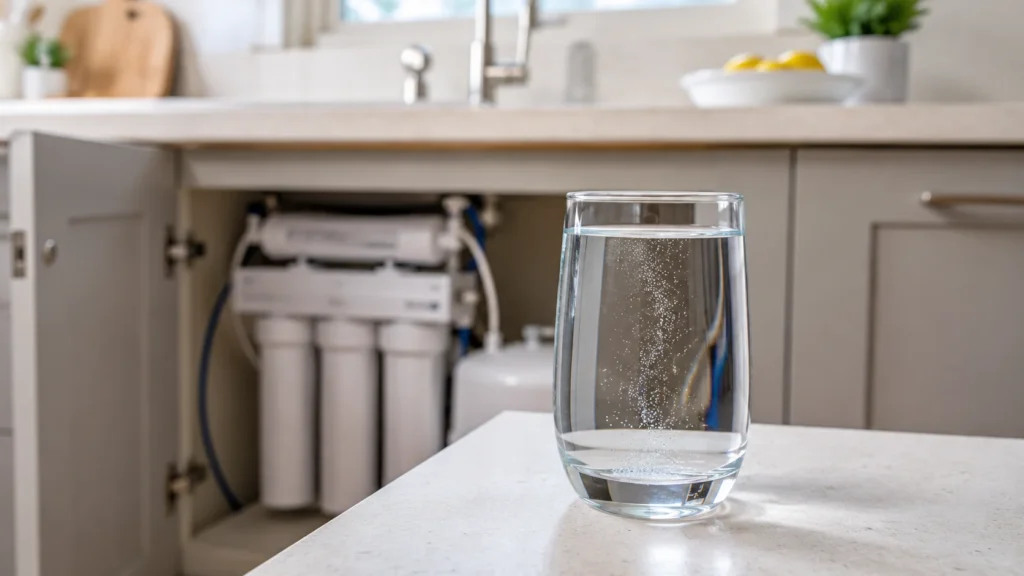
Ro Water Filter System

Reverse Osmosis

Does reverse osmosis remove lead – under sink reverse osmosis water filtration system removing lead from drinking water
Reverse Osmosis

Does Reverse Osmosis Remove Lead from Water? Complete Expert Guide

Have you been concerned about lead in your drinking water supply at home? Millions of residents, such as Tracy families, are all asking themselves the same question: does reverse osmosis remove lead effectively enough to protect my family? The short answer: Yes; reverse osmosis is one of the most efficient means available for eliminating lead from tap water sources, however full consideration should always be made depending on factors like older plumbing installations, wells or any individual family’s unique health requirements. The majority of rival materials provide you with a technical overview without addressing the fundamental worries that homeowners have: How much lead does it really remove? Will it function in my home? What should I keep up? This guide delves further. In addition to discussing whether reverse osmosis eliminates lead, it also discusses how lead gets into your water in the first place, how to determine if you are in danger, and what sort of system is best for you. Why Lead in Drinking Water Is Still a Real Problem Lead does not come from your city’s treatment plant in most cases. It enters your water as it travels through older plumbing inside or outside your home. This process is called lead leaching, and it happens when water sits in or moves through pipes, solder joints, or faucet fixtures that contain lead. Lead solder was the norm for residential plumbing in the US before 1986. Lead-containing plumbing components may still be present in homes constructed before that year and, in some situations, even until the early 1990s. This danger is extremely significant in some communities in Tracy, CA, where residences date from the 1950s to the 1980s. How Reverse Osmosis Actually Removes Lead Does reverse osmosis remove lead works by pushing water through a semipermeable membrane under pressure. This membrane has pores rated as small as 0.0001 microns, which is far smaller than lead ions. Lead particles cannot pass through the membrane, so they are separated from the water and flushed away. A quality RO system typically has multiple filtration stages working together: A sediment pre-filter that removes larger particles like rust and dirt A carbon pre-filter that removes chlorine, which can damage the membrane The RO membrane itself, which handles heavy metal ion filtration including lead A carbon post-filter that polishes the water before it reaches your glass Does reverse osmosis remove lead when functioning efficiently have the capability of extracting up to 99% of lead from drinking water, earning recognition by both the Environmental Protection Agency (EPA) and National Sanitation Foundation (NSF) as an efficient point-of-use water purification method for lead removal. Can Reverse Osmosis Remove Lead in Every Situation? This is where homeowners might get perplexed. Yes, a RO system can remove lead from any source, including corroding fixtures, aged pipelines, and lead solder. To reliably provide such outcomes, however, the system must be appropriately scaled, installed, and maintained. What Affects RO Performance for Lead Removal Water pressure plays a key role. RO systems need adequate incoming water pressure to push water through the membrane effectively. If pressure is too low, the system produces less filtered water and may allow more contaminants through. Membrane condition matters just as much. An aging or damaged RO membrane loses its rejection rate over time. A membrane that once removed 97% of lead may drop to 85% or lower if it is not replaced on schedule. Most membranes need replacement every two to three years depending on usage and water quality. Filter saturation is a common cause of performance failure that homeowners miss. Pre-filters and post-filters have a finite capacity. When they are saturated, they no longer protect the membrane properly, which shortens its life and reduces lead removal efficiency. Lead Contamination Signs Every Homeowner Should Know Lead has no taste, smell, or color. You cannot detect it through your senses. That is what makes it particularly dangerous. Here are practical ways to assess your risk at home: Check when your home was built. Pre-1986 construction carries the highest risk. Look at your pipes under the sink or in the basement. Lead pipes are dull gray and can be scratched to reveal a shiny surface. Copper pipes are orange-brown. Galvanized steel pipes are silver-gray and magnetic. Ask your city or municipality for a water quality report. Tracy CA residents can request a Consumer Confidence Report from Tracy or review it online through the California Water Boards. Get your water tested. A certified lab test is the only definitive way to know your lead levels. Test kits are available, but professional lab testing gives more accurate results. Does an RO System Work Better Than Other Lead Filters? There are other options on the market. Pitcher filters, faucet-mount filters, and whole-house carbon filters all claim to reduce lead. Here is how they compare honestly: Filter Type Lead Removal Rate Coverage Cost Range Reverse Osmosis (under-sink) Up to 99% Point of use (kitchen sink) $200 to $600+ installed NSF-certified pitcher filter 30% to 95% (varies by brand) Single pitcher at a time $25 to $60 Faucet-mount filter 50% to 85% One faucet only $30 to $100 Whole-house carbon filter Variable, not always lead-rated Whole house $500 to $2,000+ The most effective point-of-use remedy for lead-contaminated water is a RO system. Since lead is a dissolved heavy metal ion rather than merely a particle, it can handle particles that the majority of simple carbon filters cannot. Unless the filter is certified particularly for heavy metal ion filtration, carbon alone is not usually dependable for lead. When a Whole House System Makes More Sense If your water use goes beyond drinking to include bathing, cooking with hot water and washing produce then an RO system installed near your kitchen sink may still provide the appropriate level of consumption but a broader solution might also be appropriate. A Water Purification System installed at the entry point of your home can reduce contaminants before they reach any faucet or appliance. This is especially useful in homes

How does reverse osmosis work in an under-sink water filtration system with multi-stage filters and storage tank
Reverse Osmosis

How Does Reverse Osmosis Work in Water Filtration Systems?

If your tap water tastes off, smells like chlorine, or you have young kids at home and just want to be sure what they are drinking is safe, you have probably started looking into reverse osmosis. The term gets thrown around a lot, but most guides either oversimplify it or bury you in technical language that does not help you make a real decision. At RO Water Filter System, one of the most common questions we hear is simple: how does reverse osmosis work? In a way that is easy to follow, covers what actually happens at each stage, and helps you figure out whether an RO system makes sense for your home in Tracy, CA. What Is Reverse Osmosis, Really? Reverse osmosis is a water purification process that uses pressure to push water through a semi-permeable membrane with pores as small as 0.0001 microns. That is small enough to block dissolved salts, heavy metals, bacteria, and most chemical contaminants while allowing clean water molecules to pass through. The word “reverse” matters here. In natural osmosis, water moves from a lower concentration area to a higher one on its own. In reverse osmosis, applied water pressure works against that natural direction, forcing water through the membrane and leaving contaminants behind. What comes out on the clean side is called permeate. What gets flushed away with the contaminants is called concentrate or reject water. This process was originally developed for desalination of ocean water. Today it is used in homes, small businesses, aquariums, and even coffee shops because of how does reverse osmosis work it removes a wide range of contaminants. Why Tracy, CA Homeowners Pay Attention to Water Quality Water in the CA, including Tracy and surrounding areas, comes from both surface water and groundwater sources. These sources can carry sediment, agricultural runoff, chlorine from municipal treatment, nitrates, and varying levels of total dissolved solids (TDS). Hard water with high calcium and magnesium concentrations is also common in this region, which affects taste, leaves scale on fixtures, and reduces appliance lifespan. A properly installed Reverse Osmosis Water Filter addresses most of these issues at the point of use, meaning right where you drink and cook. The 7-Stage Reverse Osmosis Process Steps Explained Most home RO systems sold today use between 5 and 7 stages. Each stage handles a different type of contaminant. Here is what happens as water moves through a 7-stage system. Stage 1: Sediment Pre-Filter Water enters the system and first passes through a sediment filter, typically rated at 5 microns. This stage removes visible particles like sand, rust, silt, and dirt. Catching these early protects the delicate RO membrane from clogging or being damaged. Stage 2: Activated Carbon Block Filter Water then moves through an activated carbon block filter. This stage is critical for removing chlorine, chloramines, and volatile organic compounds (VOCs) that affect taste and odor. Chlorine is especially important to remove here because it can degrade the thin-film composite (TFC) membrane in the next stage if it gets through. Stage 3: Second Carbon or Fine Sediment Filter Some systems add a second pre-filter here, either another carbon stage or a finer sediment block. This acts as a safety buffer before the water reaches the membrane, catching anything the first two stages may have missed. Stage 4: The RO Membrane This is the core of the entire system. Water is pushed under hydrostatic pressure through a thin-film composite (TFC) semi-permeable membrane. The membrane pore size is around 0.0001 microns, which is smaller than most viruses, bacteria, dissolved salts, fluoride, lead, arsenic, nitrates, and hundreds of other chemical species. This is where cross-flow filtration happens. Rather than trapping contaminants in a filter medium, water flows across the surface of the membrane. Clean water molecules pass through to the permeate side. The concentrated reject water, carrying the removed contaminants, is flushed away to the drain. This continuous cross-flow is why the membrane stays cleaner longer compared to standard filter cartridges. Contaminant rejection rates on quality TFC membranes typically exceed 95 percent for most dissolved solids, and they can reach 99 percent for heavy metals like lead. Stage 5: Post-Carbon Polishing Filter After the membrane, water is stored in a small pressurized tank. Before it reaches your faucet, it passes through a post-carbon polishing filter. This removes any residual taste or odor that might have been picked up from the storage tank, giving you clean and neutral-tasting water. Stage 6: Alkaline or Mineral Enhancement Filter At this stage in a 7-stage system, minerals like calcium and magnesium are added back into the water through a remineralization cartridge. Pure RO water, while very clean, is slightly acidic because the membrane removes nearly everything including natural minerals. Remineralizing restores a healthier pH and improves taste. If you want to go deeper on this step, the guide on how to remineralize reverse osmosis water explains your options clearly. Stage 7: UV Sterilization or Infrared Filter The final stage in many 7-stage systems uses ultraviolet light or an infrared filter for an extra layer of protection. UV sterilization destroys any residual bacteria or viruses that somehow made it through earlier stages. This is particularly useful in areas where water quality is inconsistent or for households with very young children, elderly family members, or anyone immunocompromised. RO Membrane Filtration: How the Core Stage Really Works The RO membrane is not just a filter. It is a selective barrier that separates water molecules from dissolved solids based on molecular weight cutoff and ionic charge. Most contaminants that are dissolved in water carry an electrical charge. The membrane’s surface repels many of these charged particles, adding a second layer of rejection on top of simple size-based filtration. Water pressure drives this whole process. Residential systems typically use between 40 and 80 psi. If your home has low water pressure, a booster pump can be added to maintain consistent performance. Temperature also plays a role. Warmer water passes through the membrane slightly faster, while cold water

A woman in a sunny kitchen examining a clear glass of water after learning how to remineralize reverse osmosis water using mineral drops and Himalayan sea salt.
Reverse Osmosis

How to Remineralize Reverse Osmosis Water at Home (Easy & Effective Methods)

RO filtration is one of the most thorough water purification methods on the planet. It strips out chlorine, lead, arsenic, bacteria, and dissolved metals. But it also removes the calcium and magnesium that give water its familiar, satisfying taste. What’s left is technically pure water that feels almost too clean, thin, faintly sour, and strangely unsatisfying to drink. Learning how to remineralize reverse osmosis water is one of the most practical upgrades you can make to your home water setup. This guide covers every method worth using, what each one does, how much to add, when to use it, and how to avoid overdoing it. Why RO Water Feels “Empty” in the First Place Think of a reverse osmosis membrane like an extremely fine net, so fine, in fact, that its pores measure roughly 0.0001 microns wide. That’s small enough to block bacteria, viruses, dissolved metals, and the minerals your body actually wants. The result is water with a total dissolved solids (TDS) reading of just 5 to 30 ppm compared to 150 to 400 ppm in most untreated tap water. Here’s what that means in practice: without minerals to buffer the water’s chemistry, even small amounts of dissolved carbon dioxide push the pH into the acidic range sometimes as low as 5.5 to 6.5. That mild acidity is what creates the sharp, slightly sour edge you might notice, especially in your morning coffee. Low pH and low TDS together explain most of the taste and sensation complaints people have about RO water. It is also why some people notice their throat feels dry or why their morning coffee tastes sharp and bitter instead of smooth. Does Drinking RO Water Without Minerals Cause Health Problems? This is a legitimate question, not just anxiety. The honest answer is nuanced. Calcium and magnesium from drinking water can be bioavailable, meaning the body can readily absorb them; however, nutrition science overwhelmingly confirms food as being the main source of both minerals. If someone maintains a balanced diet then their drinking water with its low mineral content won’t become an issue to deficiency development. That said, if your diet is already marginal in calcium or magnesium, removing water as a source does matter at the margins. Children, older adults, and people with bone density concerns may benefit from consistently how to remineralize reverse osmosis water? The same applies if you drink large volumes of water daily, as some fitness, focused individuals do. How to Remineralize RO Water: 5 Methods Explained How to remineralize reverse osmosis water filter by this 5 methods Inline Remineralization Cartridge (Best Long-Term Solution) An inline remineralization cartridge installs directly after your existing RO membrane as a final post-filter stage. Inside, it is packed with calcite (calcium carbonate) or a blend of calcite and corosex (magnesium oxide). As water passes through, it slowly dissolves small amounts of these food-grade mineral media into the water. The end result is water that leaves your tap already balanced, with a pH of 7.0 to 8.0 and a moderate TDS rise that enhances both flavour and mouthfeel without making the water taste minerally or chalky. This is the most consistent and hands-free option available. You don’t measure, pour, or combine anything. When you draw water, the cartridge automatically accomplishes the task. If your system is a 5-stage or 6-stage unit, adding a remineralization cartridge essentially converts it into a more complete system. The 10-Stage Water Filtration System already integrates remineralization as a built-in stage, which is one reason homeowners upgrading from a basic RO unit often find it worthwhile. Mineral Drops (Best for Flexibility) Concentrated mineral drops are a liquid blend of calcium, magnesium, potassium, and trace electrolytes. You add a small measured amount, typically 20 to 40 drops, directly to a glass or pitcher of RO water before drinking. This method works well and gives you precise control. The minerals are ionic and dissolve immediately, so there is no waiting. Several brands on the market are third-party tested, and the ingredient lists are clean. The honest limitation: You have to remember to do it every single time. For some people, that is no problem. For households with multiple family members or high daily water consumption, the manual step gets skipped. It also adds a recurring supply cost. Alkaline Remineralization Pitcher An alkaline water pitcher works by passing RO water through a refillable mineral cartridge that raises pH and adds calcium and magnesium. The result is similar to an inline cartridge, just at a smaller volume. These pitchers are popular and genuinely useful for renters or small households. They are also a reasonable bridge option while you plan a permanent system upgrade. Magnesium Bicarbonate Solution (DIY for Enthusiasts) This method allows a high degree of control over the final mineral ratio. Specialty coffee brewers in particular use it to dial in magnesium levels that enhance coffee extraction. The trade-off is complexity. Magnesium bicarbonate has limited solubility and the concentrate must be stored cold and used within a few weeks. For everyday household use, the inline cartridge or mineral drops are simpler and just as effective. pH Balancing with Baking Soda (Short-Term Fix Only) Adding a small amount of food-grade baking soda to RO water raises its pH. This is sometimes recommended as a quick fix for the flat or slightly sour taste of low-pH RO water. It works, but it is not the same how to remineralize reverse osmosis water. Baking soda adds sodium bicarbonate, not calcium or magnesium. The pH goes up, but the mineral content does not meaningfully change. Use it as a short-term adjustment if you are waiting on a cartridge or drops to arrive, but do not rely on it as a long-term remineralization strategy. Which Method Is Right for You? Your Situation Best Method Want hands-free, permanent solution Inline remineralization cartridge Prefer control and flexibility Mineral drops Renting or small household Alkaline pitcher Coffee brewing or water geek Magnesium bicarbonate DIY Just fixing flat taste temporarily Pinch of Himalayan

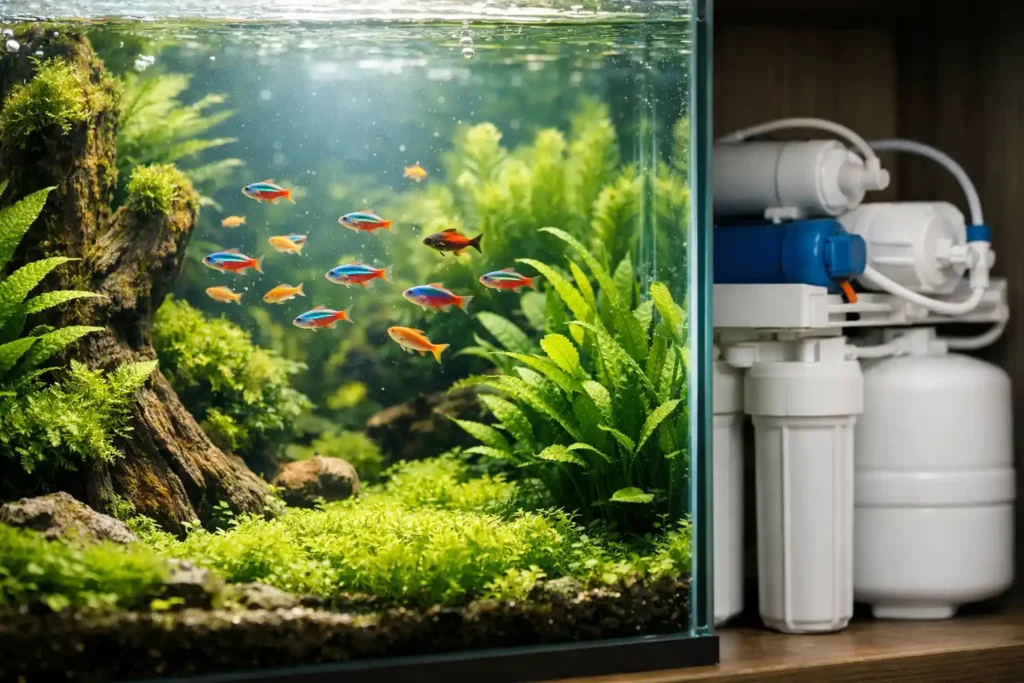
Reverse osmosis water for fish tank with healthy aquarium plants and fish supported by RO filtration system
Reverse Osmosis, Installation

Why Reverse Osmosis Water For Fish Tank Is Essential for Healthy Fish

Reverse osmosis water is essential for healthy fish because tap water contains chlorine, heavy metals, and phosphates that silently stress and kill fish over time. RO filtration removes all of it, giving you a clean, controlled starting point that sensitive species actually need to survive and thrive. These levels meet the standards for human drinking water, but fish are more sensitive to what is dissolved in their water. Reverse osmosis water for fish tank setups strips those contaminants out completely, giving you a clean, neutral baseline you can build on. At RO Water Filter System, we work with homeowners and aquarium hobbyists in Tracy and the surrounding areas to find the right filtration solution for exactly this kind of situation. What Is Wrong with Tap Water for Aquariums Most people assume that water safe for humans is safe for fish. That is not quite right. The water that comes from the city is treated to remove germs and make sure it meets public health requirements. Chlorine or chloramines are used in such treatment. These chemicals are meant to kill germs, and they do the same thing to fish gills when they are in tank water. Chloramines don’t off-gas as free chlorine does, even when you let tap water soak overnight. You need a dechlorinate, but even then, the water still has everything else in it. Here is what else Tracy tap water is likely carrying: Dissolved minerals (calcium, magnesium, sodium) that push general hardness (GH) and carbonate hardness (KH) well above what many tropical species can tolerate Heavy metals like copper and lead, which can leach from older plumbing and are lethal to invertebrates even in tiny amounts Phosphates, sometimes added by municipalities as corrosion inhibitors, which fuel algae blooms almost immediately Silicates, which cause brown diatom algae to coat glass, equipment, and substrate Nitrates, already present in some tap water before your tank even produces any biological waste Central Valley tap water contains total dissolved solids (TDS) at levels well over 300 parts per million, which is harmful for discus fish such as discus, wild-type bettas and soft water tetras; for shrimp and reef corals however it could prove fatal. How Reverse Osmosis Water For Fish Tank Works and Why It Is the Right Starting Point Reverse osmosis uses pressure to force tap water through a semi-permeable membrane with pores small enough to filter out almost everything except water molecules. Most ro systems designed for home use include several stages: Sediment pre-filter to catch sand, rust, and particulate Carbon block filter to remove chlorine and chloramines that would otherwise damage the RO membrane The RO membrane itself, which handles the heavy lifting and removes 90 to 99 percent of dissolved contaminants Post-carbon polishing filter for final cleanup before the water reaches your collection container A 5-Stage Water Filtration System adds an additional stage that provides even greater protection, making it a better long-term choice for aquarists who do regular water changes or have a larger tank setup. The result is what aquarists call a blank slate. Pure water that carries no assumptions. You decide what goes back in based on what your fish actually need. Why Aquarium Owners Specifically Benefit from RO Water Freshwater Aquariums For most freshwater tanks, the biggest win with RO water is control over pH and hardness. Tropical fish from South American river systems, like discus, cardinal tetras, and most dwarf cichlids, come from naturally soft, acidic blackwater environments. Their wild-type water has a TDS often below 50 ppm and a pH between 5.5 and 6.5. Tracy tap water is the opposite of that. With reverse osmosis water, you start at near-zero TDS and add back only what your fish need using a demineralizing product. Saltwater and Reef Aquariums In a reef tank, tap water is not a workable starting point at all. Marine salt mixes are formulated to dissolve in pure water and produce a specific elemental balance. When you mix salt into tap water that already contains calcium, magnesium, phosphates, and nitrates, the chemistry becomes unpredictable. You end up with levels you did not intend and cannot trace back to their source. Reverse osmosis water for aquarium salt mixing gives you a controlled foundation. Phosphates, which trigger aggressive algae at levels as low as 0.2 ppm, are absent. Silicates that smother coral and create diatom blooms are gone. Breeders and Sensitive Species Fish breeders working with species that only spawn in specific water conditions depend on RO water to trigger breeding behavior. Many cichlids, killifish, and soft-water tetras will not successfully reproduce unless the pH, GH, and KH are within a narrow band. You cannot reliably hit that band with untreated tap water because the mineral content of municipal water shifts with the seasons, rainfall, and treatment changes. With an ro system for fish tank breeding setups, those parameters stay consistent every time. The One Thing You Must Do After Using RO Water RO water is not plug-and-play for fish. Because it removes everything, including beneficial minerals, you must remineralize it before adding fish. Pure RO water lacks any buffering capacity to tame its pH fluctuations quickly and stabilize your biological filter in your tank, potentially stressing fish and disrupting biological filter performance. For freshwater tanks, dedicated GH and KH additives may help bring mineral levels up to what your species requires. TDS meters provide a simple means of verifying whether or not an RO system is producing water of sufficient purity for use, with readings under 10ppm before remineralization being the ideal goal. After reconstitution and reconsolidation have occurred, test again using an appropriate liquid test kit to make sure GH, KH and pH levels match. How RO Water Compares with Tap Water and Other Options Water Source Removes Contaminants Suitable for Sensitive Species Control Over Chemistry Tap Water Partial (depends on treatment) Limited Low Filtered Tap (Carbon only) Removes chlorine, some organics Limited Low-Medium RO Water High Excellent High Distilled Water High Good Moderate (no remineralization options) Deionized Water High

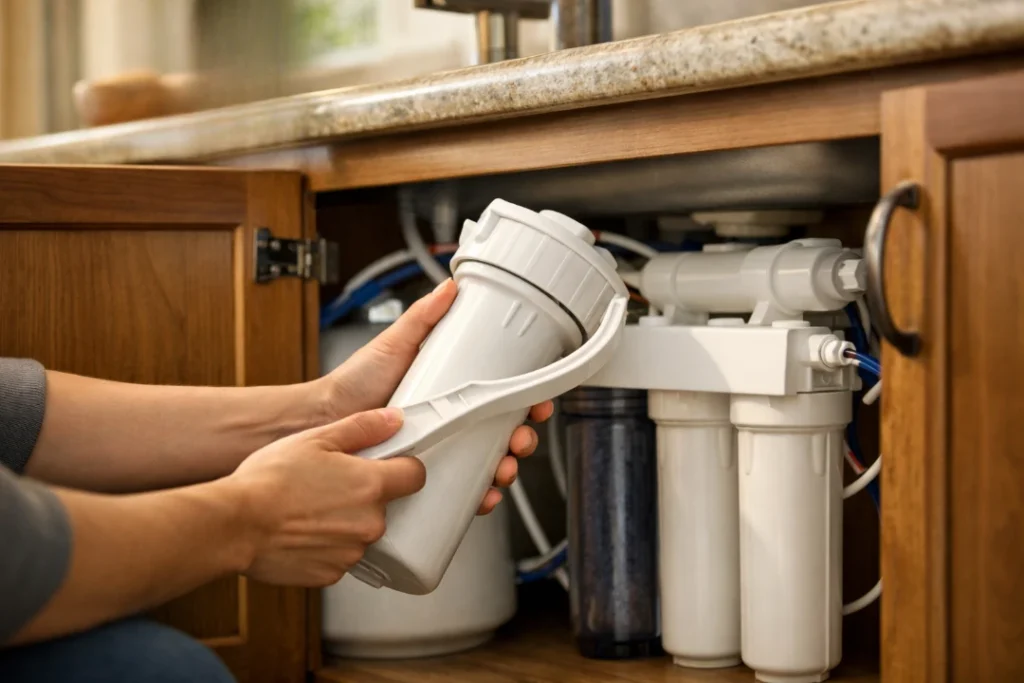
Reverse osmosis water filter replacement under kitchen sink changing RO cartridge
Installation, Reverse Osmosis

The Complete Guide to Reverse Osmosis Water Filter Replacement: Protect Your Family’s Health

You bought a reverse osmosis system to protect your family from lead, fluoride, chlorine, and other contaminants in your tap water. But here is the part most people overlook: the system only works as well as its filters. When those filters are overdue for a change, your water quality drops, sometimes without any obvious warning signs. Staying on top of reverse osmosis water filter replacement is the single most important maintenance task for RO Water Filter System. Most other tutorials on this subject offer you a broad timetable and leave it at that. They don’t explain what really occurs when a filter becomes blocked, why Tracy’s water conditions are important, or how to prevent the blunders that make your system last less long. This book accomplishes all of that and provides you with a clear, doable strategy you can start using right now. Why Reverse Osmosis Water Filter Replacement Is Not Optional An RO system contains many steps that filter the water in order. Every stage captures something else. When one step quits working, the others have to work harder, and the things you were filtering out start to get through again. Your sediment pre-filter is like the first line of defense. It prevents dirt, corrosion, and other small particles from getting to the sensitive RO membrane. If that pre-filter clogs and you ignore it, water pressure drops across the whole system. Your RO membrane, which is the most expensive component, has to work harder. Over time, it degrades faster than it should. This makes timely ro filter replacement especially important for households here. A filter schedule designed for average water conditions may not be enough in this area. Understanding What Each Filter Stage Does Before you can reverse osmosis water filter replacement correctly, it helps to understand what each one does and why it wears out. Sediment Pre-Filter (Stage 1) This filter removes physical particles: sand, silt, rust, and dirt. It protects every stage that follows. Because it takes the heaviest initial hit, it wears out fastest. Carbon Block Pre-Filter (Stage 2 and sometimes Stage 3) Activated carbon removes chlorine, chloramine, volatile organic compounds (VOCs), and bad taste and odor. This is critical in Tracy because chloramine in municipal water will actively damage your RO membrane if carbon filtration is not doing its job. RO Membrane (Core Stage) The membrane is the heart of the system. It pushes water through a semi-permeable barrier under pressure, blocking up to 99% of dissolved contaminants including lead, fluoride, arsenic, nitrates, and total dissolved solids (TDS). The membrane does not physically clog like a carbon filter, it degrades chemically and loses rejection efficiency over time. Post-Carbon Filter (Final Stage) After filtered water sits in the storage tank, a post-carbon or post-filter polishes it one final time before it reaches your faucet. This removes any residual taste or odor picked up during storage. If your system is a 6-Stage Water Filtration System, you may also have an additional remineralization or alkaline stage. That stage typically uses a mineral cartridge that needs replacement roughly once a year, depending on your water usage. The Realistic Replacement Schedule for RO Filters Here is a clear reference table for how often each filter stage should be replaced under typical residential conditions: Filter Stage What It Removes Replacement Interval Sediment Pre-Filter Dirt, rust, silt Every 6 to 12 months Carbon Block Pre-Filter Chlorine, chloramine, VOCs Every 6 to 12 months RO Membrane Lead, fluoride, TDS, arsenic Every 2 to 3 years Post-Carbon Filter Residual taste and odor Every 12 months Remineralization Cartridge Adds minerals back to water Every 12 months Important note for Tracy homeowners: If your home uses more water than average, if you have a large household, or if your incoming water has high TDS or heavy sediment, move toward the shorter end of these intervals. High sediment loads are common in parts of the Central Valley, and they will exhaust your pre-filters faster than the general schedule suggests. Warning Signs That Your Filters Need Changing Now Keep an eye on your system in case something seems off before its scheduled date arrives your system could warn of problems even before that. Watch for these signs: Slow water flows from the RO faucet. An optimal RO system should fill a glass within 30 seconds; otherwise, its filters or membrane may have become compromised and is no longer functioning as intended. If this takes any longer, your pre-filters may have become blocked up with debris, and membrane degradation could be to blame. Unpleasant taste or odor. If water starts tasting flat, musty, or slightly chemical again, your carbon pre-filter or post-filter is likely exhausted. Rising TDS readings. With an inexpensive TDS meter in hand, readings on your filtered water should be significantly lower than its source water any shrinkage indicates your RO membrane’s efficiency has diminished and needs repair. Cloudy or discolored water. This can indicate a failed sediment filter or a compromised membrane. The tank fills very slowly or not at all. A badly clogged pre-filter starves the membrane of inlet pressure, causing the tank to take hours to refill. How to Change RO Filters: Step-by-Step Most homeowners in Tracy can handle this as a DIY job. You do not need a plumber. You do need the right reverse osmosis water filter replacement cartridges for your specific system and about 30 minutes. What you will need: Replacement filter cartridges (matched to your system) Filter housing wrench (usually included with your system) A bucket or towels A clean cloth or paper towels Step 1: Turn off the water supply. Close the dedicated cold water supply valve that feeds your RO system. This is usually a saddle valve or ball valve on the cold supply line under the sink. Step 2: Close the storage tank valve. There is a small valve on the top of the storage tank. Turn it off to stop water from flowing back through the system while you work. Step 3: Open the RO

Is reverse osmosis the same as distilled water clean drinking water in glass comparison
Reverse Osmosis

Is Reverse Osmosis the Same as Distilled Water? 7 Key Differences You Should Know

You spent $40 on a gallon of distilled water for your CPAP machine, then looked at your under-sink RO system and wondered, is reverse osmosis the same as distilled water? It’s a fair question. Both look crystal clear, both remove contaminants, and both cost more than tap water. The differences in how each process works and what each one misses, directly affect which one belongs in your home. At RO Water Filter System, we walk customers through this comparison every week, especially in areas like Tracy, CA, where local water quality makes the choice even more consequential. This guide gives you the full picture, including a contamination blind spot that almost no comparison article mentions. Is Reverse Osmosis the Same as Distilled Water? Reverse osmosis does not produce identically purified water to that produced through distillation. Both processes utilize separate processes and produce distinct tastes, costs and efficiency outcomes that differ drastically in taste, efficiency and use ability. Reverse Osmosis uses a semi permeable membrane to filter contaminants. Distillation uses heat and evaporation to separate out impurities from water. Both can serve different functions when applied in real world situations. Although they appear similar on paper, in everyday household usage each serves its own specific function. How Reverse Osmosis and Distilled Water Work Reverse Osmosis Process Reverse osmosis systems push water through multiple filtration stages, including: Sediment filter Carbon filter RO membrane Post-filter polishing This system removes: Heavy metals Chlorine Bacteria and viruses Dissolved solids Water passes through the membrane under pressure, leaving contaminants behind. For homeowners, this is the most common point-of-use drinking water solution. If you want to explore system options, see Reverse Osmosis Water Filter. Distilled Water Process Distillation works by: Boiling water into steam Leaving contaminants behind Condensing steam back into liquid form This removes: Minerals Bacteria Most contaminants including heavy metals It produces very pure water, but the process is slow and energy-intensive. Seven Key Differences Between Reverse Osmosis and Distilled Water 1. Filtration Method Reverse osmosis uses pressure and a membrane Distillation uses heat and evaporation This affects energy use and convenience at home. 2. Speed and Daily Use RO systems produce water continuously Distillation is slow and batch-based For daily drinking, RO is far more practical. 3. Taste and Mineral Content RO water: Removes most contaminants Retains slight mineral balance depending on system Distilled water: Removes almost everything Often tastes flat or empty This is why many people ask, is distilled water better than reverse osmosis water. For drinking, most prefer RO taste. 4. Energy Consumption RO systems use minimal electricity Distillers require constant heating Over time, distillation costs more to run. 5. Installation and Convenience RO systems: Installed under sink Provide on-demand water Distillers: Countertop units Require manual operation If convenience matters, RO wins clearly. For homeowners in Tracy, CA, professional setup also ensures better performance. Learn more about RO System Installation. 6. Contaminant Removal Range Both methods remove: Heavy metals Bacteria and viruses Dissolved contaminants But RO systems also include carbon filtration, which helps with: Taste Odor Chlorine removal This makes RO better for everyday drinking water quality. 7. Cost Over Time RO systems: higher upfront cost, low maintenance Distillers: lower upfront, higher energy costs Budget-conscious buyers often find RO more cost-effective long term. Reverse Osmosis vs Distilled Water Comparison Table The difference between distilled water and reverse osmosis comparison given below: Feature Reverse Osmosis Distilled Water Process Membrane filtration Boiling and condensation Speed Continuous Slow batch process Taste Clean, slightly natural Flat, neutral Energy Use Low High Installation Under sink system Countertop unit Daily Use Very convenient Limited Cost Over Time Lower Higher Is RO Water the Same as Distilled Water for Drinking? No, is RO water the same as distilled is a common question, but they are not identical in real use. For drinking: RO water is more practical and better tasting Distilled water is often used for medical or lab purposes Most homeowners choose RO because it balances purity and usability. Is Boiled Water the Same as Distilled Water? Another frequent misperception is boiled water the same as distilled water are equivalent. Answer is no. Boiling water: Kills bacteria Does not remove heavy metals or dissolved solids Distillation: Removes contaminants by separating steam So boiling is not a replacement for either RO or distilled water. When Reverse Osmosis Is the Better Choice Reverse osmosis can provide exactly the clean water source you require if that’s what’s desired: Safe, clean daily drinking water Better taste compared to bottled water Low-maintenance filtration Continuous supply It is especially useful in areas where tap water may contaminants including chlorine, lead, or high TDS levels. When Distilled Water Makes More Sense Distilled water is better for: Medical devices like CPAP machines Laboratory use Appliances like steam irons It is not designed for daily household drinking due to cost and inconvenience. Common Mistakes Homeowners Make Choosing Based on “Purity” Alone Many assume more purification is always better. But over-purified water can lack taste and practicality. Ignoring Installation Quality Even the best system fails if installed poorly. A professional setup ensures: Proper pressure Leak-free connections Maximum filtration performance Not Considering Long-Term Costs Distillers may seem cheaper upfront, but electricity costs add up fast. Overlooking Water Usage Needs A family needs consistent water supply, not small batches. This is where RO systems fit better. How to Choose the Right System for Your Home Ask yourself: Consider whether water is necessary for daily drinking purposes?  Do you want convenience or occasional use? Are you concerned about energy costs? Is taste important to you? If your answer leans toward daily use and convenience, reverse osmosis is the better option. If you are still exploring options, this guide on building a How to Make a Water Purification System can help. Conclusion Is reverse osmosis the same as distilled water and most homeowners fail to recognize its differences. Reverse Osmosis provides you with an economical and practical method of purified drinking water daily without incurring excessive costs for purification systems.

Does reverse osmosis remove PFAS scientists collecting contaminated water samples for testing
Reverse Osmosis

Does Reverse Osmosis Remove PFAS? 6 Ways It Improves Water Safety

Have you heard reports about PFAS contamination of local water supplies, leaving you to wonder does reverse osmosis remove PFAS? Yes, reverse osmosis removes PFAS. A quality RO system with activated carbon pre-filters reduces PFAS concentrations by 90% or more, making it one of the most effective home water treatment options available. Reverse osmosis from start to finish, how it works, its effectiveness in reducing PFAS levels, what to expect from a system, and its place within your overall water treatment plan. RO Water Filter System cover what other sources neglect or oversimplify for practical clarity and guidance. Does Reverse Osmosis System Remove PFAS Per- and polyfluoroalkyl substances (PFASs), also referred to as forever chemicals, are an extensive group of synthetic chemicals commonly used for firefighting foam applications, nonstick cookware production, waterproof fabric products and industrial processes. Due to their lengthy chemical chains they do not break down easily in the environment, hence why PFAS are known as forever chemicals. In water supplies, PFAS can come from industrial sites, firefighting training areas, and even landfill leachate. They have been linked to health effects when present at certain levels.  How Reverse Osmosis Works A typical home Reverse Osmosis Water Filter system uses a combination of filters and a membrane to clean tap water at the point of use, usually under the kitchen sink. The process involves: Pre‑filtration that removes sediment and chlorine. Activated carbon filters that reduce many organic chemicals. A reverse osmosis membrane that separates water molecules from many dissolved solids and contaminants. Post‑filtration for taste and final polishing. Does Reverse Osmosis Remove PFAS? Yes The short answer to does reverse osmosis remove PFAS is that a properly designed and maintained reverse osmosis system can reduce PFAS levels in drinking water significantly. Reverse osmosis systems are among the most effective home water treatment technologies for PFAS reduction. That effectiveness depends on quality filtration stages and the membrane performance. Here’s why RO works for PFAS: Small pore size of the membrane rejects many PFAS molecules. Activated carbon pre‑filters help capture some PFAS before reaching the membrane. PFAS compounds are large compared to water molecules, making them less likely to pass through. Multiple filtration stages enhance overall reduction. Proper installation ensures optimal pressure and contact time. Routine maintenance ensures the system continues to perform as intended. While no home system can guarantee 100 percent removal, reverse osmosis consistently performs well in independent testing for a wide range of PFAS compounds. How Effective Is Reverse Osmosis Against PFAS Studies and practical water testing show that reverse osmosis can reduce PFAS concentrations by 90 percent or more when the system is correctly matched to water quality and maintained. The activated carbon filters in front of the membrane play a key role by adsorbing some PFAS before they even reach the membrane. The combination of carbon and RO makes a strong barrier. Note: Different PFAS molecules vary in size and chemical behavior. Long‑chain PFAS are generally easier for RO systems to reduce than some short‑chain variants. Good design and high‑quality components make a meaningful difference. Signs You May Have PFAS in Your Water You cannot see, smell, or taste PFAS in water. The only way to know if they are present is through testing by a qualified lab. Some signs that further testing may be warranted in Tracy CA include: Known industrial sites or firefighting training nearby. Water utility reports showing PFAS detections. Health advisories from local public health agencies. If you suspect PFAS, start with a certified water test that includes PFAS panels. Reverse Osmosis vs Other Filtration Options Reverse Osmosis vs Carbon Filters Alone Carbon filters do remove some PFAS, but a reverse osmosis system adds an additional barrier through its membrane. For many homeowners with PFAS concerns, RO offers higher confidence in reduction levels. For general water quality (taste, chlorine, odor) alone, carbon filters may be adequate. But for PFAS, the membrane is a key advantage. Reverse Osmosis vs Saltless Water Softener A saltless water softener improves water feel and reduces scale without using salt. It does not target PFAS. Softening and PFAS reduction serve different purposes: Softening helps appliances and plumbing. RO helps reduce chemical contaminants including PFAS. When Whole House Systems Make Sense A whole house filtration system treats all water entering your home. It’s ideal if you want every tap water outlet filtered. But for PFAS, whole house systems must include filters rated for PFAS removal. In many cases, homeowners choose a point of use RO system for drinking and cooking water because it is more cost‑effective than treating the entire house with RO level filtration. If you are comparing options, read our guide on House Water Filter vs Reverse Osmosis to determine what fits your situation. What to Expect with Installation Correct installation of a reverse osmosis system matters for performance. Here’s what to know: RO systems require a dedicated faucet. Proper water pressure ensures membrane efficiency. Pre‑filtration should match your local water quality conditions. Avoid DIY shortcuts that compromise seals or flow. Professional fitting helps ensure you get predictable results and reduces risk of leaks or reduced performance. Maintenance Matters: How Often to Change Reverse Osmosis Filter To keep your RO system reducing PFAS effectively, you must follow a maintenance schedule: Sediment and carbon pre‑filters: change every 6 to 12 months. Reverse osmosis membrane: typically replace every 2 to 3 years. Post‑filters: change annually or per manufacturer advice. Maintenance needs depend on both water quality and use. Water has more sediment or chemicals, more frequent changes might be required if water quality declines; regular checks ensure consistent performance from your system. Common Homeowner Questions and Mistakes Mistake: Thinking Any Filter Will Do Many homeowners assume their pitcher or faucet filter handles PFAS it usually doesn’t. Most basic filters lack the right media or pore size to capture these chemicals. If PFAS is your concern, you need a system specifically certified for it. Mistake: Skipping a Water Test Every water supply is different. Choosing a filtration system

Scroll to Top