You turn on your tap, and water comes out. Simple, right? But that water has traveled through pipes, treatment facilities, and who knows what else before reaching your glass. If you’re concerned about what’s actually in your drinking water chlorine, minerals, bacteria, or other contaminants you might have heard about reverse osmosis as a solution.
Here’s the honest truth: how does reverse osmosis work is a question we hear from hundreds of homeowners in Tracy and the surrounding areas every year. And it deserves a straight answer, not marketing jargon.
The Basic Science Behind Reverse Osmosis

Water molecules are tiny. But dissolved minerals, salts, chemicals, and other contaminants are even tinier. A semipermeable membrane used in reverse osmosis systems has pores so small (about 0.0001 micrometers) that they block nearly everything except water molecules themselves.
Here’s where the name comes in. Normally, water naturally moves from areas of high concentration toward areas of high concentration through osmosis. Reverse osmosis does the opposite; it uses pressure to force water backward, leaving contaminants behind.
The process happens like this: tap water enters your system under pressure. It hits the RO membrane. Water molecules pass through. Everything else (total dissolved solids, chlorine, fluoride, bacteria, viruses, minerals) gets blocked and flushed away as waste water.
What Happens Inside Your RO System
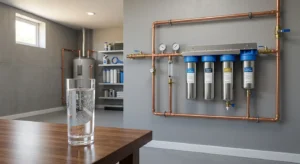
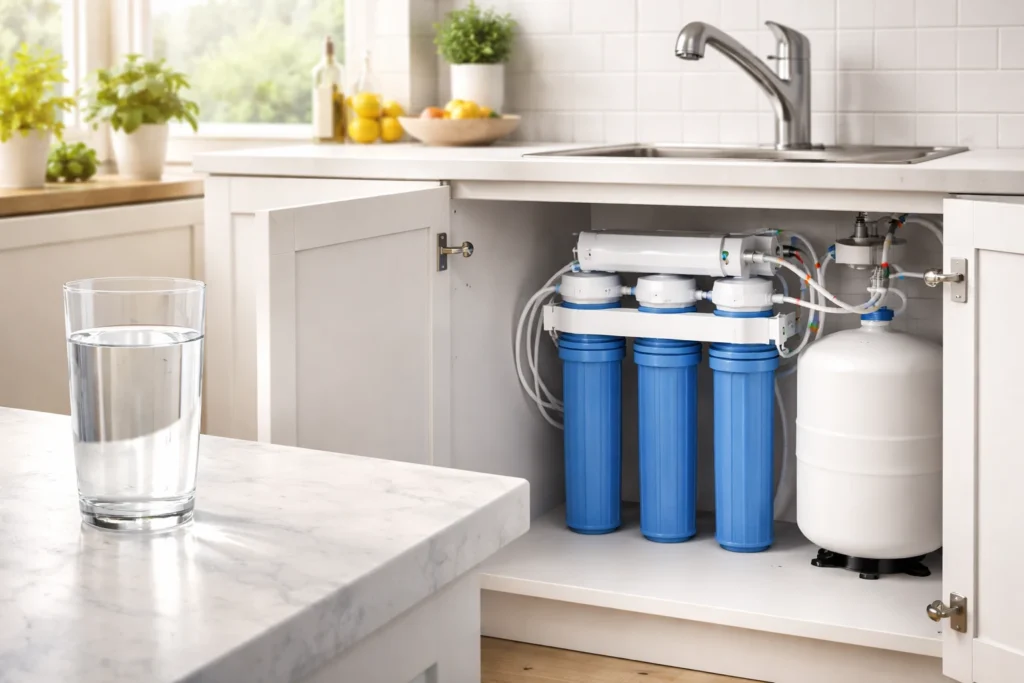
Most reverse osmosis systems don’t just stop at the membrane. They’re built with multiple stages because the membrane alone can’t catch everything, and some homeowners want extra protection.
At its core, reverse osmosis is a physical filtration process that forces water molecules through a semipermeable membrane so small that most dissolved solids and contaminants can’t fit through. The result? Clean, pure drinking water. But there’s more going on than just a barrier between you and your tap.
Stage 1: Pre-Filtration
Water enters a sediment pre-filter first. This catches larger particles of sand, rust, debris that would damage the membrane if they got through. Think of it as a net that protects what comes next.
Stage 2: Activated Carbon Pre-Filter
The second pre-filter contains activated carbon. This removes chlorine, fluoride, volatile organic compounds (VOCs), and some pesticides. Why this step? The RO membrane is expensive and sensitive. Chlorine damages it. Carbon filters protect it and improve the taste of your final water.
Stage 3: The Membrane
This is where how does ro filter work becomes real. The RO membrane is the star of the system. It forces water through under pressure (typically 50–80 PSI), separating pure water molecules from everything else. The reject water the stuff that didn’t make it through goes down the drain.
Stage 4: Post-Filtration
Some systems add a final stage: a post-carbon filter. This polishes the water one more time, improving taste and ensuring nothing escaped the earlier stages.
Does Reverse Osmosis Remove Chlorine and Other Contaminants?
This is a practical question homeowners ask all the time. Yes, will reverse osmosis remove chlorine but here’s the breakdown of what actually gets removed.
A well-maintained RO system removes:
- Chlorine and chloramines (killed by the pre-filter carbon)
- Total dissolved solids (TDS) like calcium, magnesium, sodium
- Heavy metals like lead, arsenic, cadmium
- Bacteria and viruses (membrane blocks particles larger than water molecules)
- Fluoride
- Most pesticides and VOCs
- Salt and mineral content
What it doesn’t remove well:
- Some gases (like radon, which is rare in public water)
- Certain organic chemicals (though the carbon stages help)
The carbon pre-filters are critical. If you remove chlorine with carbon first, the membrane lasts longer. Without that step, chlorine damages the ro membrane within months.
The RO Membrane: How It Works and Why It Matters
The membrane is the heart of the system. It’s a thin film composite (TFC) made of synthetic polymers. Under pressure, water molecules which are polar and small slip through the tiny pores. Everything else stops.
Here’s why this matters for you:
A good RO membrane removes 85–99% of dissolved solids from water. That’s why homes on wells or in areas with high mineral content see huge improvements. Water that tasted mineral-heavy becomes crisp and clean.
But membranes aren’t forever. Over time, they get blocked by sediment that escaped the pre-filters, salt buildup, or biological growth. That’s why reverse osmosis system filter change is a routine maintenance task we recommend every 2–3 years depending on your water supply.
Homeowners often ask whether they need to change filters constantly. The answer depends on your incoming water quality. If you’ve got a lot of sediment, pre-filters get used faster. But with proper maintenance, the system stays efficient for years.
Water Pressure and System Efficiency
This is where real-world knowledge matters. How does reverse osmosis work changes based on water pressure.
Your RO system needs adequate pressure to push water through that membrane. Most systems need at least 35–40 PSI to work at all. Ideal pressure is 50–80 PSI. Below that? The system slows down or stops working.
If your home has low water pressure naturally, you might need a booster pump. We’ve seen homes in Tracy where city water pressure fluctuates, and a booster makes the difference between a system that produces water slowly and one that works reliably.
Higher pressure doesn’t always mean better results. Too much pressure (over 100 PSI) can damage the membrane. The sweet spot is finding your system’s optimal pressure range and maintaining it consistently.
The Waste Water Question

Here’s something homeowners worry about. Reverse osmosis systems produce waste water, the reject stream that contains everything the membrane blocked.
For every gallon of purified water produced, you might waste 2–5 gallons depending on your incoming water quality and system design. That sounds wasteful, but here’s context: a typical family using an RO system for drinking and cooking uses maybe 5–10 gallons of pure water per day. The waste water is slightly higher in mineral content than your tap water goes down the drain, same as any other sink water.
Modern systems with efficiency upgrades reduce this ratio. Some newer RO systems minimize waste through better membrane technology or permeate pump designs. When choosing a reverse osmosis water system installation, ask about the efficiency ratio. It matters for your water bill.
Why RO Water Systems Vary in Quality
Not all RO systems work the same way. Some are 3-stage. Some are 5-stage. Some cost $200. Some cost $2,000. What’s the difference?
Quality comes down to:
- Membrane quality: Better membranes last longer and remove more contaminants
- Pre-filter design: More carbon and sediment protection = longer membrane life
- System materials: Quality plastic and metal components resist breakdown
- Flow rate: How fast the system produces water (measured in gallons per day)
- Installation: Poor installation leaks or creates pressure issues
We work with RO Water Filter System standards that prioritize durability and performance over quick profit. A well-designed RO system installed properly produces high-quality water for years.
When you see cheap systems online, they usually cut corners on membrane quality or build materials. You get what you pay for.
When Reverse Osmosis Is the Right Choice
Not every home needs reverse osmosis. Here’s how to know if it fits your situation. The real question isn’t how it works, it’s whether it fits your home and water quality.
If you’re on well water, dealing with chlorine taste, or concerned about contaminants like lead or fluoride, reverse osmosis is one of the most effective solutions available.
Reverse osmosis makes sense if:
- You’re on well water with high minerals or contaminants
- City water has high chlorine taste or smell you can’t tolerate
- You want to remove fluoride (some cities fluoridate)
- You have elevated heavy metals (lead, arsenic) in your water
- You want cleaner tasting drinking and cooking water
- You’re concerned about emerging contaminants
Reverse osmosis might not be the best fit if:
- Your water quality is already good (test it first)
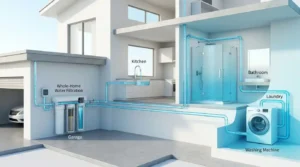
- You want whole-house filtration (a whole-house system may be better)
- You need water softening for mineral deposits (you might need a separate softener alongside RO)
- You want to remove all hardness while keeping minerals (RO removes minerals; some people want selective softening)
We recommend testing your water first. Know what you’re actually dealing with before choosing a solution. If you want to know whether RO is right for your home, start with a water test. Know what you’re dealing with.
Then we can discuss whether professional RO system installation in Tracy, CA makes sense for your situation. Call or contact us to learn more about protecting your family’s drinking water quality.
Installation and Performance
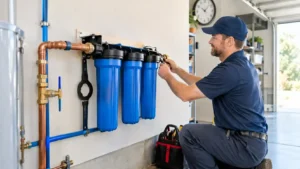
Here’s something critical that most articles skip: how does reverse osmosis work depends heavily on installation.
The system needs:
- Adequate water pressure (tested before installation)
- Proper drain line setup (preventing backpressure on the membrane)
- A storage tank (most RO systems produce water slowly; a tank holds clean water for use)
- Quality fittings and tubing (cheap connections leak)
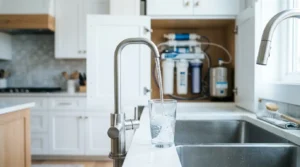
- Correct placement (usually under the sink, but configuration matters)
We’ve seen systems fail or perform poorly because they were installed in tight spaces where the membrane got pressure stress, or where the drain line created backup pressure on the system. These aren’t design flaws, they’re installation problems.
Maintenance: Keeping Your System Working
Your RO system isn’t a set-and-forget purchase. It needs basic maintenance.
Typical maintenance:
- Sediment pre-filter: Replace every 6–12 months
- Carbon pre-filter: Replace every 6–12 months
- RO membrane: Replace every 2–3 years (if your water quality is rough, maybe sooner)
- Post-filter (if included): Replace every 12 months
Costs are reasonable filters range from $30–$80 each. The membrane is more usually $100–$250 depending on quality.
Many homeowners hesitate about maintenance because they don’t understand it. It’s actually straightforward. You shut off the system, unscrew cartridges, and screw new ones in. If you want professional maintenance, that’s available too, but it’s not complicated.
Common Misconceptions About Reverse Osmosis
Here are concerns we hear constantly and the real answers.
- RO water is too pure and demineralizes your body. False. You get minerals from food, not primarily from water. RO water is safe to drink long-term. Many people live healthily on RO water for decades.
- RO systems waste too much water. Partially true. They do waste water, but it’s minimal for a household. A family using 10 gallons of RO water daily might waste 20–30 gallons spread across a full day. That’s less than a shower.
- I should add minerals back in. Optional. Remineralization filters exist and some people prefer them. But they’re not necessary for safety or health. It’s a taste preference. We can explain how to remineralize reverse osmosis water if you’re interested, but it’s not mandatory.
- RO systems remove everything good too. RO removes dissolved solids indiscriminately minerals included. Some people view this as a drawback. It depends on your water quality and preferences.
Conclusion
Understanding how does reverse osmosis work doesn’t require a chemistry degree. Water enters under pressure. It gets forced through a membrane so tiny that contaminants can’t fit. Clean water comes out one side. Waste water goes down the drain.
But installation, maintenance, and system quality matter more than the concept itself. The system installed poorly won’t serve you. Contact us with a quality system from RO Water Filter System with professional installation and routine maintenance will provide years of clean, safe drinking water.
FAQs
Does reverse osmosis remove fluoride?
Yes, reverse osmosis removes fluoride through the membrane. If your city adds fluoride to the water supply and you want to remove it, RO is effective. The pre-filter carbon stage removes some, and the membrane removes most of what’s left.
How long do RO membranes last?
Typically 2–3 years under normal household use. Duration depends on your incoming water quality. If your tap water has high sediment or mineral content, the membrane works harder and may need replacement sooner. Regular filter changes extend membrane life.
Can I install an RO system myself?
Technically, yes many homeowners do basic DIY installs. But professional installation ensures proper pressure setup, correct drain line configuration, and system optimization. We see DIY installations that work fine and others that underperform because pressure or drainage wasn’t set up correctly.
Is RO water safe to drink every day?
Yes. Millions of people drink RO water daily without health issues. If you’re concerned about losing minerals, eat mineral-rich foods. Is RO water safe to drink long term is a common worry, but scientific evidence supports daily RO consumption as safe.
What’s the difference between RO and water softening?
Reverse osmosis removes minerals and most contaminants. Water softening removes hardness minerals (calcium and magnesium) but keeps sodium and other dissolved solids. RO produces purer water; softening prevents mineral buildup on appliances. Some homes use both systems for different purposes.