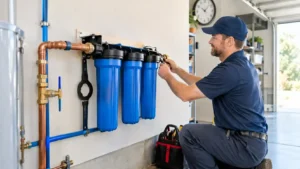
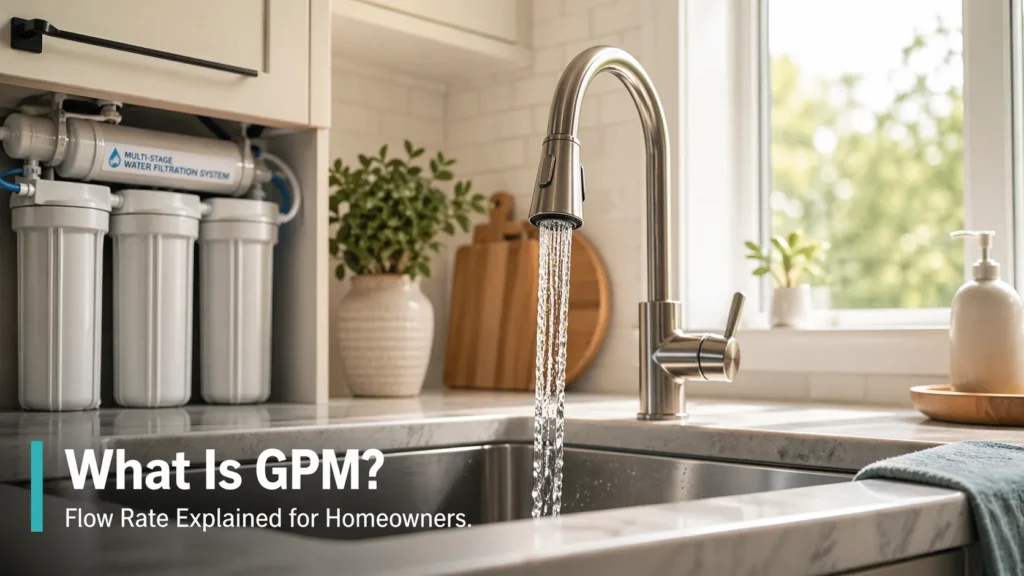
GPM stands for Gallons Per Minute and measures how much water flows through pipes, faucets or filtration systems each minute. In water filters and plumbing applications, it reveals whether these systems provide adequate supply to meet daily demands in your home.
Most competitor articles explain what is GPM in a very basic way but fail to connect it to real household problems like weak pressure, slow filtration, or system sizing mistakes. At RO Water Filter System, we work with homeowners in Tracy, CA and the surrounding area every week who are dealing with slow flow, pressure drops, and mismatched filtration systems, often because no one explained GPM before they bought it.
What Is GPM in Water Systems?
GPM stands for gallons per minute. It is the standard unit used in the United States to measure water flow rate how many gallons pass through a pipe, faucet, or water filter every minute. In home plumbing, GPM tells you how fast water is delivered to your fixtures. In water filtration, GPM determines how quickly your system can process water without losing quality.
What is GPM differs from water pressure in that GPM measures the volume actually delivered; pressure (measured in pounds per square inch or PSI) measures force exerted against your pipes by water inflow, while flow rate measures actual delivery volume. Even with decent pressure levels you could still have low GPM because your pipelines may be narrow, filters clogged up, or systems undersized compared with expected requirements.
Can You Use a Reverse Osmosis System for a Shower?
Short answer: No. A standard RO system produces 0.03 to 0.07 GPM in real-time output, far too slow for a shower that needs 2.0 to 2.5 GPM. RO systems store filtered water in a pressure tank and are designed for drinking water only, not high-flow applications like showers or washing machines.
What Does GPM Stand For in Real-World Plumbing?
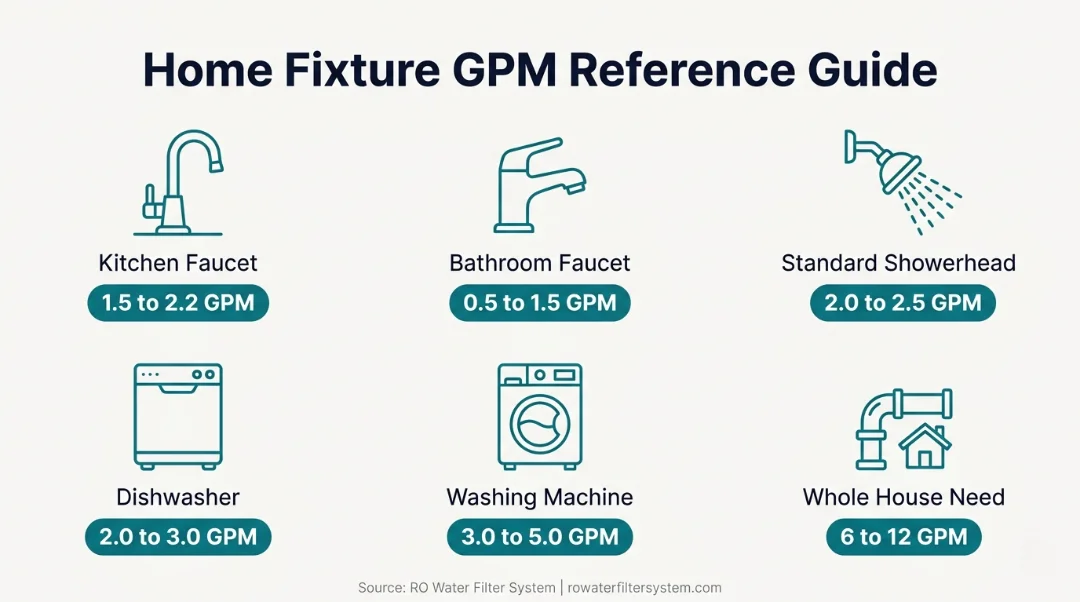
In residential plumbing, GPM is used to describe the output of nearly every fixture in your home. Here is a practical reference for common fixtures:
|
Fixture |
Typical GPM Range |
| Kitchen faucet |
1.5 to 2.2 GPM |
|
Bathroom faucet |
0.5 to 1.5 GPM |
| Standard showerhead |
2.0 to 2.5 GPM |
|
Toilet (per flush) |
1.28 to 1.6 GPF |
| Dishwasher |
2.0 to 3.0 GPM |
|
Washing machine |
3.0 to 5.0 GPM |
Federal regulations have capped new showerheads at 2.5 GPM since 1992. If you have an older showerhead from the 1980s, it may be using 3.5 GPM or more, which adds up fast on your water bill.
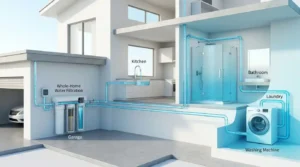
For whole-house supply, most U.S. homes need between 6 and 12 GPM depending on size and the number of people. Larger homes with multiple bathrooms running at the same time may need 15 GPM or higher.
GPM Meaning in Water Filters: Why It Works Differently
This is where things get a little more specific, and where many buyers get confused.
Point-of-Use Filters vs. Whole-House Systems
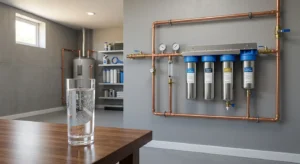
A whole-house filtration system handles your entire home’s water supply. It needs to match or exceed your peak household GPM so every fixture gets clean water without pressure loss. If your home peaks at 10 GPM and you install a system rated for 5 GPM, you will feel the difference every time two fixtures run at once.
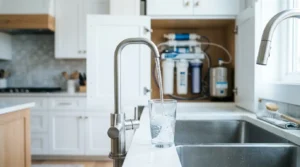
Reverse Osmosis systems work differently: RO systems use semi-permeable membranes to filter water slowly through, then store the filtrated solution in a pressure tank for later dispensing when needed. Instead of measuring what is GPM output directly, their performance is typically reported in GPD units per day instead; an under sink RO system usually produces 50 to 100 GPD which equates to around 0.03 to 0.07 GPM in real-time output; though their output seems small in real-world usage due to being stored and dispensable upon demand unlike GPM systems which produce constant output regardless of time!
If your RO faucet is running slowly or the tank takes a long time to refill, it is worth checking both the GPD rating of your system and the condition of the filters. A clogged pre-filter or a degraded membrane can cut actual output significantly. You can learn more about keeping your system running well by looking into Reverse Osmosis Water Filter Replacement.
Why GPM Affects Filtration Quality
There is a reason whole-house filter manufacturers specify a maximum GPM. If water moves through the filter media too fast, it does not stay in contact with the media long enough for full contaminant removal. This is called contact time, and it directly affects how well chlorine, sediment, and other particles are captured.
Running water too fast through a filter rated for lower flow means you are getting partially treated water. On the flip side, a filter rated far higher than your actual usage may not perform at full efficiency either. Proper sizing matters on both ends.
How to Calculate GPM at Home
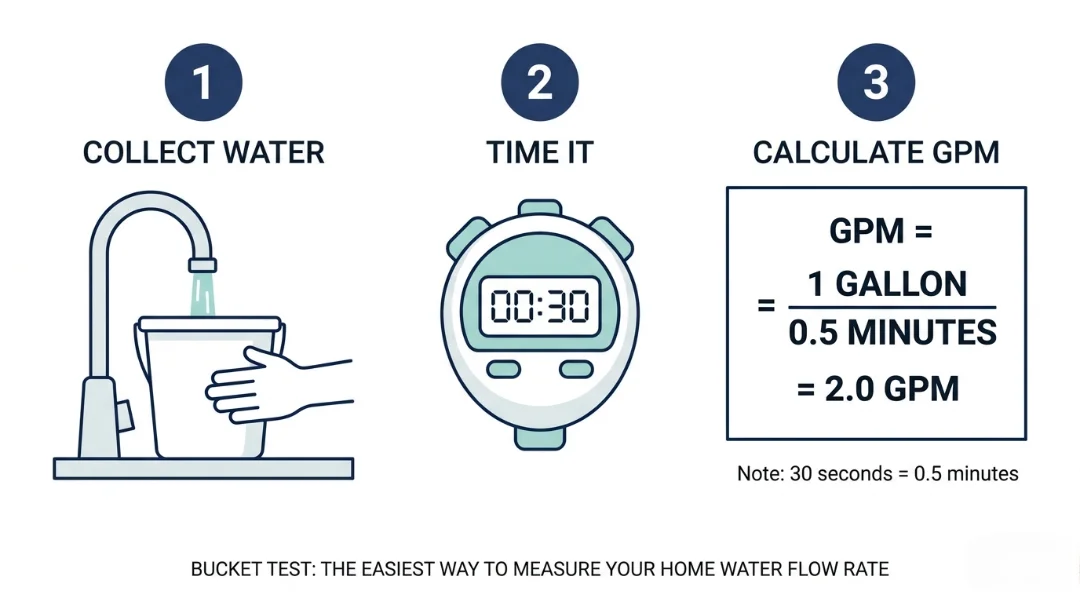
You do not need special equipment. Use the bucket test:
What you need: A bucket with a known volume (1 gallon works well), a stopwatch, and a fully open tap.
Steps:
- Place the bucket under a fully open faucet or showerhead.
- Start the timer when water begins to flow.
- Stop the timer when the bucket is full.
- Use this formula: GPM = Volume (gallons) divided by Time (minutes)
Example: If your 1-gallon bucket fills in 20 seconds, that is 0.33 minutes. So GPM = 1 divided by 0.33 = 3 GPM.
A plumber may utilize your main water meter to determine the total GPM entering your home in order to estimate your whole-house input flow rate. This figure serves as the basis for accurately sizing any whole-house softener or filter system.
What Is a Good GPM for Your Home?
The right GPM depends on your home size, number of people, and how many fixtures run at once.
- 1 to 2 people, small home: 4 to 6 GPM is usually enough
- Family of 3 to 4, 2 bathrooms: 8 to 12 GPM is the common target
- Larger home, 3 or more bathrooms: 15 to 20 GPM may be needed
An individual fixture that provides optimal water efficiency standards would include a kitchen faucet at 1.8 GPM or 2.0 to 2.5 GPM as suitable kitchen faucet and showerhead options respectively.
GPM and Residential Water Flow Rate: Local Considerations in Tracy, CA
Homes in Tracy and the near by area often deal with water that is high in hardness, sediment, and total dissolved solids. This matters for GPM because mineral scale buildup inside pipes and filter housings gradually reduces flow rate over time. A home that had 10 GPM at the meter three years ago may be delivering noticeably less today if scale has been accumulating unchecked.
A properly sized Reverse Osmosis Water Filter Tracy, CA for point-of-use drinking water, combined with a whole-house system for full household coverage, is one of the most effective setups for local water conditions. If you are evaluating how many filtration stages make sense for your home’s flow and water quality, the 7-Stage Water Filtration System Tracy CA is worth reviewing.
Common GPM Mistakes Homeowners Make
Buying a filter rated for lower GPM than their home needs. This leads to pressure drops and potentially incomplete filtration during peak use.
Confusing GPM with PSI. These are related but different measurements. Fixing pressure does not always fix flow, and vice versa.
Ignoring GPM when the real issue is a clogged filter. A dirty sediment pre-filter is one of the most common reasons a whole-house or under-sink system loses GPM over time. Filter replacement on schedule is the simplest fix.
Buying an oversized whole-house system. More GPM capacity is not always better. An undersized home running water through an oversized system may get poor contact time and reduced filtration efficiency.
GPM vs. GPD: Understanding the Difference
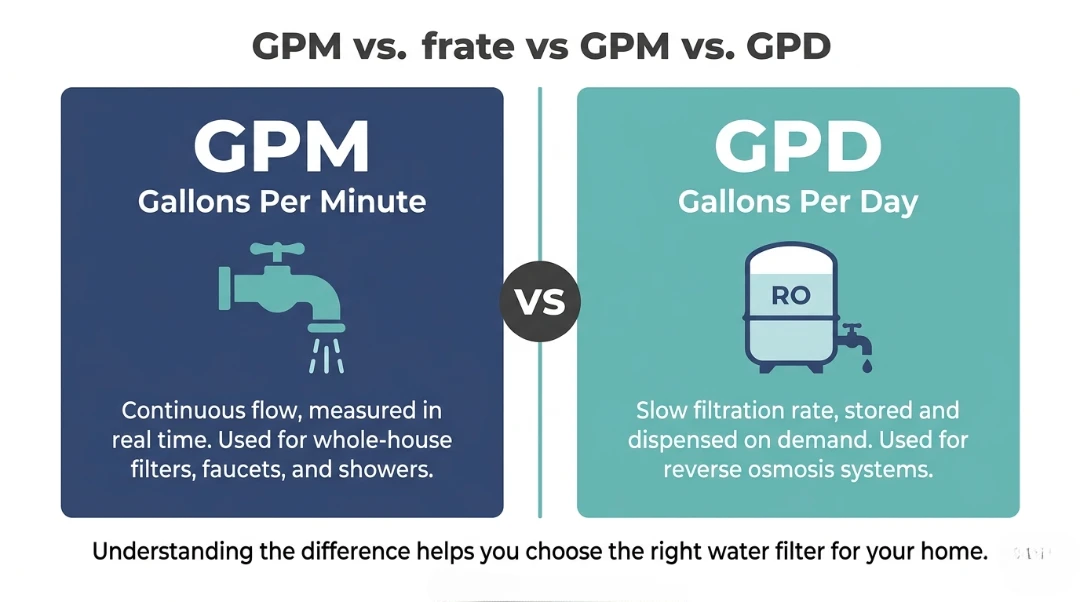
When you go shopping for water filters, you will come across both words.
GPM (gallons per minute) is used for whole-house systems, faucets, showers, and pumps where water flows continuously on demand.
GPD (gallons per day) is used for reverse osmosis systems and other filters that work slowly and store water before dispensing it.
If a system is rated at 100 GPD, that converts to about 0.07 GPM in continuous output. But because RO systems store water in a pressure tank and deliver it when you open the tap, the experience feels faster than that number suggests.
When comparing RO Water Filter System products with competitors, always check What is GPM or GPD figure refers to raw production rate or actual output at the faucet. These are sometimes listed differently, and the gap can be misleading.
Conclusion
Understanding what is GPM gives you control over your home’s water performance. It helps you diagnose slow flow, choose the right filtration system, and avoid costly mistakes. Instead of guessing, you can now measure and evaluate your system based on real numbers.
RO Water Filter System will assist you in measuring, diagnosing, and fixing the problem with the appropriate system for your water and your house if you live in Tracy, CA, or the surrounding area and are experiencing low water pressure, sluggish tap output, or a filter that seems to be underperforming. Get in touch with us right now to discuss your possibilities.
FAQs
What is a good GPM for a house?
A good GPM depends on home size. Most homes work well between 8 and 12 GPM total flow capacity. Smaller homes may need less, while larger homes need more.
What does GPM stand for in plumbing?
It stands for gallons per minute. It measures how much water flows through your plumbing system each minute.
Why is my faucet GPM so low?
Low faucet gallons per minute can be caused by clogged aerators, old pipes, or filter blockages. It may also relate to low water pressure.
Does higher GPM mean better water flow?
Not always. Higher GPM increases speed, but too much flow can reduce filtration efficiency. Balance is important.
How does GPM affect reverse osmosis systems?
GPM controls how fast water flows through the system. If it is too low, output is slow. If too high, filtration quality can drop.