You’re right to worry about lead in your tap water. The EPA says no level of lead in drinking water is safe, and you can’t see, smell, or taste it. So here’s the quick answer. Does Reverse Osmosis Remove Lead from Water? Yes. A certified RO system removes about 97 to 99 percent of it at the tap it serves.
We’ll walk through what that number means and where it falls short. You’ll see how RO works, how it compares with carbon filters, when a whole house system helps, and which buying mistakes cost people money. By the end, you’ll know what to ask before you buy.
Why Lead in Drinking Water Is Still a Real Problem
Lead rarely starts at the water source. It enters on the way to your tap. Old service lines, lead solder, and brass fixtures release lead into water as they corrode. The EPA calls the lead service line the most significant source of lead in drinking water.
Age matters. Homes built before 1986 carry the highest risk, because lead pipes and solder were still common then. Plenty of lead service lines still run underground across the country, too.
Drinking water makes up at least 20 percent of a person’s total lead exposure, according to EPA estimates. Young children face the greatest danger, since lead harms brain and nervous system development. That’s why the EPA sets its health goal for lead at zero.
The rules are tightening. The EPA’s Lead and Copper Rule Improvements lower the lead action level from 15 ppb to 10 ppb, and most water systems must meet the new requirements by November 1, 2027. But an action level is a trigger for utilities, not a promise that your tap is safe. One home can test high while the whole system passes.
How Reverse Osmosis Actually Removes Lead
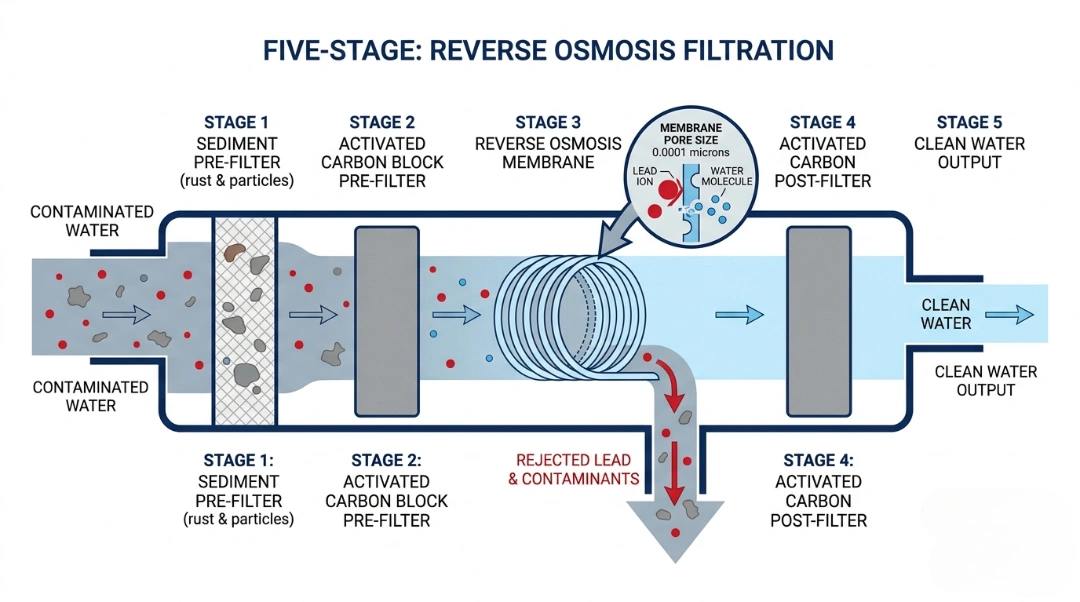
Does reverse osmosis remove lead works by pushing water through a semipermeable membrane under pressure. This membrane has pores rated as small as 0.0001 microns, which is far smaller than lead ions. Lead particles cannot pass through the membrane, so they are separated from the water and flushed away.
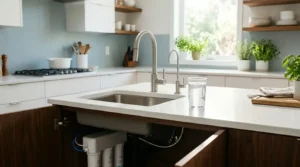
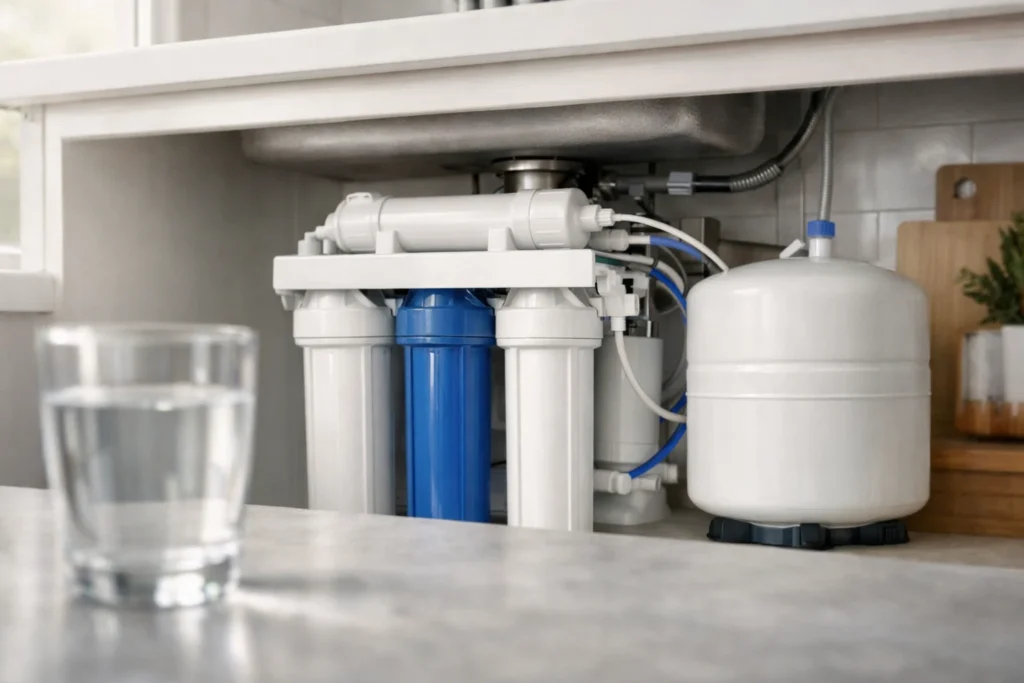
A quality RO system typically has multiple filtration stages working together:
- A sediment pre-filter that removes larger particles like rust and dirt
- A carbon pre-filter that removes chlorine, which can damage the membrane
- The RO membrane itself, which handles heavy metal ion filtration including lead
- A carbon post-filter that polishes the water before it reaches your glass
Does reverse osmosis remove lead when functioning efficiently have the capability of extracting up to 99% of lead from drinking water, earning recognition by both the Environmental Protection Agency (EPA) and National Sanitation Foundation (NSF) as an efficient point-of-use water purification method for lead removal.
Can Reverse Osmosis Remove Lead in Every Situation?
No. A certified RO system removes about 97 to 99 percent of lead from the water that passes through it, but results depend on the membrane’s condition, incoming water pressure, and the lead’s form. RO also treats only the tap it feeds, so lead elsewhere in your plumbing stays untouched.
So will reverse osmosis remove lead every time? Only when the system is healthy and installed well. Four things can weaken results:
- A worn membrane. Membranes lose rejection performance as they age.
- Low water pressure. RO needs steady pressure to push water through the membrane.
- Missed filter changes. Clogged pre-filters strain the membrane.
- Uncertified parts. Cheap units may never have been tested for lead.
Scope matters too. An under-sink unit treats one faucet. That’s usually enough, since drinking and cooking are where lead gets swallowed. Think of it like a deadbolt on your front door. It protects the door you put it on, not the open back window.
Lead can also hide in the system itself. Check that the faucet and tubing carry NSF/ANSI 372, the standard for lead-free materials.
Lead Contamination Signs Every Homeowner Should Know
Here’s the tricky part. Lead has no color, taste, or smell. Clear, fresh-tasting water proves nothing.
Look for risk clues instead:
- Your home was built before 1986.
- Your service line or indoor pipes are lead or galvanized steel.
- Your utility sent a lead notice, or lists your service line as lead or unknown.
- Water runs brown, or fixtures show blue-green stains. Both point to corroding plumbing.
- Recent water main work or plumbing repairs disturbed the lines.
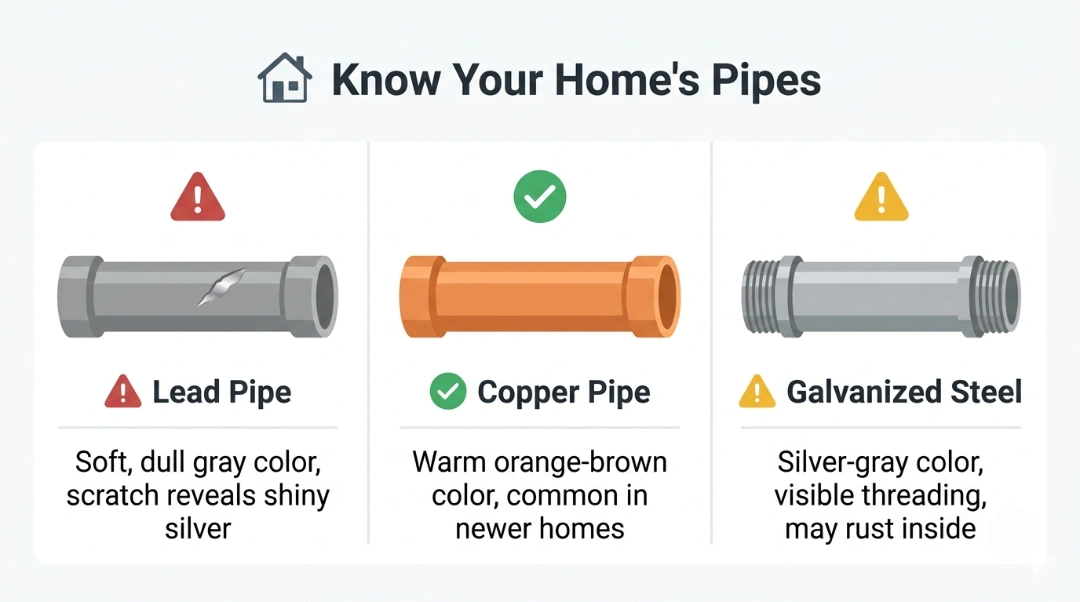
You can check exposed pipes yourself. Scratch one gently with a key. Lead is soft and dull gray, and it shows shiny silver under the scratch. A magnet won’t stick to it. If you suspect lead, call a plumber or your utility to confirm.
Parents can also ask a pediatrician about blood lead testing for young children.
Does an RO System Work Better Than Other Lead Filters?
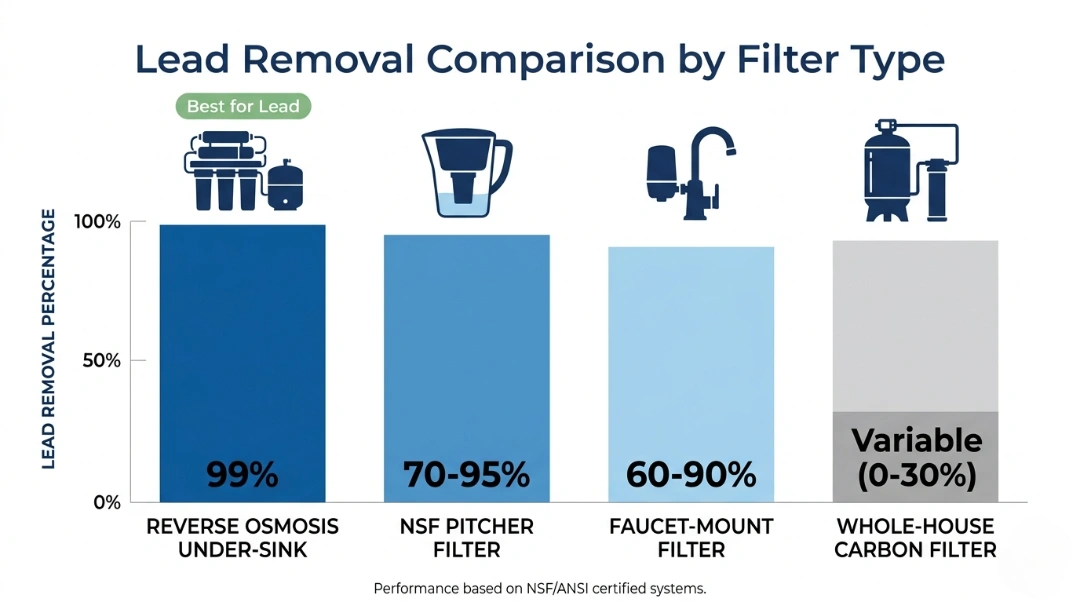
There are other options on the market. Pitcher filters, faucet-mount filters, and whole-house carbon filters all claim to reduce lead. Here is how they compare honestly:
| Filter Type | Lead Removal Rate | Coverage | Cost Range |
| Reverse Osmosis (under-sink) | Up to 99% | Point of use (kitchen sink) | $200 to $600+ installed |
| NSF-certified pitcher filter | 30% to 95% (varies by brand) | Single pitcher at a time | $25 to $60 |
| Faucet-mount filter | 50% to 85% | One faucet only | $30 to $100 |
| Whole-house carbon filter | Variable, not always lead-rated | Whole house | $500 to $2,000+ |
The most effective point-of-use remedy for lead-contaminated water is a RO system. Since lead is a dissolved heavy metal ion rather than merely a particle, it can handle particles that the majority of simple carbon filters cannot. Unless the filter is certified particularly for heavy metal ion filtration, carbon alone is not usually dependable for lead.
When a Whole House System Makes More Sense
Whole house filtration treats water where it enters your home. That helps when the incoming water carries lead or other contaminants. It also protects every tap, from the bathroom sink to the ice maker.
Here’s the catch. A whole house filter can’t catch lead that enters after it. Indoor pipes, solder, and fixtures add lead downstream. The strongest setup pairs both: a whole house system for incoming water, plus an under-sink RO at the kitchen tap for drinking and cooking.
Whole house reverse osmosis exists, but it’s rare. RO water has very few minerals, which can make it more corrosive to metal pipes. If you’re considering it, ask a pro about pH and remineralization first.
UV Water Treatment and Lead: What You Need to Know
UV water treatment is an excellent technology for killing bacteria, viruses, and other biological threats in well water or municipal supplies. However, UV treatment does not remove lead. Lead is a heavy metal, not a living organism. UV light cannot filter it out.
When combined with a RO system, UV therapy for biological issues provides protection against both chemical and biological hazards. This combo is used by many well-watering houses in rural regions close to Tracy to provide complete protection.
RO System Installation Matters More Than Most People Realize
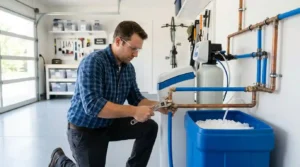
Even the best RO system will underperform if it is incorrectly installed. Common installation mistakes include improper tubing connections that cause slow leaks, skipping the flush cycle on a new membrane, failing to connect the drain line at the correct angle, and installing the system without checking incoming water pressure first.
A professional RO System Installation eliminates these risks. Proper installation ensures your system runs at full efficiency from day one and protects the warranty on your equipment. If you prefer to handle it yourself, Install Reverse Osmosis Water Filter guides are available to walk you through the process.
Common Buying Mistakes When Choosing a Lead Filter for Water
Most mistakes happen before the box arrives. Avoid these:
- Trusting a “removes 99 percent of contaminants” claim without checking that lead appears on the NSF/ANSI 58 data sheet.
- Skipping the water test, then buying more or less system than you need.
- Ignoring replacement costs. Filters and membranes are a recurring expense.
- Overlooking space and drain requirements under your sink.
- Assuming one RO tap protects the whole home.
- Choosing a unit with no lead-free materials certification.
- Never retesting the treated water.
Conclusion
The answer to the question of whether does reverse osmosis remove lead is unquestionably yes, and it does so more consistently than almost any other point-of-use solution now accessible to householders. One of the most sensible investments you can make for long-term health is a properly built and maintained RO system for people in Tracy, CA, who live in older houses or who battle with deteriorating plumbing and lead-contaminated tap water.
For people who want to know precisely what is in their water and how to remedy it, RO Water Filter System offers local knowledge. Get in touch with us to find the best option for your house and your family, whether you need a system suggestion, expert installation, or advice on whole-home water treatment.
FAQs
Does reverse osmosis remove lead completely?
A properly functioning RO system with a certified membrane can remove up to 99% of lead from drinking water. This does not mean 100% in all cases, but the level of reduction is well below the EPA’s action level of 15 parts per billion. Regular maintenance keeps the system performing at that standard.
How do I know if my home has lead in the water?
The only reliable way to confirm lead contamination is through water testing from a certified laboratory. Visual inspection of your pipes can point to risk, but dissolved lead has no taste, smell, or color. Homes built before 1986 have the highest probability of lead-containing plumbing materials.
Can I use a reverse osmosis system if I already have a water softener?
Yes, and it is often a smart combination. A water softener treats hardness, which protects the RO membrane from scaling. The RO system then handles dissolved heavy metals like lead. The two systems work well together and serve different purposes.
How often do I need to replace filters in an RO system?
Pre-filters and post-filters typically need replacement every 6 to 12 months depending on water quality and household usage. The RO membrane usually lasts two to three years. Following the manufacturer’s schedule is essential for maintaining consistent lead removal performance.
Is a uv water treatment system enough to remove lead?
No. UV treatment is designed to neutralize biological contaminants such as bacteria and viruses. It has no effect on lead or other heavy metals. If your water has both biological contamination and lead, a combined approach using UV treatment alongside reverse osmosis provides comprehensive protection.