Does reverse osmosis remove fluoride? The answer is yes. It does, and it’s among the best at-home techniques. People usually rely on carbon filters beneath their sinks, but professional RO systems with TFC membranes can reduce fluoride contamination up to 98% of drinking water sources.
Why carbon filters cannot handle fluoride at all, how water pressure and membrane age affect what percentage is actually removed, and what the water situation in Tracy looks like specifically. At RO Water Filter System, we have answered this question for hundreds of local households, and the details below reflect practical, real-world knowledge, not just a quick internet summary.
How Reverse Osmosis Actually Removes Fluoride
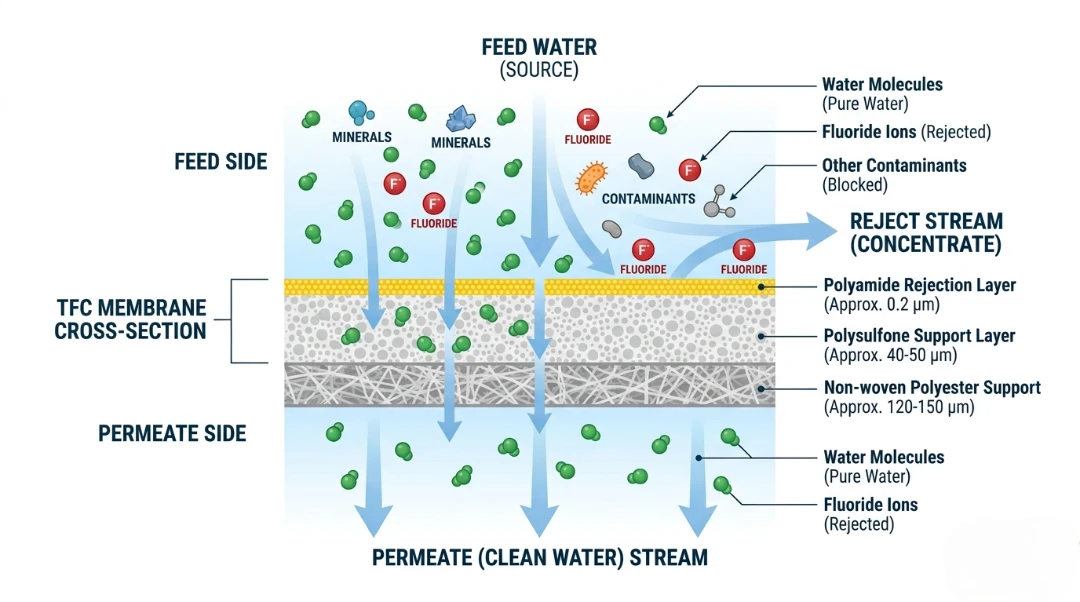
Your home’s water pressure pushes tap water through a semi-permeable RO membrane. The pores in a standard thin-film composite (TFC) membrane measure roughly 0.0001 microns, far smaller than a dissolved fluoride ion. But size is only part of it. Fluoride carries a negative ionic charge, and the polyamide layer inside the membrane repels it through monovalent ion selectivity, a charge-based rejection process that works alongside the physical barrier. So when reverse osmosis removes fluoride, it is doing two things at once: blocking it by size and repelling it by charge.
Carbon filters work through adsorption, pulling molecules like chlorine onto the surface of the filter media. Fluoride does not bind to carbon, so it passes straight through without being captured. The RO membrane does not rely on adsorption at all, does reverse osmosis remove fluoride so effectively when a carbon filter simply cannot.
What Percentage of Fluoride Does an RO System Remove?
Most homeowners searching this topic want one clear number. A certified RO system tested to NSF/ANSI Standard 58 removes between 85% and 98% of fluoride from drinking water. Where you land in that range depends on membrane quality, your home’s incoming water pressure, how old the membrane is, and how much fluoride was in the water to begin with.
Tracy’s municipal water sits at roughly 0.7 mg/L of fluoride, which is the level California requires. A well-maintained RO system brings that down to somewhere between 0.01 and 0.1 mg/L at your tap. If you are formula-feeding an infant or managing a specific health concern, that difference is real and it matters.
These numbers reflect systems that are properly installed and well maintained. A membrane past its service life or one running under low water pressure will not reach those rates. That is one reason professional RO system installation makes a real difference. The way a system is set up directly affects the results you actually get from it long term.
Does RO Remove Fluoride Better Than Carbon Filters?
Yes, and the difference is significant enough that it is worth being direct about.
Standard activated carbon filters, the kind found in pitcher filters, fridge filters, and basic under-sink systems, are not built to reduce fluoride. They handle chlorine, chloramines, and taste issues well enough, but fluoride is a small dissolved ion with a negative charge and it moves straight through carbon media without being captured. Activated alumina can reduce fluoride under specific pH conditions, but it is rarely found in residential systems and is not a reliable everyday solution for most households. If you are using a carbon-only filter and counting on it to remove fluoride, it is not doing that job.
A reverse osmosis system is a different tool entirely. Does RO remove fluoride consistently across real California tap water conditions? Yes, a RO membrane does not depend on adsorption; rather it physically blocks and charge-repels dissolved ions instead. Therefore it handles fluoride along with arsenic, nitrates, lead, and other pollutants without needing pH adjustments or special conditions, making RO the practical choice when fluoride reduction is a serious consideration for Tracy residents.
Do Water Filters Remove Fluoride? A Practical Comparison
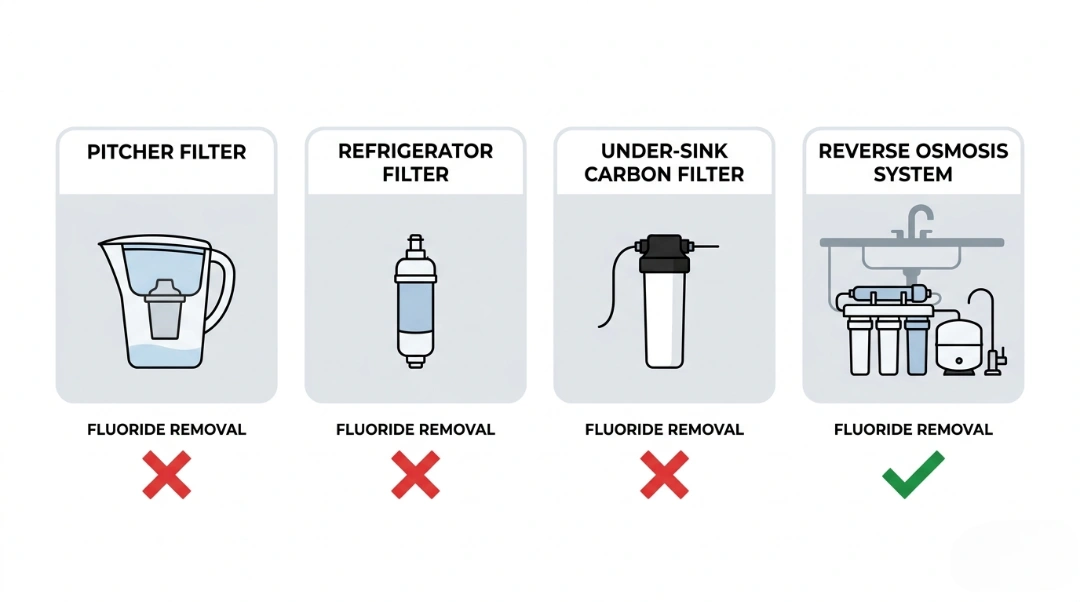
Not all filtration systems handle fluoride the same way. This table shows how common home filter types compare on fluoride removal.
|
Filter Type |
Removes Fluoride? |
Notes |
|
Activated carbon (pitcher, fridge) |
No | Not effective for fluoride; good for chlorine and taste |
| Carbon block under-sink | No |
Same limitation as pitcher filters |
|
Activated alumina |
Partially | pH-sensitive, not commonly used in residential settings |
| Reverse osmosis (RO) | Yes, 85 to 98% |
Most reliable and consistent method for home use |
|
Distillation |
Yes, around 99% | Slow and energy-intensive; not practical for daily household use |
| Ion exchange (water softener) | No |
Addresses hard minerals, not fluoride |
Reverse osmosis is the option that gives homeowners real, measurable fluoride reduction without requiring specialized conditions or constant monitoring.
What Tracy, CA Homeowners Should Know About Their Water
If you live in Tracy, Mountain House, Lathrop or Manteca, your tap water comes from both surface water and groundwater sources in the San Joaquin Valley. California law mandates utilities serving large populations fluoridate their supply when state funding allows, with Tracy adhering to this mandate. According to CDC data, Tracy’s fluoridation levels meet or surpass state guidelines of 0.7 mg/L fluoride content in its water source. Fluoridated tap water should generally be safe for adults to drink; however, those feeding formula mixed with fluoridated tap water receive significantly more fluoride exposure than breastfed babies, according to pediatric organizations that recommend lower fluoride exposure during the first months of life.
Tracy’s water also shows detectable levels of total trihalomethanes, measurable arsenic, and PFAS-related compounds that have raised concerns across San Joaquin Valley systems in recent years. This is where reverse osmosis water filtration makes practical sense beyond just fluoride. Does RO remove fluoride and other contaminants at the same time? Yes, through the same membrane process, which means one properly installed system addresses the full picture rather than forcing you to layer multiple filters for multiple problems.
How Many Stages Does an RO System Need?
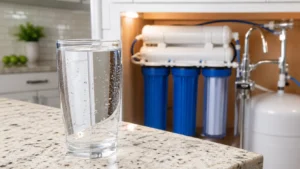
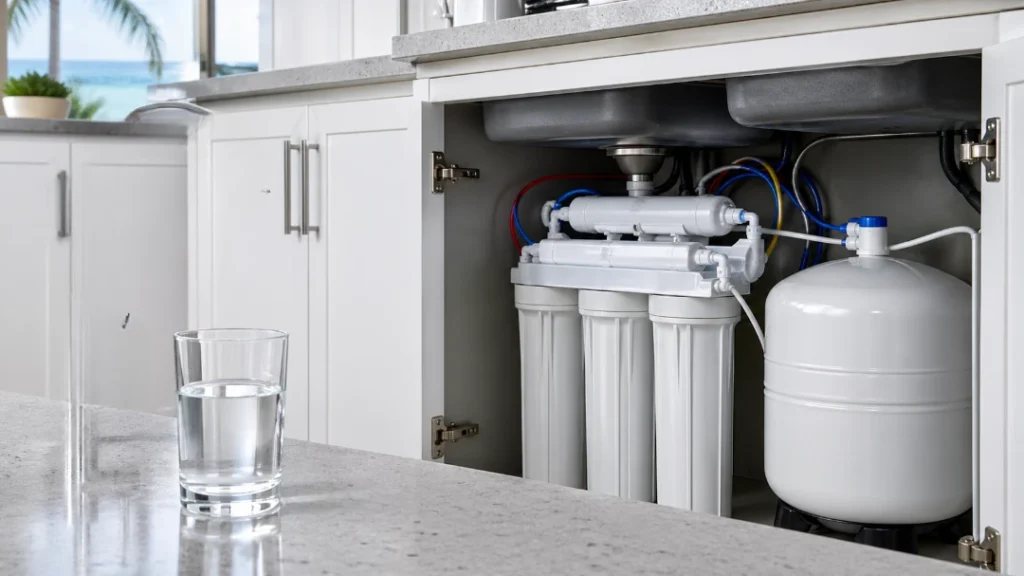
A 5-stage RO system is the standard starting point for most households and handles fluoride effectively at stage three, where the RO membrane does the actual rejection work. The first two stages, a sediment filter and a carbon pre-filter, remove particles and chlorine before water reaches the membrane. Chlorine degrades a TFC membrane quickly if it gets through untreated, so those pre-filter stages matter more than most people realize. Stages four and five are a post-carbon filter and a polishing stage that clean up the taste and clarity of your reverse osmosis water before it reaches your glass.
Stages six and seven in a more advanced system typically include remineralization post-filtration, which adds back a small amount of calcium and magnesium. The RO process removes beneficial minerals along with contaminants, and the water that comes out can be slightly acidic. A remineralization stage restores a natural mineral balance and improves the taste of the water without reintroducing fluoride. If that matters to your household, a 7-stage water filtration system that includes this stage is worth considering.
What Affects RO Performance Over Time
A new system with a quality TFC membrane will perform at or near its rated fluoride rejection rate. That changes as the system ages, especially if maintenance gets skipped.
Membrane replacement is the most important maintenance task for long-term fluoride removal. Most TFC membranes last two to three years under normal residential use. Past that service life, rejection rates drop and more fluoride passes through with the filtered water. Replacing pre-filters every six to twelve months also matters. A clogged sediment or carbon pre-filter reduces water pressure reaching the membrane, and lower pressure means lower rejection rates.
Low incoming water pressure is one of the most common reasons homeowners get worse results than expected. If your home pressure runs below 40 psi, the membrane cannot do its job properly. Adding a booster pump is a straightforward fix and is commonly included in professional RO installations for homes with this issue.
If you are concerned about other contaminants beyond fluoride, it is also worth reading about Does Reverse Osmosis Remove Lead, since lead is another dissolved contaminant that RO systems handle very effectively through the same membrane process.
Buying Mistakes That Cost Homeowners Later
A few patterns come up repeatedly when homeowners research fluoride removal on their own and end up with a system that does reverse osmosis remove fluoride?
Choosing Based on Marketing Language Without Verifying NSF Certification
Any product can claim to “reduce” or “filter” fluoride. Without NSF/ANSI Standard 58 certification from an independent testing organization, that claim has not been verified against real performance standards. Look for the certification number, not just the label.
Assuming All Under-sink Filters Work The Same Way
A standard under-sink carbon filter and an RO system can look similar when boxed and be priced similarly in some stores. The difference is that one uses only carbon media and cannot touch fluoride, while the other uses a semi-permeable membrane and can remove up to 98% of it. If the product does not specifically describe an RO membrane, it is not an RO system.
Underestimating How Much Installation Quality Affects Results
An RO system installed with incorrect fittings, at the wrong pressure, or without proper line connections will not perform at its rated efficiency. The specification sheet assumes correct installation. Professional installation is not just about saving time. It is about getting the fluoride reduction you are actually paying for.
Skipping Filter Maintenance
Buying a system and never replacing filters is one of the most common ways performance quietly degrades. Set a reminder for pre-filter replacement every six months and membrane replacement every two to three years.
Conclusion
When someone asks does reverse osmosis remove fluoride, the honest answer is yes, reliably and measurably, as long as the system is certified to NSF/ANSI Standard 58, uses a quality thin-film composite membrane, and is maintained on schedule. Tracy, CA households dealing with fluoridated municipal water or who want to know exactly what’s in their children’s formula or cooking water should use RO systems as they offer solid evidence backing their claims up with solid data.
RO Water Filter System works with homeowners throughout Tracy and the surrounding area to match them with the right system and install it correctly from day one. If you want clean, filtered drinking water you can trust, contact us today and we will walk you through your options.
FAQs
Does RO remove fluoride completely from water?
No, it does not remove 100%, but it can reduce fluoride by over 90%. This level is considered effective for most residential needs.
Do carbon filters remove fluoride from tap water?
No, standard carbon filters are not designed to remove fluoride. They mainly target chlorine, taste, and odor.
Is reverse osmosis safe for drinking water long term?
Yes, RO water is safe. Many systems include remineralization to improve taste and balance minerals.
How do I know if my RO system is removing fluoride properly?
You can test your water using a fluoride test kit or lab testing. Regular maintenance also helps ensure consistent performance.
Is reverse osmosis better than activated alumina for fluoride removal?
For most homes, yes. RO systems are easier to maintain and provide broader contaminant removal.