You pour a glass of tap water and it smells faintly like a swimming pool. Or the kettle is crusted with white scale again. That is usually the moment people start asking, what is a reverse osmosis water purifier, and is it worth putting one under the sink?
Quick Answer: Here is the short version. It is a multi-stage filter that uses water pressure to squeeze tap water through a membrane with microscopic pores. Most dissolved salts, metals and many chemicals get left behind and flushed away, and under good conditions the system can cut dissolved solids by up to about 98 percent. At RO Water Filter System, we install these systems in homes across the Central Valley and Bay Area, so the questions below are the ones we hear most.
This guide covers how it works, what it removes, what it cannot do, and whether it suits your home. It also covers a few practical details most guides skip, like water pressure, tank size, and the situations where a simple carbon filter is enough.
What Does a Reverse Osmosis Water Purifier Actually Do?

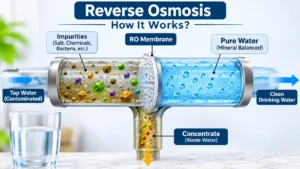
A reverse osmosis water purifier uses household water pressure to push tap water through a semi-permeable membrane. Water molecules pass through, while most dissolved salts, metals and chemicals stay behind and are flushed to the drain. What reaches your dedicated faucet is water with far fewer dissolved contaminants. So, what is a reverse osmosis water purifier in everyday terms? Think of a strainer so fine that only water molecules fit through the holes. Everything bigger gets rejected and washed away instead of piling up.
If you are new to the topic and wondering what is reverse osmosis exactly, it is a separation method, not a brand or a gadget. The reverse osmosis principle comes from natural osmosis, where water drifts from a weaker salt solution toward a stronger one through a thin membrane. Applying pressure flips that direction, which is why the system needs a decent level of water pressure to do its job. You will see this product called a purifier, an RO system, or an RO filter. For home use, those names mean the same thing. What matters is the technology inside, not the label on the box.
How Does Reverse Osmosis Work, Step by Step?
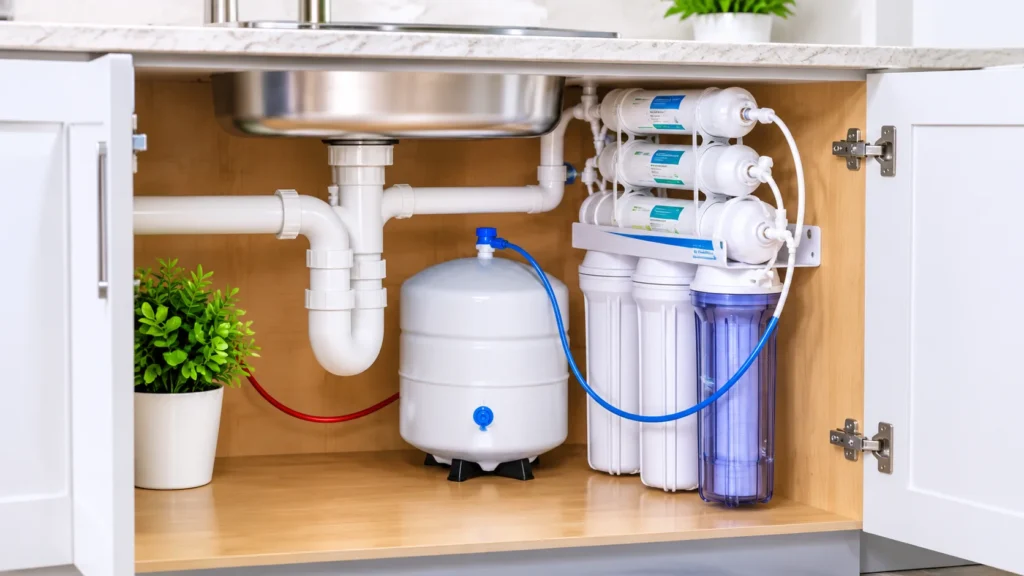
Tap water passes through a sediment filter and a carbon filter first, then gets pushed through the RO membrane under pressure. The clean water, called permeate, collects in a small tank, while the concentrated leftovers flow to the drain. A final carbon filter polishes the taste before water leaves the faucet.
The pre-filter and carbon stages
The sediment filter catches the big stuff: sand, rust flakes and dirt. The carbon block comes next and absorbs chlorine, volatile organic compounds and the chemicals behind that swimming pool smell.
This stage does more than improve taste. Many household membranes are sensitive to chlorine, so a worn-out carbon filter slowly damages the most expensive part of the system. Late filter changes often cost more than on-time ones.
The membrane and the storage tank
The membrane has pores around 0.0001 microns wide. The reverse osmosis process splits the incoming water into two streams: clean permeate, and a concentrated stream of rejected minerals and contaminants that runs to the drain. That drain stream also keeps the membrane surface from clogging with scale.
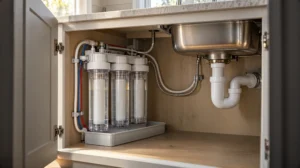
Membranes work slowly, so an under sink reverse osmosis system stores finished water in a small pressurized tank, usually 2 to 4 gallons. That is why your RO faucet gives you a strong pour even though the membrane itself only trickles. After the tank, a post-carbon filter cleans up any last taste before the water reaches your faucet. Some systems also add a remineralization stage that puts a little calcium and magnesium back.
If you want a deeper technical answer to how does reverse osmosis work in different system types, our full guide to how reverse osmosis works goes further.
What Is Inside a Home RO System?
| Part | What it does | What to watch |
| Sediment filter | Traps sand, rust and dirt | Clogs faster in older plumbing |
| Carbon pre-filter | Removes chlorine and taste chemicals | Protects the membrane, so do not delay changes |
| RO membrane | Separates clean water from dissolved contaminants | Lasts years, but not forever |
| Storage tank | Holds finished water for instant flow | Needs correct air pressure inside |
| Post-carbon filter | Final taste polish | Replace with the pre-filters |
| Dedicated faucet | Delivers RO water at the sink | Needs a small hole in the sink or counter |
| Drain line | Carries rejected water away | A loose connection means leaks or gurgling |
What Can an RO Water Purifier Remove, and What Can It Not?
It can remove most dissolved contaminants, including lead, fluoride, nitrates, and much of the total dissolved solids that make water taste salty or leave scale. It is less reliable for gases and some chemicals unless carbon filters are doing their share, and it should not be trusted as a disinfectant.
Here is how that plays out in a real kitchen:
- Lead, fluoride and nitrates: Reduced significantly by a properly working membrane.
- Total dissolved solids (TDS): Strongly reduced, which is why coffee, tea and ice taste cleaner.
- Chlorine and odors: Handled mostly by the carbon stages, not the membrane.
- PFAS and arsenic: Results depend on the specific system and, for arsenic, its chemical form. Look for a certification that names the exact contaminant. We cover that in our guide on whether reverse osmosis removes PFAS.
A claim printed on a box is not the same as a tested claim. Check whether the specific model is certified to the NSF/ANSI 58 standard for the contaminant you care about.
One cheap habit worth adopting is using a handheld TDS meter. Measure your tap water, then the RO water. A big drop means the membrane is working, and a shrinking gap over the months is your cue to service it. Keep in mind a TDS meter cannot detect lead or most chemicals, so it is a performance check, not a safety test.
Does RO make water safe from bacteria?
Not on its own. The membrane pores are tiny, but home units are generally not certified as disinfection devices, and seals, tanks and fittings can all be weak points. If your source is a private well or you are under a boil-water notice, add a UV stage or treat the water first, and do not treat RO as a replacement for official advice.
Is Reverse Osmosis Water Safe and Healthy to Drink?
Yes, RO water is safe to drink, and many households use it daily. The main debate is about minerals. RO removes most of the calcium and magnesium in tap water, but food supplies most of those minerals, and a remineralization stage can add some back for taste. Some people find RO water a little flat, because dissolved minerals give water much of its taste. If that bothers you, a remineralization cartridge usually fixes it.
RO water also tends to read slightly acidic, which is normal for water with so few dissolved minerals. For cooking, tea, coffee and ice, most people simply notice cleaner flavor. For infant formula, ask your pediatrician about the water you plan to use, since guidance depends on the child’s age and the formula.
How Much Water Does an RO System Waste?
Every RO system sends some water to the drain. Traditional units can send four or more gallons down the drain for each gallon of drinking water, while efficient models need far less. WaterSense labeled systems must meet minimum efficiency standards, so the label is a useful shortcut when comparing options.
Some waste is built into the design, because the reverse osmosis process needs a flowing stream to carry rejected contaminants away. The US EPA published its WaterSense specification for point-of-use RO systems in late 2024. It requires labeled systems to reach at least a 30 percent efficiency rating and at least 75 percent TDS reduction. At that minimum, you are roughly looking at a couple of gallons of drain water per gallon you drink, which is still well below what many older units waste.
A few practical ways to cut waste:
- Use RO only at the drinking tap. Running it through the whole house is wasteful. A whole-house comparison helps if you are unsure which fits.
- Consider a permeate pump. It boosts efficiency, especially on lower pressure, and needs no electricity.
- Keep filters fresh. Clogged pre-filters make the membrane work harder and waste more.
- Check your pressure. The reverse osmosis principle depends on pressure, and many systems perform best at around 40 psi or more at the inlet. A cheap gauge on an outdoor spigot tells you where you stand.
Pros and Cons at a Glance
| Advantage | Where you notice it |
| Strong reduction of dissolved contaminants | Homes with high TDS or nitrate concerns |
| Cleaner taste in drinks | Coffee, tea, ice cubes |
| Less need for bottled water | Families who buy cases every week |
| Fits under the sink | Small kitchens with no space for large equipment |
| Works with ordinary water pressure | No power needed for standard units |
| Drawback | Where you notice it |
| Sends some water to the drain | Homes with tight water budgets |
| Slow membrane, needs a tank | Cabinet space gets crowded |
| Removes useful minerals too | People who find the taste flat |
| Needs regular filter changes | Skipped changes lower performance |
| Does not soften the whole house | Scale in showers and appliances remains |
Who Should Choose RO, and Who Probably Does Not Need It?
RO makes the most sense for households with high dissolved solids, lead or nitrate concerns, or persistent taste problems that carbon filters cannot fix. If your main complaint is chlorine taste in already soft or moderate water, a good carbon filter may be enough and will waste no water.
A water test before you buy is the step we would put first at RO Water Filter System, because the right system depends on what is actually in your water. Knowing what is a reverse osmosis water purifier is half the decision, and the other half is your tap.
A quick checklist:
- Hard water or high TDS: RO is a strong fit. Central Valley water often carries a lot of dissolved minerals, so check your utility’s annual water quality report.
- Older plumbing or lead worries: Homes built before the late 1980s may have lead solder or older service lines. RO adds real protection at the drinking tap.
- Nitrates, often an issue near farmland or wells: RO is one of the few home options that handles them well.
- Only chlorine taste or smell: Start with carbon. You may not need RO.
If you live nearby, our Reverse Osmosis Water Filter Tracy, CA page explains what a local installation involves.
Cost, Maintenance, and Lifespan
Plan on replacing the sediment and carbon filters every 6 to 12 months, and the membrane every 2 to 5 years. Hard water and high TDS shorten that timeline. Replacement filters and membranes often work out to somewhere around $60 to $150 a year for typical home units, though prices vary by model, so ask for the full annual cost before you buy.
Maintenance has a few details people tend to miss. Check the tank’s air pressure when it is empty, since a low reading makes the faucet sputter. Flush and sanitize the system during filter changes, and learn the right way of flushing a new RO membrane. Discard the first tank or two after any installation or membrane swap.
Professional installation helps with the unglamorous parts. A drain connection in the wrong spot causes gurgling, a loose fitting causes a slow leak inside the cabinet, and low inlet pressure makes the whole system underperform. If you want to see what the job involves, read our guide on how to install a reverse osmosis water filter.
Final Thoughts
So, what is a reverse osmosis water purifier? It is a pressure-driven membrane system that reduces dissolved contaminants at the tap, works best with fresh filters and decent water pressure, and is not a cure-all. The best results come from matching it to what is actually in your water.
If you want a second opinion on your water or help choosing and installing a system, our team at RO Water Filter System is happy to help. Take a look at our Water Filtration Installation Services in Tracy, CA page, or contact us to talk through your home’s setup.
FAQs
Is an RO water purifier the same as a regular water filter?
For home use, “purifier,” “RO system” and “RO filter” usually mean the same product. Reverse osmosis is the method, and the purifier is the whole system built around it. If you are still unsure what is reverse osmosis in simple terms, think of it as pressure plus a very fine membrane, which goes well beyond what a basic carbon filter does.
Does RO remove fluoride?
Yes, a working reverse osmosis system typically reduces fluoride by a large margin. For a precise figure, check the certification listed for your specific model.
Can I drink RO water every day?
Yes, many households do. Most of the minerals your body needs come from food, and a remineralization stage can improve the taste if you find the water flat.
How often should I change the membrane?
Most membranes last about 2 to 5 years. High TDS water, skipped pre-filter changes, or a shrinking TDS gap between tap and RO water are signs it may be time sooner.
Does an RO system work without electricity?
A standard under sink reverse osmosis system runs on water pressure alone, so a power outage does not stop it. Booster pumps and UV stages are the parts that need electricity.