Ask a chemist, a plumber and an aquarium owner to explain filtration and you’ll get three completely different answers. All three are right, which is exactly why searching what are the types of filtration can leave you more confused than when you started. This guide from RO Water Filter System sorts the science, the industry jargon and the home water side into one clear picture, so you can see where each idea actually fits.
Quick Answer: Here’s the short version. Filtration is a way of cleaning a liquid or gas by making it pass through a barrier that holds unwanted material back, whether that’s grit, dissolved chemicals or microbes. The three classic groups are mechanical filtration, which catches particles by size, chemical filtration, which pulls dissolved substances out through adsorption, ion exchange or reactions, and biological filtration, where helpful bacteria convert harmful waste like ammonia into safer forms. Membrane filtration handles the finest separation, and most homes end up combining two or three methods. Below, you’ll see how each one works, which water filter types suit a house, and where filtration simply runs out of road.
How Filtration Works in Simple Terms

Think about pour-over coffee. Hot water runs through the grounds, the paper holds the grounds back, and only the liquid drips into your cup. That’s filtration at its simplest: something moves through a medium, and the medium decides what gets to pass. Tap water works the same way, just with smaller troublemakers. Filters rely on three basic actions. Straining blocks anything too big to fit through the openings, like sand or rust flakes.
Sticking, known as adsorption, makes dissolved substances cling to a surface such as activated carbon. Swapping, or ion exchange, trades unwanted ions like calcium for harmless ones that take their place. Every product you’ll read about below leans on one of these actions or a mix of them. That’s also why no single filter can do everything. Filtration methods differ mostly in which action they favor and how finely they work.
The Main Categories of Filtration
So what are types of filtration when you zoom out to the full picture? Most filtration methods fall into a few groups based on what does the work. Mechanical filtration is physical blocking. Screens, mesh, sand beds and pleated cartridges hold back anything larger than their openings. It handles grit, silt and rust well, but it does nothing about dissolved minerals, chlorine or chemicals, because those are far smaller than any practical opening.
Chemical filtration deals with what’s dissolved. Activated carbon grabs chlorine, odors and many organic compounds, while ion exchange resins swap one set of ions for another, which is how a softener removes the minerals behind scale. Some media also work through reactions that turn a contaminant into something easier to catch.
Biological filtration relies on living bacteria. In an aquarium, beneficial bacteria convert toxic ammonia into less harmful compounds. At community scale, slow sand filters grow a thin living layer that helps break down organic matter. It’s a wastewater, aquarium and municipal tool, not something you’ll install under a kitchen sink.
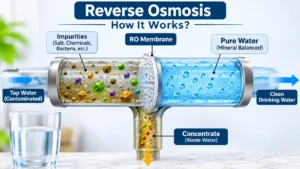
Membrane filtration is the finest category. Water is pushed under pressure against a membrane, and the tighter the pores, the smaller the particle it stops.
| Membrane level | Typical pore size | What it mainly stops |
| Microfiltration (MF) | Roughly 0.1 to 10 microns | Suspended solids, many bacteria |
| Ultrafiltration (UF) | Roughly 0.01 to 0.1 microns | Colloids, proteins, bacteria |
| Nanofiltration (NF) | Around 0.001 micron | Multivalent ions like calcium and sulfate, some dyes |
| Reverse osmosis (RO) | Tighter still | Nearly all dissolved salts and many other contaminants |
You’ll also run into labels that describe how a filter behaves rather than what it removes. Surface filtration catches particles on the top layer, like a sieve, while depth filtration traps them throughout a thick, porous bed. In dead-end filtration, all the liquid pushes straight through the media and solids pile up on its face. Cross-flow filtration sweeps liquid across the membrane instead, which slows clogging, and RO units use that idea. Cake filtration, common in industry, lets trapped solids build into a layer that starts filtering on its own. These labels cut across the different types of filters above, so one product can be several things at once.
Laboratories add a few more. Gravity filtration uses a simple funnel and paper, vacuum filtration pulls liquid through faster, centrifugal separation spins heavy solids out, and hot or cold filtration helps manage crystals and waxes. Useful at a lab bench, irrelevant at your kitchen tap.
Filtration Types Used in Homes
When people shop for the types of water filtration used in houses, the list is shorter than the marketing suggests. Here’s what each one does well, plus a mistake people tend to make with it.
Sediment and Carbon Filters
Sediment filters are the bouncers at the door. They catch sand, silt and rust flakes before those can clog everything downstream, so they usually sit first in a system or where water enters the house. A common slip is choosing a very fine filter for gritty water, then wondering why the flow drops within weeks. Starting coarser and stepping down to finer stages avoids that.
Activated carbon is the taste and smell specialist. Its porous surface holds on to chlorine, many organic chemicals and the odors that make tap water unpleasant, which is why it shows up in pitchers, fridge filters, under-sink units and whole-house tanks. What it won’t do is remove dissolved salts, nitrates or most minerals, and a spent cartridge quietly stops working, so the replacement schedule matters more than people expect.
Reverse Osmosis and Other Membrane Filters
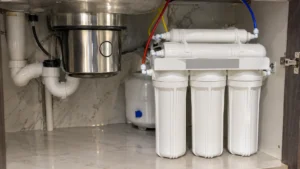
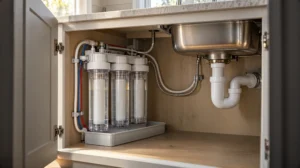
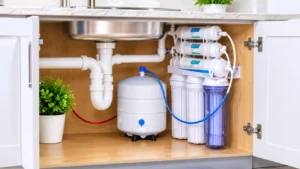
Reverse osmosis is the heavy hitter for drinking water. The membrane rejects dissolved solids, and certified models can be tested for contaminants such as lead, nitrate and several PFAS compounds. The trade-offs are real, though. RO systems send a share of the incoming water down the drain as reject water, and they depend on decent line pressure. Homeowners often underestimate that second point, because a unit fed by weak pressure tends to produce slowly and waste proportionally more.
Ultrafiltration sits a step looser. It stops particles and bacteria but lets dissolved minerals pass, and many units need no electricity. It suits homes that want better microbial and particle control without the rejected water of RO, but it doesn’t address dissolved chemicals.
UV, Softeners and Ceramic Filters
UV is disinfection, not true filtration. A lamp exposes water to ultraviolet light that scrambles the DNA of bacteria, viruses and cysts, and nothing is physically removed. Cloudy water can shield microbes from the light, so UV belongs after a sediment filter, and the lamp needs replacing on the manufacturer’s schedule, commonly about once a year.
Softeners use ion exchange to swap hardness minerals, calcium and magnesium, for sodium or potassium. They’re excellent against scale, but they aren’t drinking water filters. They don’t remove chlorine, bacteria or most chemicals, and plenty of people expect softened water to taste cleaner when it usually doesn’t.
Ceramic and gravity filters are the low-tech option. Water seeps through fine ceramic pores that block sediment and many bacteria, with no power or plumbing needed, which makes them handy for camping, emergencies or homes without pressure. They need regular scrubbing, and on their own they don’t touch dissolved chemicals.
Filtration Types Compared at a Glance
Here’s a side-by-side look at the water filter types covered above.
| Type | What it removes | What it doesn’t remove | Typical use | Maintenance |
| Sediment | Sand, silt, rust | Dissolved chemicals, bacteria | First stage, whole house | Replace when flow drops |
| Activated carbon | Chlorine, odor, taste, some organics | Dissolved salts, nitrates, most microbes | Taste improvement | Replace on schedule |
| Reverse osmosis | Dissolved solids, lead, nitrate, many PFAS (certified models) | Some gases and small organics, varies by model | Under-sink drinking water | Prefilters often, membrane less often |
| Ultrafiltration | Particles, bacteria | Dissolved minerals and chemicals | Low-power drinking water | Clean or replace periodically |
| UV | Inactivates bacteria, viruses, cysts | Sediment, chemicals, minerals | Disinfection, wells | Lamp about yearly |
| Ion exchange | Hardness minerals | Bacteria, chlorine, most organics | Whole-house softening | Salt refills, resin wears out |
| Ceramic | Sediment, many bacteria | Dissolved chemicals | Camping, emergencies | Scrub, replace when worn |
Which Type Fits Your Water Problem
The right choice starts with your problem, not with a product. If you’d like a professional to read your results and match a setup to them, RO Water Filter System can help.
Bad taste or a chlorine smell points toward activated carbon. Visible grit, rust or cloudiness calls for sediment filtration up front. White scale on faucets and spotty dishes means hard water, which is a job for ion exchange softening. Worries about bacteria, especially on a private well, call for UV or a certified microbiological filter behind a sediment stage. Concerns about lead, nitrates or PFAS usually lead to certified reverse osmosis. Wells often need several stages, since they can carry sediment, hardness, bacteria and dissolved minerals all at once.
Before buying anything, get your numbers. City customers can read the annual water quality report their utility publishes, while private well owners need to arrange their own lab test, because no utility is monitoring a well for them. Pair that with how you plan to use the water, drinking only or the whole house.
Across the Central Valley and parts of the Bay Area, hard water scale and chlorine taste are commonly mentioned complaints, so it’s normal to see a softening stage, a carbon stage, or both. If that sounds like your home, a water purification system in Tracy, CA can be built around your test results instead of a one-size package.
You may also read: What Filter Is Best for Drinking Water?
What Filtration Cannot Do
No single filter removes everything. Carbon can’t pull out dissolved salts, a sediment filter can’t stop bacteria, and even RO isn’t a guarantee against every microbe or gas. That’s why the claim on the box matters more than the type on the box. Look for third-party certification to standards such as NSF/ANSI 42 for taste and odor, 53 for health-related contaminants like lead, 58 for reverse osmosis and 55 for UV, and read what the performance data sheet actually lists.
The words filter and purifier get thrown around loosely, too. A purifier is generally expected to deal with microbes, while a filter might only improve clarity or taste, so check the tested claims instead of trusting the label.
Common Mistakes People Make When Choosing a Filter
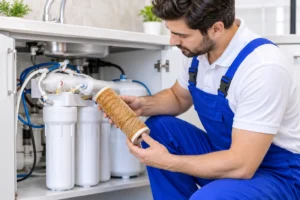
Skipping the water test is the biggest one. Without results you’re guessing, and an expensive system aimed at the wrong contaminant solves nothing. Ignoring replacement dates comes next. A clogged sediment cartridge chokes your flow, and a spent carbon cartridge stops doing its job while still looking perfectly fine.
Then there’s the idea that one filter fixes everything. Different types of filters exist because contaminants behave differently, and a pitcher can’t do a softener’s work. Finally, whole-house systems get undersized more often than you’d think. If the rated flow is lower than what your household uses at peak, say two showers and a washing machine running together, pressure drops and the system strains.
Final Thoughts
So, what are the types of filtration in the end? Mechanical, chemical and biological methods, with membranes handling the finest work. Across the types of water filtration, the lesson is the same: test first, match the method to the problem, and keep up with replacements. A home setup usually layers two or three methods to suit the water coming in.
If you’re ready to choose, RO Water Filter System can help you sort out the right setup. Explore our Water Filtration Installation Services in Tracy, CA, or contact us to talk through your water.
FAQs
What are the types of filtration most homes actually use?
Most homes rely on sediment filters, activated carbon, reverse osmosis, ion exchange softeners and sometimes UV disinfection, while ceramic and gravity units cover camping and emergency use. Each handles a different job, so they’re usually stacked together rather than used alone. A pitcher or single cartridge can still be enough when your only complaint is taste.
What is the simplest type of filtration?
The simplest type is mechanical filtration, which strains water through a screen, mesh or cartridge that blocks anything larger than its openings. A basic sediment filter works this way, catching sand, silt and rust flakes but letting dissolved chemicals and minerals slip straight through. That’s why it usually acts as the first stage in a bigger setup rather than working alone.
Which type of filtration is best for drinking water?
Reverse osmosis covers the widest range for drinking water, since its tight membrane rejects dissolved salts, lead, nitrates and many other contaminants that carbon and sediment filters miss. Most under-sink units pair it with carbon and sediment stages, so you get taste improvement and broad removal together. The best choice still depends on what your water test shows, so confirm the contaminant before you buy.
Is UV a type of filtration?
Not in the strict sense, because UV light doesn’t trap anything. It scrambles the DNA of bacteria, viruses and cysts so they can’t reproduce, while minerals, chemicals and sediment pass through untouched, which makes it a disinfection method rather than a physical filter. Particles can shield microbes from the light, so UV usually sits behind a sediment filter.
How often should filters be changed?
There’s no single schedule, because it depends on the filter type, your water quality and how much you use. Sediment and carbon cartridges are commonly changed every several months to a year, while membranes and UV lamps follow longer or fixed cycles set by the manufacturer. Treat the label as a starting point and shorten the interval if flow slows or taste changes.