
Walk down any filter aisle and every box promises the cleanest, purest, healthiest water. Pitchers, faucet mounts, under-sink units, whole house tanks: they all sound like the answer. Then you read the fine print and realize each one removes a different list of things, and none of them tells you which list matters for your home. That is why so many people get stuck on what type of filtration is best for drinking water.
Quick Answer: Here is the short version. The right choice depends on where your water comes from and what you want out of it. For most homes on city water, a certified carbon block filter handles chlorine taste, odor, and many chemicals. When the worry is heavier, such as lead, nitrate, arsenic, fluoride, or PFAS, reverse osmosis is the stronger fit. Pitchers work for renters and tight budgets, as long as you accept their limits. Before you buy anything, read your water report, because a filter built for the wrong problem is money wasted.
At RO Water Filter System, we help homeowners match the system to the water, and this guide walks through the same logic step by step.
Which Filtration Type Removes What? A Quick Verdict Table

No single filter removes everything, so the best match depends on your main concern. Carbon block filters suit chlorine, taste, and many chemicals. Reverse osmosis covers the widest range, including lead, nitrates, arsenic, fluoride, and PFAS. UV targets microbes only, and softening handles hardness. Pick by contaminant first, then by convenience.
| Your concern | Best-fit technology | What to avoid |
| Chlorine taste and smell | Activated carbon block | Plain sediment filters, which do not touch chemicals |
| Lead | RO, or a carbon block certified for lead | Uncertified pitchers, and boiling, which does not remove lead |
| PFAS | RO, or a carbon block tested for PFAS | Any filter with no PFAS claim on its data sheet |
| Nitrate | RO or nitrate-specific resin | Carbon alone, and boiling, which concentrates nitrate |
| Bacteria and viruses | UV, or a filter certified for microbial reduction | Carbon alone |
| Hardness and scale | Water softener | Expecting a drinking-water filter to protect pipes and heaters |
| Salty or flat taste, high TDS | RO | Carbon alone |
Treat this table as a starting point. The next section shows how to find out which row is really yours.
Start With Your Water, Not the Filter
A filter is a tool for a specific job, so the first step is learning what job your water needs done. If you are on city water, your utility publishes a Consumer Confidence Report every year, and the EPA requires it. Skim it for four things: the disinfectant used (chlorine or chloramine), any lead or copper results, hardness or total dissolved solids, and whether nitrate or PFAS were tested. The disinfectant matters more than most people expect. Standard carbon handles chlorine well but struggles with chloramine, so some homes need a catalytic carbon cartridge or an RO stage to get the same taste improvement.
Keep one limit in mind. The report describes water leaving the treatment system, not water coming out of your kitchen faucet. Older solder, brass fixtures, and aging service lines can add metals on the way. If your home is older, a lab test of a tap sample is worth the small cost. Private wells are a different story. No utility is checking them for you, so public health agencies generally suggest testing at least once a year for bacteria and nitrate, plus anything else common in your area.
Some results change the whole decision. A positive bacteria test points toward disinfection like UV. High nitrate points toward RO or a nitrate-specific resin. Lead in a sample taken after water sat overnight points toward a lead-certified filter at the kitchen tap. High dissolved solids with a salty or flat taste points toward RO.
How Water Filtration Works in Plain English
Four ideas cover almost every filter on the market.
- Physical straining. A screen or dense media catches particles like sand, rust flakes, and silt. Sediment filters do this, and most systems use one first to protect the parts behind it.
- Adsorption. Activated carbon has a huge internal surface area, and chemicals such as chlorine byproducts stick to it as water passes. Once that surface fills up, the cartridge is spent.
- Ion exchange. Resin beads swap unwanted ions for harmless ones. Softeners trade calcium and magnesium for sodium or potassium, and specialty resins can target nitrate.
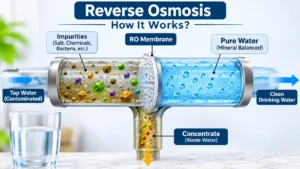
- Membrane separation. In reverse osmosis, pressure pushes water through a membrane with microscopic openings. Most dissolved substances stay behind and get flushed to the drain.
The Main Filtration Types for Drinking Water Compared
When people ask what type of filtration is best for drinking water, they usually expect one winner. In practice, each method does one job well and another job badly. Here is how the main families compare.
Activated Carbon Filters
Carbon comes in two common forms. Granular carbon is loose, so water can find shortcuts through it. Carbon block is pressed solid, which forces more contact and usually performs better on chemicals. For city water, a carbon block under the sink is often the sweet spot. It cuts chlorine taste and smell, reduces many VOCs, and leaves natural minerals in the water. A block certified for lead or PFAS can reduce those too, but only if the certification says so.
The limits are real. Carbon does little about dissolved salts, nitrate, or arsenic. It also has a finite capacity, and a wet cartridge left in place far too long can become a place where bacteria settle in.
Reverse Osmosis Systems
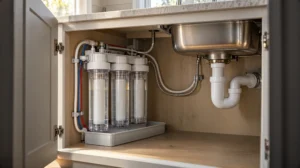
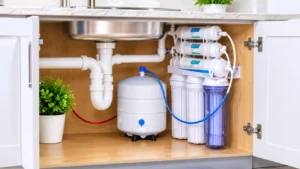
A typical under-sink RO system stacks a sediment filter, a carbon stage, the membrane, and a final polishing stage, with a small storage tank and its own faucet. It has the broadest reach of any home option, reducing dissolved solids, nitrate, fluoride, arsenic, lead, and many PFAS compounds when the system is certified for them.
The trade-offs are worth knowing. RO sends some water to the drain while it works, and the amount varies a lot between designs, so ask about the ratio. It also removes minerals, which can make water taste flat to some people, and a remineralizing stage can fix that. Low household pressure can slow production, and a booster pump may help. The prefilters need regular changes to protect the membrane, which is the most expensive part.
UV, Ion Exchange and Distillation
UV light disrupts the DNA of bacteria, viruses, and cysts so they cannot reproduce. It is a strong fit for wells with microbial risk, but it removes no chemicals and needs clear water and steady power. Ion exchange powers softeners and some nitrate systems, so it fits hardness or one specific dissolved problem, not a general cleanup. Distillation boils water and collects the steam, which removes most contaminants, but it is slow and energy hungry, and some volatile chemicals can carry over unless a carbon stage follows.
Not sure which of these your home needs? Homeowners in Tracy and nearby areas can ask RO Water Filter System to look over a water report and point out the options that make sense.
Which Certifications Actually Matter?
Look for NSF/ANSI 42 for taste and odor, 53 for health-related contaminants like lead, 58 for reverse osmosis, 401 for emerging compounds, and P473 for PFOA and PFOS. A certification only counts if the specific contaminant you care about is listed on the performance data sheet.
Words like “purifies,” “pure,” or “up to 99% cleaner” mean little without a test behind them. The practical split is simple: 42 is about how water tastes, while 53 and 58 are about health.
Here is how to read a label without getting fooled. First, find your exact contaminant on the data sheet. A filter can be certified for chlorine and say nothing about lead. Second, check the reduction percentage and the rated capacity in gallons. Third, confirm the certification covers your specific model and replacement cartridge, because a certified housing paired with an off-brand cartridge is not the same product. If you cannot find a data sheet, treat the claim as unproven.
Point-of-Use or Whole House: Where Should Filtration Happen?
Drinking and cooking use only a small share of the water a home runs through. Showers, laundry, dishwashers, and toilets use the rest. That is why many families treat drinking water at one tap and leave the rest alone. An under-sink system costs far less than treating every pipe, and it puts the effort exactly where you swallow the water.
A whole house system makes sense when the problem affects the whole house: sediment wearing out fixtures, hardness building scale in the water heater, or chlorine drying out skin and hair. RO is rarely practical at that scale because of the water use and cost. A common setup pairs a whole house sediment or carbon stage, or a softener, with an under-sink RO unit for the kitchen. For a deeper side by side, read our comparison of whole house water filter vs reverse osmosis.
Which Filter Fits Your Situation? A 5-Minute Scorecard
So what type of filtration is best for drinking water in your situation? Find your row below.
| Situation | Best fit | Good add-on | Skip |
| City water, chlorine taste and smell | Carbon block at the kitchen tap | Whole house carbon if showers bother you | RO, unless other concerns show up |
| Older home, lead concern | RO or a lead-certified carbon block | Lab test of a tap sample | Uncertified pitchers |
| PFAS concern | RO or a carbon block tested for PFAS | Recheck the data sheet each cartridge change | Filters with no PFAS claim |
| Private well | Lab test first, then treat the results | UV for microbes, sediment prefilter | Buying anything before testing |
| Hard water area | Softener for the whole house | Under-sink RO for drinking | Relying on a pitcher to stop scale |
| Renter | Certified pitcher or countertop filter | Countertop RO unit | Plumbing changes without landlord approval |
Hard water is common across the Central Valley, which is why a softener paired with an under-sink RO unit shows up so often in local homes.
What No Filter Can Fix
Honesty here saves you money. No single filter removes everything, and anyone who claims otherwise is selling something. Taste is a poor safety test. Water can taste fine and still carry nitrate or lead, while water that smells like a pool is usually just chlorine doing its job. Filters also cannot repair the source of a problem. If lead comes from a service line or fixture, a filter reduces what reaches your glass, but the plumbing stays the same. A filter that is overdue for replacement may do very little at all.
During a boil water notice or after a flood, follow guidance from your local utility or health department instead of relying on a household filter. And if someone in your home has a weakened immune system, ask a doctor what level of microbial protection is appropriate.
Common Mistakes When Choosing a Drinking Water Filter
- Buying before testing. Picture a family that buys a carbon pitcher to fix a salty, flat taste. Nothing changes, because dissolved salts pass straight through carbon. A quick look at the water report would have pointed them to RO.
- Trusting the front of the box. The data sheet tells you what a filter was actually tested on. The marketing copy does not.
- Putting off replacements. Cartridges do not send an alert. A common pattern is a filter that stays in place for well over a year because nothing seems wrong, until the taste returns. A calendar reminder fixes this.
- Shopping by sticker price. A cheap unit with pricey proprietary cartridges can cost more over a few years than a better system. Compare cartridge price, rated capacity, and how easy replacements are to find.
- Ignoring install details. RO needs space under the sink, a drain connection, and decent water pressure. Check all three before you order.
What to Expect for Cost, Maintenance and Replacement
Prices vary by product and region, so here is the pattern instead of exact numbers. Sediment prefilters commonly need changing every six to twelve months. Carbon cartridges often last from a few months to a year, depending on capacity and how much you drink. An RO membrane typically lasts a few years when the prefilters are kept fresh, and the storage tank and tubing deserve a look once a year. Pitcher cartridges tend to be swapped every couple of months.
Over several years, replacement parts usually cost more than the unit itself, so compare cartridge price and rated capacity before you buy. Write change dates on the housing or set phone reminders, and follow the manual for your exact model, because schedules differ.
Final Thoughts
The question of what type of filtration is best for drinking water gets easier once you stop looking for a winner and start looking at your own water. Read the report, test when your home or source calls for it, match the technology to the contaminant, confirm the certification, and plan for upkeep. Carbon block covers taste and many chemicals in city water. RO handles the heavier list. UV and softening fill specific gaps, and pitchers are a fair start for renters.
If you want professional help with an under-sink RO or a whole house setup, see our Water Filtration Installation Services in Tracy, CA. To compare options for the entire home, read What Is the Best Water Filtration System for Home. And if you have questions about your water results, contact RO Water Filter System and we will help you choose a setup that fits your water, your space, and your budget.
Frequently Asked Questions
Is a pitcher filter enough for drinking water?
A certified pitcher can be enough for taste, chlorine, and some metals on city water. It will not match RO for nitrate, fluoride, or dissolved salts. Check the performance data sheet for your concern, and replace cartridges on schedule, since an old cartridge stops doing its job.
Does reverse osmosis remove beneficial minerals?
It removes most dissolved minerals, including calcium and magnesium, along with the contaminants. Most of your mineral intake comes from food, so this is rarely a health concern. If you prefer the taste of mineral water, a remineralization cartridge adds some back.
Is carbon filtration or RO better for tap water?
Neither wins everywhere. Carbon suits city water where the goal is better taste and fewer chemicals, while RO suits water with dissolved contaminants like nitrate, arsenic, or high salts. Many homes use both inside one under-sink system, which gives broad coverage.
Do I need a drinking water filter if my city water is treated?
Treatment makes municipal water meet legal standards at the plant, but it can pick up lead or other metals from pipes and fixtures before reaching your tap. A filter also improves taste and smell from disinfectants. Your annual water report helps you decide whether one is worth it.
How often should a drinking water filter be replaced?
It depends on the type and your water. Carbon cartridges commonly last a few months to a year, while an RO membrane can last several years. Follow the schedule printed for your exact model, and change sooner if taste, odor, or flow changes.