
You fill a glass at the little faucet beside your sink, and the water tastes clean. Behind the cabinet door, that glass just traveled through a chain of filters, a membrane, and a storage tank. Most people have no idea what each piece does. If you have ever looked at those cartridges and wondered whether you really need all of them, you are in good company.
Quick answer: What are the stages of the reverse osmosis system? In most homes, tap water passes through three to five steps: a sediment filter, one or two carbon filters, the RO membrane, and a final polishing filter. The early steps shield the membrane from damage, the membrane does the heavy cleaning, and the last step sharpens the taste. Models with six or seven steps add extras like remineralization or UV.
At RO Water Filter System, these are the questions homeowners ask most, so this guide follows one glass of water from your tap to your faucet and shows what each stage protects and what goes wrong when it gets skipped.
The Stages at a Glance
If you only have a minute, this table covers the standard layout of an under-sink system.
| Stage | Filter type | What it does | What it protects |
| 1 | Sediment pre-filter | Catches sand, silt, rust flakes, and dirt | The carbon filter and membrane from clogging |
| 2 | Carbon pre-filter | Pulls out chlorine, chloramines, and organic chemicals | The membrane from chemical damage |
| 3 | RO membrane | Pushes water through microscopic pores and rejects dissolved solids, many metals, and fluoride | Your drinking water quality |
| 4 | Carbon post-filter | Polishes taste and odor after the storage tank | Your glass of water |
| 5 and up (optional) | Second carbon filter, remineralization, UV | Adds extra protection or conditioning | Depends on your water and your taste |
A five-stage layout usually splits carbon filtration into two cartridges. Six and seven stage layouts layer on conditioning steps. More on those later.
Follow One Glass of Water From Tap to Faucet

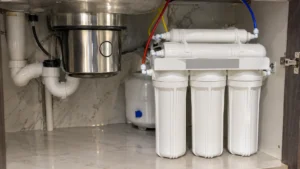
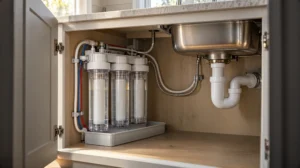
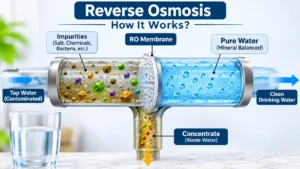
Picture a single glass of water entering the system. It leaves your cold water line through a small feed valve and goes straight into the sediment filter. From there it moves through the carbon filter, then reaches the membrane, which is where the real separation happens. The membrane splits the flow in two. Clean water, called permeate, heads to the storage tank. The leftover water, now loaded with the rejected minerals and contaminants, flows down the drain line. When you open the RO faucet, tank pressure pushes the stored water through the post-carbon filter and out to your glass.
That is the short version of how the stages of the reverse osmosis system work together, and the order is not random. Sediment comes first because a clogged carbon filter does its job poorly. Carbon comes before the membrane because chlorine slowly breaks down the thin membrane layer. The polishing filter sits after the tank because stored water can pick up a faint stale taste while it waits for you. Swap the order, and something downstream pays for it.
The Pre-Filtration Stages
The first stages work like bodyguards. They never do the headline job, but the membrane would not last long without them.
Stage 1: The Sediment Filter
This filter is a physical screen, usually rated around 5 microns. It catches grit, sand, silt, and rust flakes from aging pipes. A sediment cartridge that turns brown after a few months is doing exactly what it should.
Skip it, or leave it in for too long, and the particles move downstream. They can plug the carbon block and scratch or foul the membrane surface. Homes that see water main repairs, nearby construction, or older plumbing often load this cartridge faster than the usual schedule predicts. If your faucet flow slows down, check this one first.
Stage 2 and 3: The Carbon Pre-Filters
Activated carbon grabs chlorine, chloramines, and many organic chemicals that cause bad taste and odor. In a basic system, one carbon cartridge handles this job. In a five-stage setup, the work is split between granular carbon and a carbon block, which gives the water more contact time and spreads the load across two cartridges.
Here is why this matters. Most home RO membranes are thin-film composite, and chlorine wears that material down over time. The carbon stage is the membrane’s best insurance policy. Some water suppliers disinfect with chloramine instead of plain chlorine, and chloramine is harder for ordinary carbon to catch. If that applies to you, ask about catalytic carbon or a longer carbon stage. Your supplier’s yearly water quality report will tell you which disinfectant is in use.
The RO Membrane: The Stage Doing the Heavy Lifting
The membrane is a semi-permeable sheet with pores around 0.0001 microns, small enough that water molecules slip through while most dissolved solids cannot. Reverse osmosis works by using pressure to push water the opposite way it would naturally move, which is where the name comes from. This stage handles dissolved salts, many heavy metals such as lead, fluoride, nitrates, and much of the total dissolved solids (TDS) in your water. One small detail worth knowing: arsenic removal depends on its chemical form, and RO handles the pentavalent form much better, so a test result matters if arsenic is your concern.
Pressure matters more than most people expect. Many under-sink systems work best with household pressure somewhere around 50 to 60 psi or higher. When pressure drops well below that, the tank fills slowly and more water goes down the drain. A booster pump can fix this in low-pressure homes. And yes, waste water is real. A conventional system sends several gallons to the drain for every gallon it stores, depending on pressure and design. That is the cost of carrying rejected contaminants away so they never build up on the membrane.
The Storage Tank and the Post-Carbon Polishing Stage
RO makes water slowly, a little at a time, so the system keeps a small tank under the sink to have water ready when you open the faucet. The tank holds treated water under air pressure, which is what pushes it to the faucet.
The last cartridge, the post-carbon filter, is the final checkpoint. It removes any lingering taste or odor picked up in the tank and the tubing. This explains a common puzzle. If your water suddenly tastes off but the membrane is healthy, the culprit is often an overdue post-filter or an old tank that needs attention, not a failing membrane.
Optional Extra Stages: Remineralization and UV
Some systems go beyond the basics. Whether you need them depends on your water and your preferences, so here is the honest version.
- Remineralization adds calcium and magnesium back after the membrane, which raises the pH slightly and softens that flat taste some people notice. It is a taste upgrade, not a health requirement. Most of the minerals you take in come from food.
- UV treatment uses a lamp to neutralize bacteria and viruses. It makes sense for private wells or any supply where microbes are a real concern. It does nothing about chemicals, and the lamp needs replacing about once a year. City water that is already disinfected rarely needs it.
- Deionization (DI) strips the last traces of ions and suits aquariums and lab work. For drinking water at home, it is usually overkill.
3, 4, 5 or 6 Stages: Which One Fits Your Water?
More stages do not automatically mean cleaner water. Match the setup to the problem you actually have.
| Your situation | Setup that tends to fit | Why |
| City water, mainly chlorine taste | 3 or 4 stages | Sediment, carbon, membrane, and a polish handle it |
| Visible grit or older pipes | 4 or 5 stages with a stronger sediment step | Protects the carbon and membrane |
| Chloramine in your supply | 5 stages with catalytic carbon | Better chemical removal before the membrane |
| Private well with microbe concerns | Add a UV stage | Targets bacteria and viruses |
| Water tastes flat after RO | Add remineralization | Restores a rounder taste |
So when someone asks about the stages of a reverse osmosis system, the real answer is that stage count is a design choice, not a quality score. A well-matched four-stage unit often beats a poorly matched seven-stage one.
What the Stages Mean for Tracy and Central Valley Homes
Homes in Tracy are on a municipal supply, and Central Valley tap water generally carries a noticeable mineral load. That means the membrane has plenty of dissolved solids to reject, so keeping the early stages fresh matters. Heavier mineral content also means scale can build up faster on the membrane surface if prefilters are neglected. RO Water Filter System typically recommends starting with your city’s annual water quality report, which lists the disinfectant used and the contaminants detected, so you can pick stages based on real data instead of guesswork.
A simple home check helps too. A handheld TDS meter lets you compare tap water with RO water. A healthy membrane normally rejects the large majority of dissolved solids. When the gap between the two readings starts to shrink, the membrane is telling you something.
Signs a Stage Is Wearing Out
Your system usually gives hints before it fails. Intervals below are general ranges, and your manufacturer’s guidance and water quality will adjust them.
| Symptom | Likely stage | What to do | Typical interval |
| Slow flow, brown cartridge | Sediment filter | Replace the cartridge | 6 to 12 months |
| Chlorine smell or taste returns | Carbon pre-filter | Replace the carbon cartridge | 6 to 12 months |
| TDS creeping up, salty taste | Membrane | Test, then replace if needed | 2 to 5 years |
| Stale taste at the faucet | Post-carbon filter | Replace the polishing filter | About 12 months |
| Tank empties fast | Storage tank | Have the air pressure checked | As needed |
Common Mistakes People Make With RO Stages
- Stretching prefilter changes. Old sediment and carbon cartridges push the cost onto the membrane, which is the priciest part.
- Judging a system by stage count. A longer list of stages on the box says little about how well it fits your water.
- Ignoring water pressure. Low pressure quietly cuts output and raises waste, and people often blame the filters.
- Mixing random cartridges. Mismatched sizes or ratings can leak, bypass, or underperform. Use cartridges made for your model.
- Never sanitizing the system. A yearly sanitization during filter changes keeps the tank and tubing fresh.
Final Thoughts
Understanding the stages of a reverse osmosis system makes ownership far less mysterious. Every cartridge has one job: the early ones protect the membrane, the membrane cleans the water, and the last one polishes the taste. Keep them on schedule, and the whole system runs the way it was designed to.
If you want help choosing the right setup or servicing the one you have, RO Water Filter System is happy to look at your water and your space. You can read more about our Reverse Osmosis Water Filter Tracy, CA options or see how RO System Installation in Tracy, CA works. Contact us anytime and we will walk you through the next step.
FAQs
Is a 5-stage RO system better than a 3-stage one?
Not automatically. A 5-stage system adds extra carbon or conditioning steps, which helps when your tap water has strong chlorine, chloramine, or sediment problems. If your water is fairly clean, a well-built 3-stage or 4-stage system can perform just as well for drinking water.
Which stage removes chlorine?
The carbon pre-filter does most of the chlorine removal, and it sits ahead of the membrane on purpose. Chlorine can damage the membrane over time, so catching it early protects the most expensive part of the system. The post-carbon filter then cleans up any leftover taste.
How long does each stage last?
Sediment and carbon pre-filters usually need changing every 6 to 12 months, while the post-carbon filter is typically changed once a year. The membrane often lasts two to five years. Your actual schedule depends on water quality and the manufacturer’s guidance.
Do I need a remineralization stage?
It is optional. RO removes most minerals, so some people find the water tastes flat and add a remineralization cartridge for a smoother flavor. Most of your daily minerals come from food, so this stage is about taste more than nutrition.
Can I skip a stage to save money?
Skipping the sediment or carbon pre-filter is the most expensive shortcut, because it exposes the membrane to clogging and chlorine damage. The membrane may fail far sooner than it should. If you want to simplify, ask a technician for a setup that fits your water instead of pulling cartridges yourself.