You’re wondering: does deionized water expire, or is it still good to use? It’s a question we hear constantly from Tracy, CA homeowners who run an RO system at home and end up with extra purified water on hand. At RO Water Filter System, we’ve tested enough stored water to know the honest answer isn’t a simple yes or no.
Most articles about deionized water tend to focus on its effects in laboratory settings rather than for consumers with gallon jugs under their kitchen sinks. Though its chemical components remain unchanged, what it actually means in your home environment and climate may differ significantly here’s an insight into what happens as you let deionized water sit around for awhile and when to start making more.
What Deionized Water Actually Is
Deionized water, often called DI water, is water that’s had nearly all its charged particles stripped out using ion exchange resin. The resin swaps minerals like calcium, magnesium, and sodium for hydrogen and hydroxide ions, which then bond together as more water. What’s left is pure water with extremely low conductivity and a near neutral pH level.
This is different from reverse osmosis, even though people use the terms interchangeably. RO pushes water through a membrane that physically filters out contaminants. Deionization removes them through a chemical swap instead.
If you’re trying to pin down what’s deionized water in plain terms, think of it as water with almost nothing left in it except H2O. Freshly made, it’s about as high quality and purified water as you can get without lab equipment.
Does Deionized Water Expire?
Here’s the short answer: does deionized water expire the way milk or bread does? No. There’s no bacteria breaking it down and no expiration date stamped on it that means much chemically. But DI water doesn’t stay deionized forever either. The second it’s exposed to open air, it starts pulling in carbon dioxide and slowly drifting away from its purest state.
So the real question isn’t whether it goes bad. It’s whether it’s still pure enough for what you’re using it for. Water that’s absorbed some CO2 is still safe to touch and usually still safe to drink.
It’s just no longer deionized in the strict sense. For lab work or a CPAP machine, that distinction matters. For topping off a fish tank, it usually doesn’t.
Why Deionized Water Changes the Longer It Sits
Carbon Dioxide Absorption and pH Level
Open a container of DI water and leave it out, and carbon dioxide from the air starts dissolving into it almost immediately. CO2 reacts with water to form a weak acid, which lowers the pH level and raises conductivity. This is the main reason ultra-pure water doesn’t stay ultra-pure once it’s exposed to open air.
Conductivity Change Explained
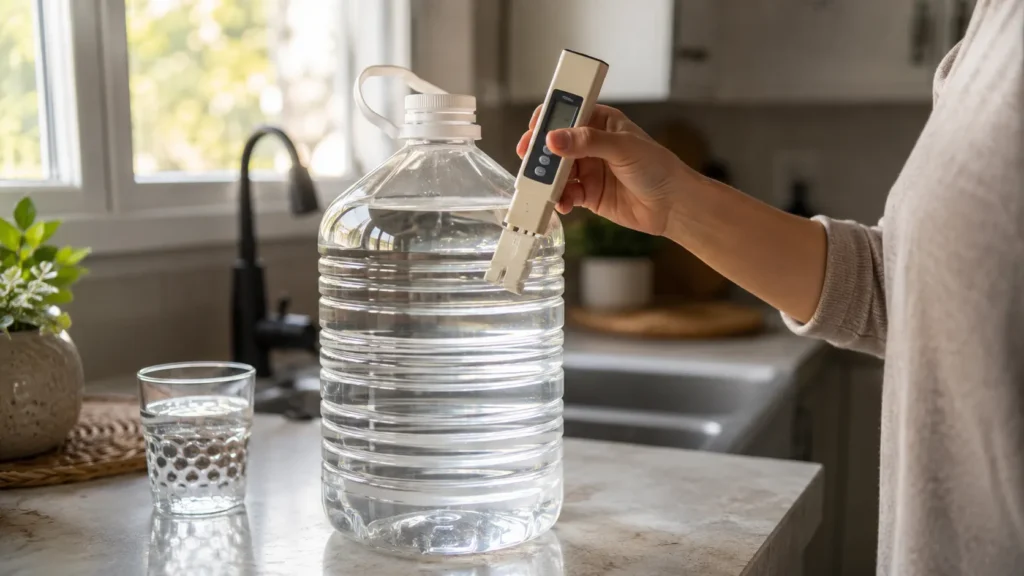
Conductivity is how labs measure DI water purity. Freshly deionized water has resistivity near 18 megohms. That number drops fast once the water is exposed to air. You won’t notice this with your eyes or hands at home. You’d need a TDS meter or conductivity meter to actually catch it.
Bacterial Growth in Reused Containers
DI water itself doesn’t feed bacteria, since there’s nothing left in it for microbes to eat. But the container is a different story. Reuse an old milk jug or a bottle that wasn’t cleaned properly, and bacterial growth can happen inside it, even if the water started out completely pure. This is almost always about the container, not the water.
Distilled Water vs. Deionized Water: Does It Matter for Storage?
Distilled water and deionized water often get lumped together, and for storage purposes, they behave almost the same. Distillation removes minerals through evaporation and condensation.
Deionization removes them through ion exchange resin instead. Both end up as pure water with very little dissolved content, and both will slowly pick up carbon dioxide and trace impurities once exposed to air.
If you’ve also wondered about does water expire in a broader sense, tap water and bottled water follow a similar pattern of gradual change rather than a hard cutoff. The container and storage conditions usually matter more than which purification method made the water in the first place.
Is DI Water Safe to Drink?
Is di water safe to drink in small amounts? Yes, plenty of people do it without any issue. The real debate is whether you should drink it regularly.
Can You Drink Deionized Water Every Day?
Can you drink deionized water as your main source long term? Most water treatment professionals, including our team, don’t recommend it. DI water has no minerals left in it, and your body does pull some calcium, magnesium, and trace minerals from drinking water over time.
Drink it occasionally and you’re fine. Make it your only water source for months, and it tends to taste flat, and you lose out on the small mineral contribution your daily water normally provides.
If you run an RO system at home and want water with some mineral character for everyday drinking, this guide on how to remineralize reverse osmosis water walks through how that works.
How Long Can You Store Deionized Water at Home?
There’s no universal shelf life stamped on a jug of DI water. How long it stays usable depends almost entirely on three things: the container, the seal, and the temperature where you store it.
| Storage Container | Typical Stability | Why |
|---|---|---|
| HDPE plastic (sealed) | Several months to a year | Doesn’t leach chemicals, holds a tight seal |
| Glass (sealed, dark) | A year or more | Chemically inert, but breakable |
| Stainless steel | Longest, multi-year | Heavy duty, common in industrial storage |
| Open or reused containers | Days to a few weeks | Fast CO2 absorption and contamination risk |
A few habits shorten that shelf life fast:
- Leaving the cap loose or off the container
- Storing it in direct sunlight or a hot garage
- Reusing a container that previously held something else
- Opening and closing it repeatedly for small amounts
How to Store Deionized Water the Right Way
- Use a sealed, airtight container, ideally HDPE plastic, glass, or stainless steel
- Keep it in a cool, dark spot, not a hot garage or a sunny windowsill
- Avoid reusing containers that held food, soap, or chemicals
- Label the container with the date you filled it
- Pour out only what you need instead of opening it repeatedly
Follow these steps and you can extend the shelf life of stored DI water by months. Skip them, and you’re looking at pH drift and contamination within weeks instead.
Common Deionized Water Uses Around the Home
Most deionized water uses around the house come down to one thing: appliances and hobbies that hate mineral buildup.
- Steam irons and humidifiers, to prevent white mineral residue
- Aquariums and reef tanks, for precise water chemistry
- Car batteries and vehicle cooling systems
- CPAP machines
- Watering sensitive houseplants
- Mixing cleaning solutions where mineral spotting is a problem
These deionized water uses all share one thing in common. They care about what’s not in the water. Minerals cause buildup, spotting, or chemical interference, and DI water sidesteps all of it.
Signs Your Stored DI Water Isn’t Worth Using Anymore
- Cloudy or discolored appearance
- Any off smell, even a faint one
- A container that’s cracked, swollen, or no longer sealing tightly
- It’s been open and exposed to air for more than a few weeks
- A TDS or conductivity reading well above what it was when you filled it
None of these mean the water turned dangerous overnight. They mean it’s no longer doing the job you bought it for. When in doubt, it’s cheap enough to just make a fresh batch.
When Fresh RO Water Beats Stored DI Water
If you keep buying jugs of DI water for household use, that’s usually a sign a dedicated system would serve you better. Stored water always has a slow clock running on its purity. A system that makes it fresh on demand doesn’t.
This is exactly what we help homeowners with at RO Water Filter System. Whether you need water for drinking or something closer to lab-grade purity for hobbies and appliances, a properly sized Water Purification System in Tracy, CA removes the guesswork around storage and contamination entirely. For households mainly focused on tap water quality at the kitchen sink, our Drinking Water Filtration in Tracy, CA service covers that without any of the extra steps DI water requires.
Conclusion
Deionized water doesn’t “expire”, per se; but over time its purity may diminish with carbon dioxide emissions, heat exposure, sunlight exposure, container usage and container quality all having an effect. For most household purposes slightly aged DI water should still work just fine; for any sensitive applications like CPAP machines or reef tanks however fresher is always preferable.
If you’re tired of guessing how old your water is, or you’d rather have a system that produces pure water on demand instead of stockpiling jugs, RO Water Filter System has helped Tracy area homeowners get this right for years. Reach out to our team, and we’ll help you figure out exactly what your household actually needs.
FAQs
Can you drink deionized water straight from a stored jug?
Yes, in small amounts it’s generally fine. It isn’t toxic, but it lacks minerals, so it isn’t the best choice as your only daily water source.
Is DI water safe to drink for kids?
Occasional use is fine for kids too. For regular drinking, lightly remineralized water is usually the better long-term choice for growing bodies.
What’s deionized water used for most in homes?
Most households use it for steam irons, humidifiers, aquariums, and car batteries. Mineral buildup causes more problems in these than almost anywhere else in the house.
Does deionized water expire faster in hot weather, like a Central Valley summer?
Yes. Heat speeds up the chemical changes that affect DI water purity, so a hot garage in a place like Tracy will shorten its usable shelf life compared to a cool, dark closet.
Can I just keep refilling the same bottle with deionized water?
You can, but rinse it well and let it dry completely between fills. Reused bottles are the most common reason stored DI water picks up contamination faster than expected.