It is not something to disregard if your water test reveals arsenic. Long-term health may be impacted by even minute amounts over time, particularly for kids and families that use well water. Many households begin looking best water filter for arsenic removal, but they soon encounter unclear recommendations and inadequate solutions.
Most competitor guides list filters without explaining when each one works or fails. They rarely address real homeowner situations like well water conditions, pre-treatment needs, or local groundwater risks in areas like Tracy, CA. This guide from RO Water Filter System focuses on practical, real-world decisions so you can choose a solution that actually protects your household.
Why Arsenic in Drinking Water Is a Serious Problem
Arsenic is an element found naturally in soil and rock that enters groundwater as it moves through it, with private well owners bearing an increased exposure risk than the general public due to agriculture runoff and older pesticide use.
The Environmental Protection Agency has set the maximum contaminant level (MCL) of arsenic in drinking water at 10 parts per billion (ppb), but health researchers and environmental activist organizations such as Environmental Working Group argue that even lower concentrations pose long-term health risks when exposed for extended periods. Chronic exposure has been linked with cancer of bladder, lung and skin as well as cardiovascular and neurological illnesses over time.
Pregnant women, families with small children or newborns, and anybody with weakened immune systems are considerably more at risk.
The Two Forms of Arsenic in Water (and Why It Matters)
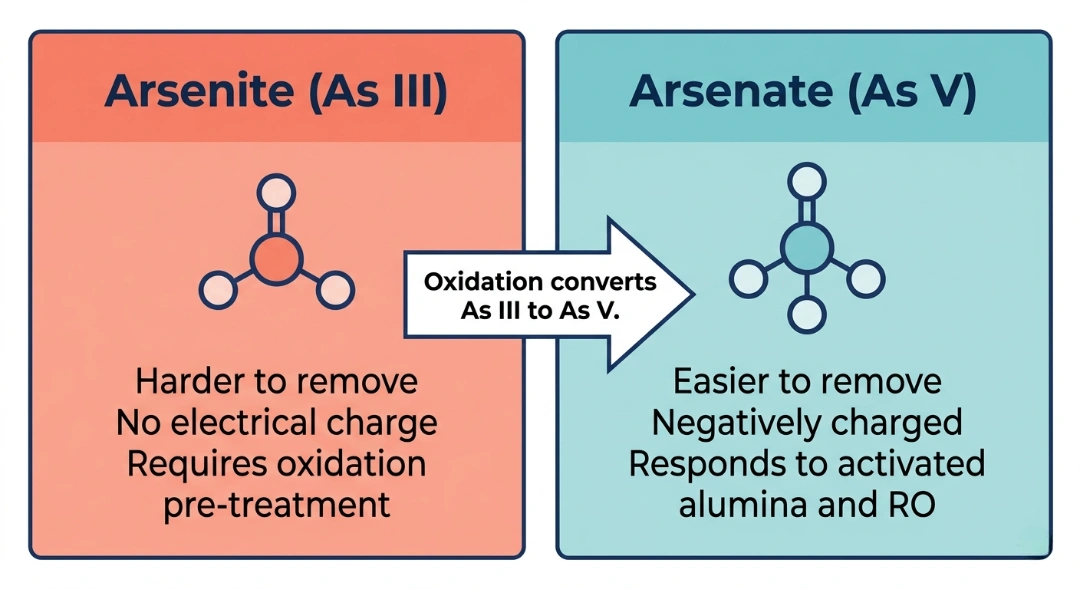
You should be aware that there are two chemical types of arsenic before selecting a water filter for arsenic removal.
Arsenite (As III) is the reduced form. It carries no electrical charge, which makes it harder to capture with most filtration media. It is more toxic and more difficult to remove.
Arsenate (As V) is the oxidized form. It carries a negative charge and binds much more readily to filter media like activated alumina and iron oxide.
Arsenate is far more efficiently removed by the majority of water treatment systems. Your system will need an oxidation pre-treatment phase to convert any considerable arsenite in your water before filtration. You may determine which type predominates in your supply with a certified water test.
Water Filter Technologies That Actually Remove Arsenic
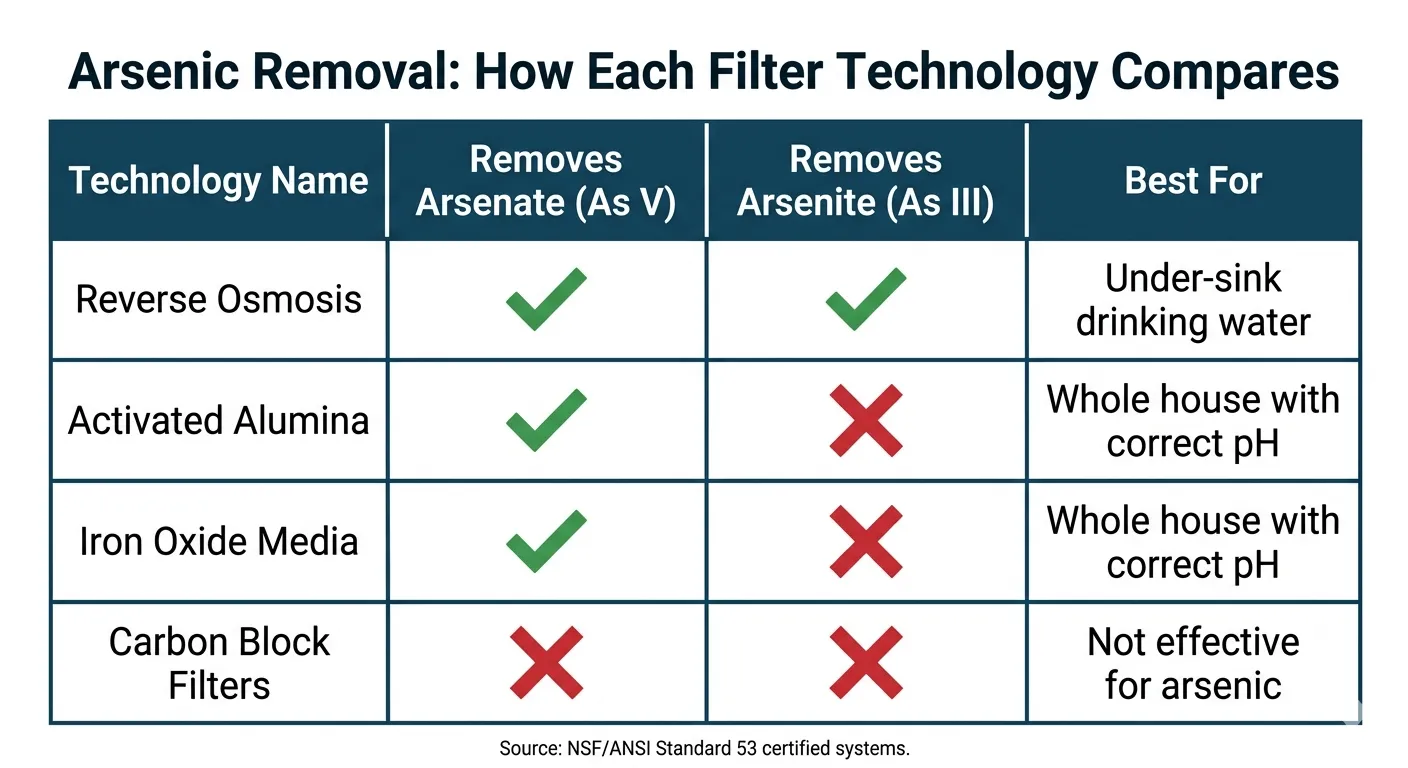
When it comes to arsenic, not all filters are created equal. This is what real-world performance and science really support.
Reverse Osmosis
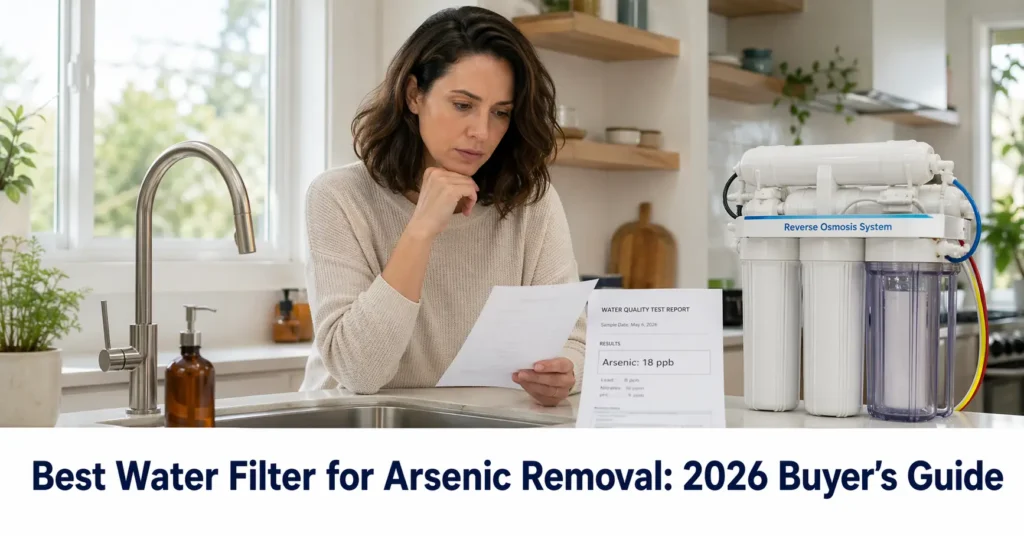
Reverse osmosis (RO) is one of the most effective and proven methods for removing arsenic from drinking water at the point of use. A quality RO membrane can reduce arsenic levels by 90 to 99 percent depending on the system design, water chemistry, and incoming concentration.
For most homeowners dealing with arsenic-contaminated well water, an under-sink RO system is the most practical and cost-effective starting point for drinking and cooking water. A 7-stage system or a 10-stage water filtration system provides additional layers of filtration that further reduce total arsenic and other co-contaminants that often appear alongside it, such as iron, manganese, and nitrates.
One important note: RO systems remove minerals broadly. If your household has a water softener already in place, that pre-treatment can actually help RO performance for arsenic by reducing competing ions in the water.
Activated Alumina
Activated alumina is an adsorptive media with an extremely large surface area which attracts arsenate through chemical attraction, making it one of the most widely utilized media in arsenic water treatment systems and recognized under NSF/ANSI Standard 53 for arsenic reduction.
Performance for this media is at its optimal between pH 5.5 to 6.0; hence it should only be relied upon if water chemistry can support its use. In addition, regeneration or replacement should occur periodically depending on volumetric flow rate and arsenic load.
Iron Oxide and Adsorptive Media
Iron oxide-coated media and specialty adsorptive materials are increasingly common in arsenic water filtration systems, particularly in whole house point of entry configurations. These media attract and hold arsenate ions through a surface binding process similar to activated alumina but often with higher capacity at neutral pH levels.
Manganese greensand is another option occasionally used in conjunction with oxidation for removing arsenite that has been converted to arsenate through pre-treatment.
What Doesn’t Work Well
Standard carbon block filters and pitcher filters do not reliably eliminate arsenic. While carbon can effectively remove chlorine, taste, and some organic compounds from water sources, arsenic does not adsorb to carbon media in any meaningful manner, meaning if your primary protection against arsenic comes from using your countertop or refrigerator carbon filter as your only line of defense, your protection could be inadequate.
Distillation water does an effective job at eliminating arsenic from tap water, yet home distillers are impractical for daily household use due to slow production rates and energy requirements.
Best Water Filters for Arsenic Removal 2026 Comparison
Water filter for arsenic the right system depends on your arsenic level, water source, household size, and whether you need treatment at one tap or throughout the entire home. The five systems below represent the most reliable options across different use cases based on NSF certification, removal rates, and real-world performance data.
| Product | Type | Arsenic Removal | NSF Cert | Price Range |
|---|---|---|---|---|
| Countertop RO | Point of Use | 96–99% | NSF 58 + 53 | $300–$400 |
| RCC7AK | Under-Sink RO | 95–98% | NSF 58 | $200–$300 |
| AD-26 | Whole House | 99%+ | NSF 61 | $800–$1,200 |
| Arsenic WH | Whole House | 95–99% | NSF 61 | $600–$900 |
| ROALK10D | Under-Sink RO | 93–97% | NSF 58 | $150–$250 |
Point of Use vs. Point of Entry: Which One Do You Need?
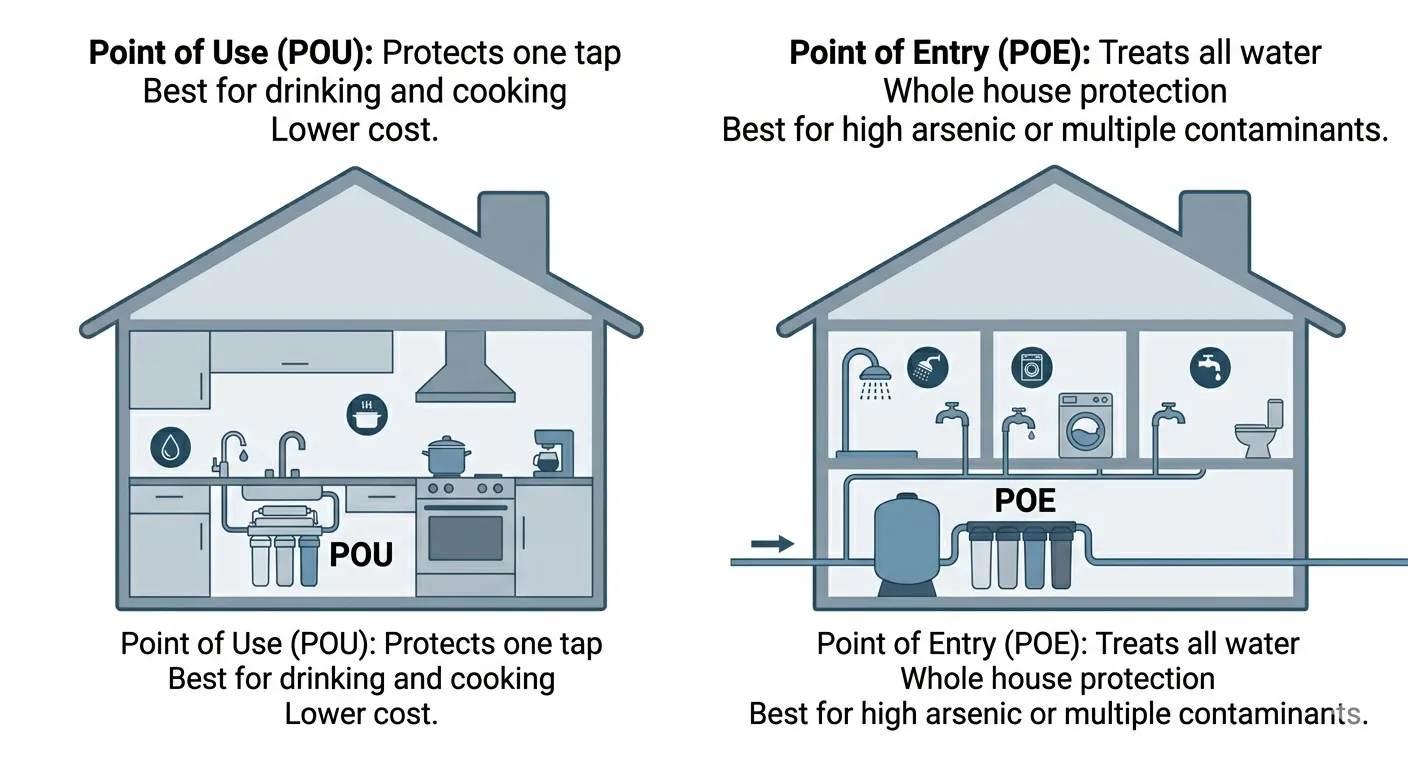
Almost all homeowners who deal with the removal of arsenic from well water have this question.
POU (point-of-use) systems such as under sink RO units provide water purification at one specific tap for drinking and cooking use; making these installations much simpler to set up and maintain than their larger counterparts; they’re often the ideal starting point for many households looking for clean drinking/cooking water sources.
Point-of-entry (POE) systems treat all water entering the home before it reaches any tap, shower, or appliance. These are whole-house systems, and they make sense when arsenic levels are very high, when you have additional co-contaminants that affect bathing water, or when you need to protect plumbing fixtures from iron and manganese alongside arsenic.
For most Tracy area homeowners on well water with moderate arsenic contamination and a standard family of two to five people, a high-stage under-sink RO unit installed at the kitchen sink covers daily drinking and cooking needs at a reasonable cost. If arsenic levels are above 25 to 30 ppb, or if a water test shows multiple contaminants, a whole-house approach through a Water Purification System becomes the stronger option.
How to Know What You’re Actually Dealing With Before You Buy
Buying any water filter for arsenic removal system without a current lab test is a mistake. You need to know:
- Total arsenic level in ppb
- Whether you have primarily arsenite (As III) or arsenate (As V)
- Water pH, because it affects which media performs best
- Presence of co-contaminants like iron, manganese, fluoride, or nitrates
- Flow rate and water hardness if you’re considering a whole-house system
A certified water test from a state-accredited laboratory will typically cost between $30 and $150 depending on how many parameters you include. Many counties in California offer low-cost testing resources for private well owners. This test result is the single most important input for choosing the right system.
What to Look for in Any Arsenic Removal Filter System
When evaluating arsenic water treatment systems, focus on these factors.
NSF/ANSI Standard 53 certification is the benchmark for contaminant reduction claims. Any system you consider should have this certification specifically for arsenic reduction. Do not assume certification for one contaminant extends to arsenic.
Tested influent concentration matters because certifications are often granted based on testing at specific input levels, such as 50 ppb. If your water has 15 ppb, a system certified at 50 ppb will likely perform well. But always confirm this with the manufacturer.
Membrane and media replacement schedules affect long-term performance. RO membranes typically last two to three years. Pre-filters and post-filters require annual replacement. Adsorptive media in whole-house units has a finite capacity and must be replaced or regenerated based on water volume processed.
Flow rate compatibility is especially important for whole-house systems. A system rated for 6 gallons per minute may underperform in a household that regularly draws water from multiple sources simultaneously.
Common Buying Mistakes Homeowners Make
Many homeowners waste money on systems that do not solve the problem.
Avoid these mistakes
- Choosing a basic carbon filter
- Skipping water testing
- Ignoring arsenite vs arsenate
- Not considering pre-treatment
- Buying undersized systems
A proper arsenic water treatment systems setup must match your exact water chemistry.
Maintenance: What to Expect After Installation
Arsenic filter systems are not install-and-forget. Here is what regular ownership looks like.
Maintenance
Expect:
- Filter changes every 6 to 12 months
- RO membrane replacement every 2 to 3 years
- Periodic water testing
Regular upkeep ensures your water filter for arsenic continues to perform as expected. If you’re also curious about other water treatment terms that come up during this process, understanding what is deionized water can help clarify how different purification methods compare.
Conclusion
Finding water filter for arsenic removal doesn’t boil down to selecting one from among many popular options; rather it requires understanding your water, recognizing which form it takes and selecting an effective system tailored specifically towards its conditions in your home environment.
Your water test shows arsenic or you rely on well water in Tracy, CA, it is worth getting expert guidance. The team at RO Water Filter System can help you evaluate your water and recommend a system that actually works for your household. Reach out to get a proper solution instead of guessing.
FAQs
How do I know if my water has arsenic?
You need a certified lab test. Arsenic cannot be detected by taste, smell, or color, so testing is the only reliable method.
Does boiling water remove arsenic?
No. Boiling can actually increase arsenic concentration because water evaporates while arsenic stays behind.
Is reverse osmosis enough for arsenic removal?
In many cases yes, but not always. If arsenite is present or water has iron, pre-treatment may be required.
What is the safest level of arsenic in drinking water?
The EPA limit is 10 ppb, but many homeowners aim for levels as close to zero as possible for safety.
Do whole house filters remove arsenic completely?
They reduce arsenic significantly, but many homes still use reverse osmosis at the tap for drinking water to ensure maximum safety.