If your water smells of rotten eggs or leaves rust stains on fixtures, or has bacteria and viruses present, these are real issues in Tracy, CA and its surrounding areas. Ozone water treatment offers one solution which addresses them all without adding chlorine or any other chemical into the environment, this includes our RO Water Filter System that assists homeowners to understand their issues more fully in order to make informed treatment decisions.
Most articles on this topic either go too deep into industrial chemistry or stay too shallow to be genuinely useful. This guide hits the middle ground. You will learn exactly how ozone works, what it can and cannot do, how home systems are set up, and how to tell whether ozone is the right fit for your situation.
What Is Ozone and Why Does It Matter for Water?
Ozone, also referred to as oxygen trioxide (O3) is an unstable form of oxygen with three oxygen atoms bonded together, making ozone chemically unsteady but ideal for water purification applications. This extra atom renders it chemically inert. This instability makes ozone useful as an ingredient used in purifying processes like disinfecting wastewater systems or producing biogas for powering cars and airplanes.
Ozone always seeks to lose its third oxygen atom due to its instability. When it happens, that liberated atom assaults the first thing it comes into contact with, whether it is a sulfur complex, an iron molecule, a virus, or a bacteria. Ozone is a potent oxidizing agent because of this. It reacts quickly, dissolves impurities, and then transforms back into oxygen. Not a trace of chemicals. Nothing remains.
How Ozone Water Treatment Works: Step by Step
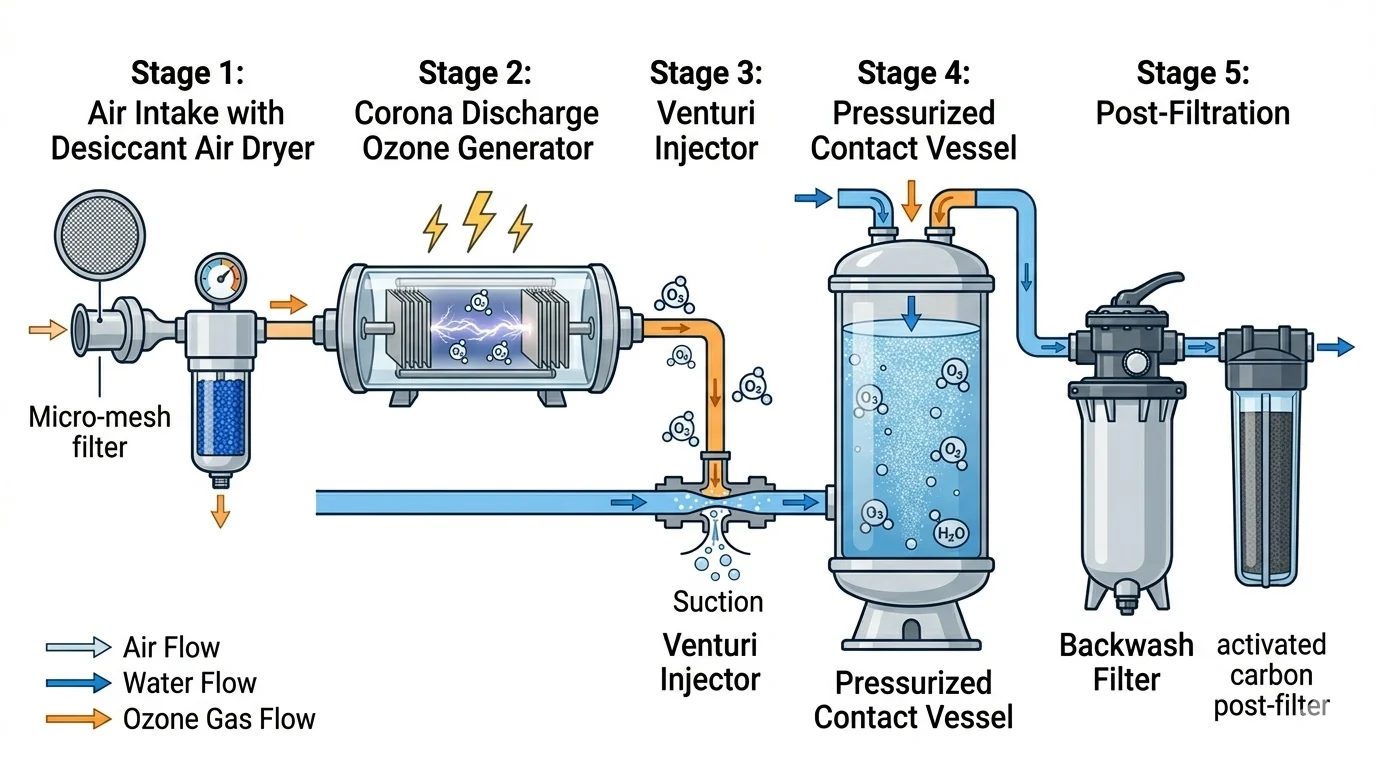
Knowing the procedure enables you to make more informed purchasing decisions. This is the general operation of an ozone water system.
Step 1: Ozone Generation
Ozone cannot be stored or transported. It must be made on-site, right where it will be used. There are two main ways ozone generators produce ozone.
Corona discharge is the most common method for home and commercial systems. It passes dry, filtered air through a high-voltage electrical field inside a ceramic or stainless steel cell. This is the same basic process as a lightning strike, which is why you sometimes smell that sharp, clean scent in the air after a storm. The electrical energy splits oxygen molecules, and the free oxygen atoms temporarily bond with other O2 molecules to form O3.
UV light generation uses high-intensity ultraviolet lamps to split oxygen molecules and create ozone. UV light can produce low levels of ozone and works well for removing slight odors, but it should not be relied on for full disinfection purposes. Corona discharge is the better choice when bacteria or heavy contamination is the main concern.
Step 2: Injecting Ozone Into the Water
Ozone must effectively enter the water once it is produced. Instead of just bubbling the ozone into an open storage tank, where the majority of the ozone escapes before it can react, it is much preferable to draw in the ozone using a venturi injector into a pressurized contact tank at 40 to 50 PSI for optimal ozone transfer.
The venturi creates a vacuum that pulls ozone gas directly into the water stream. The pressurized contact vessel then holds the ozonated water long enough for the ozone to react fully with contaminants. This contact time is critical. Without enough time in the vessel, pathogens may not be fully inactivated.
Step 3: Reaction and Oxidation
Inside the contact vessel, ozone goes to work. It oxidizes iron and manganese, turning them from dissolved metals into solid particles that can be filtered out. It destroys bacteria and viruses through direct cell damage. It breaks apart sulfur compounds that cause bad odors. It also attacks organic micropollutants and other compounds that affect taste and smell.
Iron and manganese may be oxidized by ozone disinfection producing insoluble metal oxides that are simple to filter out. It also improves the flavor and odor of the water while eliminating germs and viruses.
Step 4: Filtration of Oxidized Particles
After ozone reacts with metals and other contaminants, the solid particles that remain need to be physically removed. These insoluble particles are then removed by filtration media such as activated carbon, manganese dioxide, or filter sand.
Activated carbon also plays a second role here. Any residual ozone that did not fully decompose will be removed as water passes through the carbon bed, so there is no ozone left in your drinking water.
Step 5: Treated Water Reaches Your Tap
By the time water exits the system, it has been oxidized, disinfected, filtered, and polished. What comes out is clean, odor-free, and free of chemical residues.
What Ozone Water Treatment Removes
|
Contaminant |
Ozone Effective? | Notes |
|
Bacteria and viruses |
Yes |
Faster and more effective than chlorine |
|
Iron and manganese |
Yes |
Oxidized to solid particles, then filtered |
|
Hydrogen sulfide (sulfur smell) |
Yes | Oxidized and eliminated |
| Cryptosporidium and Giardia | Yes |
These parasites are resistant to chlorine but not to ozone and can be swiftly eliminated fresh water systems |
|
Taste and odor compounds |
Yes | Highly effective |
|
Hard water minerals (calcium, magnesium) |
No |
Requires a water softener |
| Nitrates | Limited |
Not a primary ozone target |
| Heavy metals like lead | Partial |
Needs additional filtration |
This table helps homeowners avoid making an easy homeowner error: expecting one system to cover everything. Ozone works great at disinfection and oxidation, but does not soften water; for this reason if your hard water contains bacteria or iron issues too then both an ozone system and water softener or multi-stage solutions could be necessary for best results.
Real-World Applications: Who Actually Benefits from Ozone Treatment?
Well Water Users in Tracy and the Surrounding Areas
Well water in this region often carries iron, manganese, and hydrogen sulfide. These are natural minerals that leach into groundwater from the surrounding geology. The result is water that smells bad, stains laundry, leaves orange or brown buildup on fixtures, and may carry bacteria from surface contamination or aging casings.
If your well has iron, manganese, odor and bacteria all at the same time, ozone combined with appropriate filtration can provide lasting solutions that are often more cost-effective in the long run than treating each problem separately with chemical additives.
Homeowners Concerned About Waterborne Pathogens
Chlorine-resistant pathogens like Cryptosporidium and Giardia are a real concern for anyone on private well water or older distribution systems. Ozone handles both of these effectively where chlorine falls short.
Restaurants, Cafes, and Small Businesses
Water quality directly affects the taste of food and beverages. Ozone treatment removes the compounds that cause tap water to taste flat or chemically off. For a restaurant in Tracy investing in a Water Purification System, ozone is worth serious consideration as part of a layered treatment approach.
Pool and Spa Owners
Ozone reduces the amount of chlorine needed to keep pool water safe, which means less skin and eye irritation and lower ongoing chemical costs. It does not replace chlorine entirely in pools, but it reduces how much you need.
Agricultural Users
Ozone-treated water increases its dissolved oxygen levels, creating an aerobic environment for plants and potentially improving crop health and reducing pathogen-related losses in farming applications. Particularly beneficial is this solution when dealing with irrigation water quality issues relating to delicate crops that necessitate irrigation water treatment systems containing ozone for irrigation water quality purposes.
Ozone vs. Chlorine: What Homeowners Should Know
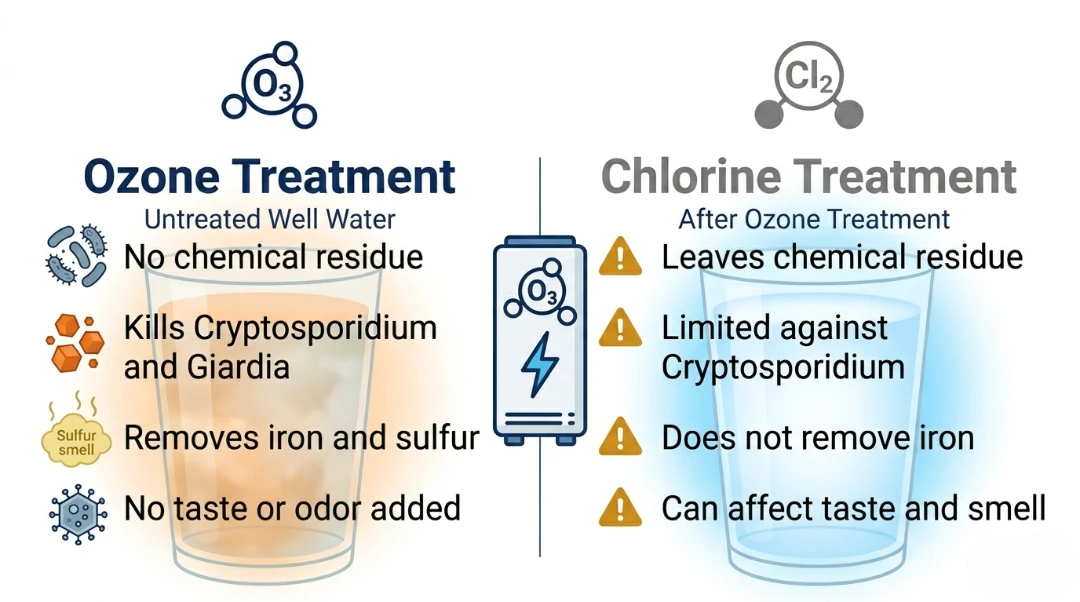
|
Factor |
Ozone | Chlorine |
|
Disinfection speed |
Very fast | Slower |
| Residual in water | None (breaks down to O2) |
Yes (can affect taste/odor) |
|
Chemical byproducts |
None | Can form THMs with organic matter |
| Cryptosporidium/Giardia | Effective |
Not effective |
|
Cost to install |
Higher upfront | Lower upfront |
| Ongoing chemical cost | None |
Ongoing chlorine purchases |
| Iron/manganese removal | Yes |
Limited |
Important Limitations to Know Before You Buy
Ozone is powerful, but it is not magic. Here are the real limitations homeowners should understand.
Ozone does not leave a residual. Once it has done its job, it disappears. This means there is no ongoing protection downstream the way chlorine provides in a distribution line. For a home system, that is usually fine since treatment happens right at the point of entry.
Ozone requires dry air to work efficiently. Moisture creates nitric acid inside corona discharge generators, which reduces ozone output and corrodes equipment over time. This is why a properly sized air dryer is a required part of any quality ozone installation.
Contact time matters. Ozone must be in contact with water long enough to fully inactivate pathogens and oxidize metals. An undersized contact vessel will reduce effectiveness significantly. This is one reason why professional sizing and installation matters more with ozone than with simpler filter systems.
Ozone does not soften water. If hardness is your main issue, check out a 10-Stage Water Filtration System that combines multiple treatment stages to handle a wider range of water quality problems.
Residual ozone safety. It is recommended to wait at least thirty minutes after treatment before drinking the water so any residual ozone has time to convert back into oxygen. A properly installed system with an activated carbon post-filter eliminates this concern automatically.
What Does Ozonated Water Taste Like?
Many homeowners ask themselves this question before investing in an ozonated water system. When properly treated with ozone treatment, water tastes clean and neutral – the goal being to eliminate anything which causes bad taste or odor – such as iron sulfur compounds and organic compounds from filtering out their system; once this has happened many find their water tastes noticeably better and fresher! If you are curious about how water quality affects taste, you can learn more in our article on what does water taste like.
Maintenance: What to Expect After Installation
Ozone systems are generally low-maintenance compared to chemical injection systems, but they are not zero-maintenance.
- The air dryer or desiccant cartridge needs periodic replacement or regeneration, typically annually.
- The ozone generator cell has a lifespan and will eventually need replacement, usually every 3 to 5 years depending on the model and usage.
- Post-filtration media, especially activated carbon, needs to be replaced on schedule to maintain water quality.
- The contact tank should be inspected periodically for buildup or biofilm.
- An annual water test is still recommended to confirm the system is performing as expected.
These maintenance requirements are manageable and comparable to other whole-house filtration systems. The key is not skipping scheduled service.
Conclusion
One of the most effective methods for enhancing water quality across a whole home is ozone water treatment. It eliminates smells, operates quickly, and addresses issues that conventional filters are unable to resolve on their own. When properly constructed, it can turn dirty water into clean, usable water for daily needs.
Those living in Tracy, California experiencing persistent water issues should explore all possible solutions available to them. At RO Water Filter System in Tracy we can assist in testing the quality of water available and selecting and installing an ideal filter system, taking this next step can save ongoing problems as well as provide peace of mind every time water enters or leaves your body. Contact us now could save both time and energy later down the line!
FAQs
Is ozone water treatment safe for drinking water?
Yes, ozone water treatment is safe when the system is properly designed and installed. Ozone breaks down into plain oxygen after disinfection, leaving no chemical residue in your water.
How long does an ozone system for water treatment last?
A well-maintained ozone system can last 10 to 15 years or more. The ozone generator cell typically needs replacement every 3 to 5 years, and filtration media requires scheduled replacement.
Can ozone and water treatment work together with a reverse osmosis system?
Yes, and this combination is highly effective. Ozone handles disinfection, iron, manganese, and sulfur at the point of entry to your home.
Will an ozone water system remove the rotten egg smell from well water?
In most cases, yes. The sulfur smell in well water comes from hydrogen sulfide gas. Ozone oxidizes hydrogen sulfide rapidly, converting it into a form that can be filtered out.
Does ozone water treatment work for city water, or is it only for well water?
Ozone works for both. Well water users benefit most because of the combination of bacteria, iron, and sulfur issues common in private wells. City water users can also benefit from ozone as an added layer of protection, removing residual chlorine taste, trace organic compounds, and any pathogens that make it through the municipal treatment process.