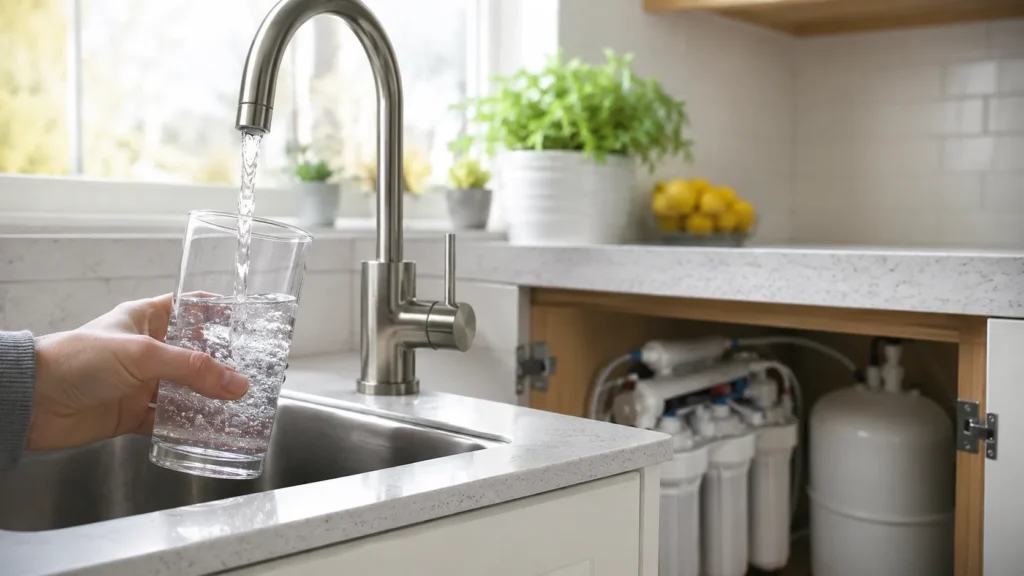
The question is, do water filters remove bacteria? There is a simple yes or no. Most water filters do not remove bacteria. Standard carbon filters, pitcher filters, and basic faucet attachments are built to improve taste and reduce chlorine. They are not designed to block or kill bacteria in your drinking water.
If you’re on well water or if you’ve had any concerns about your local water supply, this matters a lot. At RO Water Filter System, we’ve been answering this exact question for homeowners across California for over 15 years. Here’s the real answer.
Do Water Filters Remove Bacteria? It Depends on the Filter
Not all filters are built the same. A basic carbon block or pitcher filter is designed to improve taste and reduce chlorine. Bacteria? That’s a different story. Whether a filter can remove bacteria comes down to one thing: pore size.
Bacteria range from about 0.2 to 2 microns in size. For a filter to physically block bacteria, its pores need to be smaller than that. Most standard filters don’t meet that threshold. Here’s a quick breakdown:
|
Filter Type |
Removes Bacteria? | Notes |
| Activated carbon (pitcher, faucet) | No |
Improves taste, not bacteria |
|
Sediment filter |
No | Removes particles, not microbes |
| Ceramic filter | Yes (most strains) |
Pore size typically 0.2 to 0.5 microns |
| Reverse osmosis (RO) | Yes | Membrane removes bacteria and more |
|
UV light purifier |
Yes (kills, not removes) |
Disables bacteria but doesn’t filter them out |
|
Ultrafiltration (UF) |
Yes |
Effective at 0.01 to 0.1 microns |
The honest takeaway here is that most common household filters do not remove bacteria. If that’s your main concern, you need to know specifically what your system is rated for.
Do Carbon Water Filters Remove Bacteria?
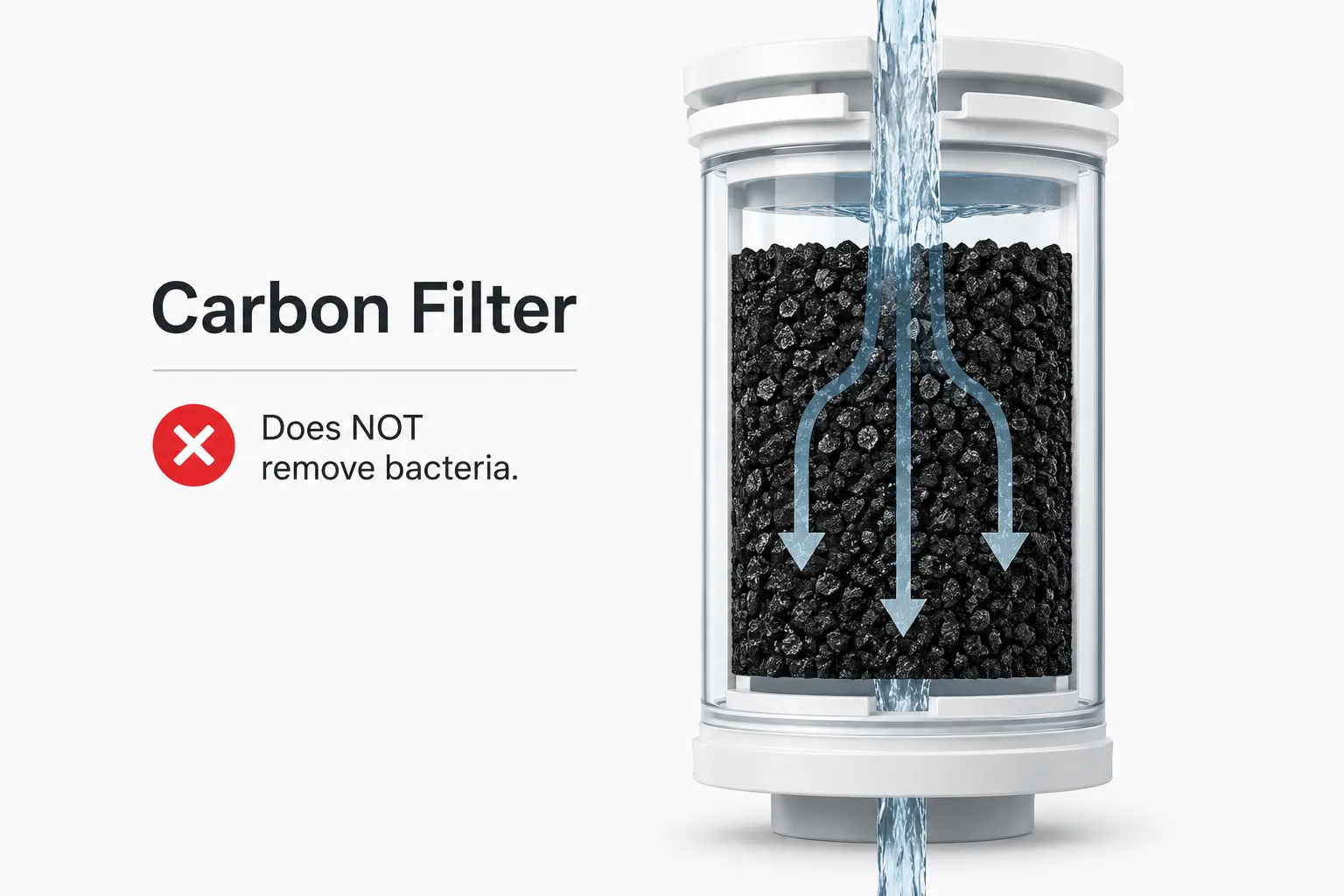
This is one of the most common questions we hear. Carbon filters, including popular pitcher-style units, are excellent at pulling out chlorine, bad tastes, odors, and some heavy metals. But they don’t reliably filter bacteria from water.
Carbon works through adsorption, meaning contaminants stick to the surface of the carbon material. That works well for chemical contaminants. Bacteria, though, can actually grow inside a carbon filter if it isn’t changed regularly. That’s not a scare tactic. It’s something we’ve seen with neglected systems in homes across the California.
What About Brita?
Brita filters are activated carbon filters. They are not rated to remove bacteria. Brita is clear about this on their own website. So if someone asks “do Brita water filters remove bacteria,” the straight answer is no.
This doesn’t mean Brita is a bad product. For municipal tap water that’s already treated, it does its job. But if bacteria in water filters or your water source is your concern, a pitcher filter isn’t the solution.
How Reverse Osmosis Handles Bacteria
Reverse osmosis is different. An RO membrane has pores in the range of 0.0001 microns. That’s far smaller than any bacteria. Bacteria can’t pass through. Neither can viruses, most heavy metals, dissolved salts, or fluoride.
This is why RO is often considered the gold standard for residential water purification. A well-installed system doesn’t just filter bacteria from water, it removes a wide range of contaminants in one process.
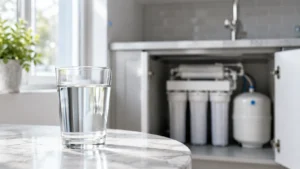
What a Standard RO System Includes
A quality multi-stage system typically works like this:
- Stage 1 (Sediment filter): Removes sand, rust, and large particles
- Stage 2 (Carbon block): Reduces chlorine and organic compounds
- Stage 3 (RO membrane): Rejects bacteria, viruses, dissolved solids
- Stage 4 (Post-carbon filter): Final polish for taste and odor
- Stage 5+ (Optional): Remineralization or UV sterilization
For homeowners comparing options, a 6-Stage Water Filtration System in Tracy, CA adds remineralization after the RO membrane, which puts beneficial minerals back into the purified water.
UV Light vs. Reverse Osmosis: Which Is Better for Bacteria?
Both are effective, but they work very differently. And if you’re on well water or live in an area with older infrastructure, understanding this difference matters.
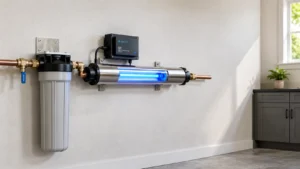
UV light disrupts the DNA of bacteria and viruses, preventing them from reproducing. It doesn’t physically remove them from the water, it just renders them harmless. UV is fast, chemical-free, and highly effective against bacteria and viruses. But it does nothing for heavy metals, dissolved solids, or sediment. Is a UV Light Water Filter Really Worth It
Reverse osmosis physically blocks bacteria (and nearly everything else) through membrane filtration. It addresses a much broader range of water quality issues in one system.
Here’s where it gets interesting. Many well water users in rural and semi-rural parts of California actually benefit from combining both. A UV stage added after the RO membrane handles any surviving microorganisms with a second layer of protection. Some multi-stage systems include this as a built-in final stage, which the team at RO Water Filter System can help configure based on your specific water test results.
Well Water Users: Pay Extra Attention
If you’re on a private well, your water isn’t regulated by the municipal water treatment system. That means no one is testing it for you. Bacteria like E. coli and coliform can enter well water through surface runoff, septic system issues, or casing damage.
California has hundreds of thousands of private wells, many in the San Joaquin Valley. If you’re in a rural area east of Tracy toward the Delta or foothills, your risk profile for bacteria contamination is different from a city home on a treated municipal supply.
For well water situations, a multi-stage RO system with a UV stage isn’t overkill. It’s the right call. You can look at different types of filtration to understand which combination makes the most sense for your property.
Do Water Purifiers Remove Bacteria?
The term “water purifier” is often used loosely. Technically, a true water purifier must remove, kill, or inactivate viruses, bacteria, and protozoa. Not every filter marketed as a purifier actually meets that standard.
Systems that legitimately qualify as purifiers include:
- Multi-stage RO systems (especially with UV)
- Certified UV purifiers (NSF/ANSI 55 Class A)
- Hollow fiber ultrafiltration systems certified to 0.1 micron or smaller
A standard pitcher filter or faucet-mounted carbon filter does not qualify as a purifier by that definition, regardless of what the packaging says.
How to Know What Your Water Actually Needs
Before buying any system, test your water. A basic water test for bacteria (total coliform and E. coli) is inexpensive and tells you whether bacteria is even a real concern in your tap water.
For homes on municipal supply in California, bacteria are usually well-controlled. Your bigger concerns are often chlorine byproducts, nitrates, or hard water. But if you’re on a well, if you’ve had any recent plumbing work, or if your water looks, smells, or tastes off, don’t assume it’s fine.
The Professional RO System Installation in Tracy, CA team can walk you through what your water needs based on your address, water source, and any test results you have.
Conclusion
So do water filters remove bacteria? Some do. Most don’t. The filter you have right now, unless it’s a certified RO system, ultrafiltration unit, or UV purifier, is probably not removing bacteria. It might be doing other helpful things. But bacteria filtration requires a system designed specifically for that job.
RO Water Filter System has helped thousands of California homeowners get genuinely clean drinking water. If you’re not sure what you need, reach out and we’ll help you figure it out before you spend a dollar.
FAQs
Do water filters remove bacteria or only kill them?
Most filtration systems remove bacteria physically through membrane filtration. UV systems work differently because they neutralize microorganisms using ultraviolet light instead of trapping them.
Can reverse osmosis remove bacteria completely?
Reverse osmosis systems remove bacteria at very high rates when properly maintained. The RO membrane contains tiny holes small enough to block many harmful contaminants from drinking water.
Do all water purifiers remove bacteria?
No. Some water purifiers mainly improve taste and reduce chlorine. Always check NSF ANSI standards and product specifications before assuming bacteria protection exists.
Can bacteria grow inside old water filters?
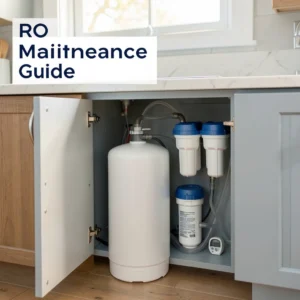
Yes. Dirty or expired filters may allow bacteria in water filters to develop over time, especially if cartridges are not replaced properly. Regular maintenance is extremely important.
What water filters remove bacteria and viruses best?
Reverse osmosis combined with UV light treatment is one of the strongest options for residential water safety. This setup helps remove bacteria and viruses while also improving taste and reducing dissolved contaminants.