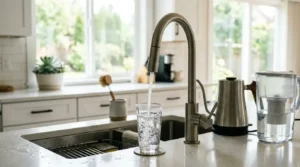
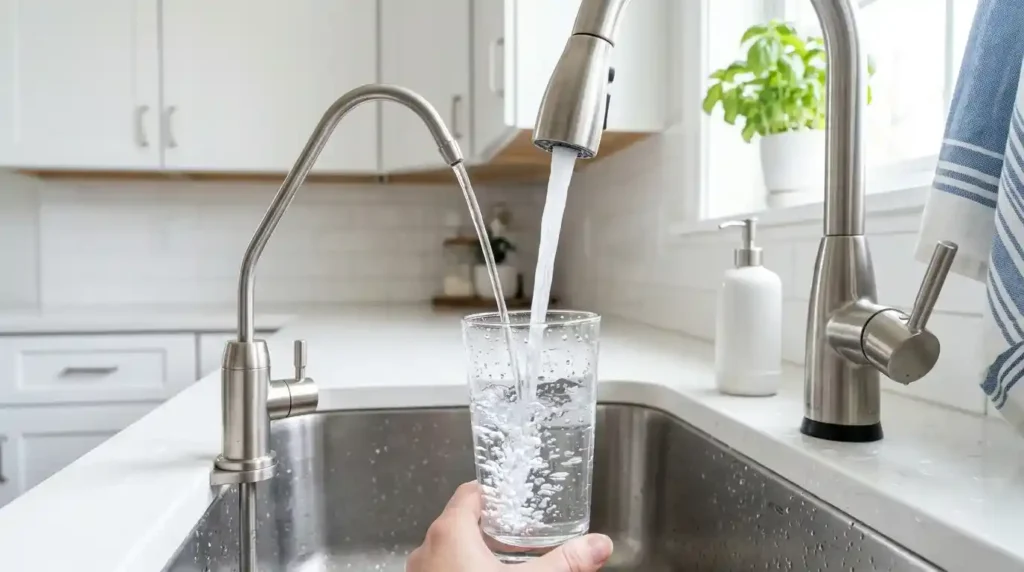
You fill a glass at the tap and wonder what’s in it. Good instinct. If you’re asking what is filtered water, here’s the quick answer: it’s tap or well water that has passed through a filter to remove particles, chlorine, and other contaminants. The filter you use decides what gets removed.
I’ll walk you through how the water filtration process works, what a filter removes and misses, and how filtered water compares with purified, distilled, and tap water. You’ll also see how to pick a household water filter that fits your home. By the end, you’ll know what to buy and what to skip.
How Does Water Filtration Work?
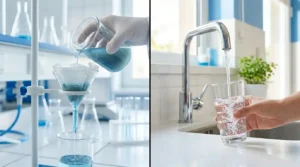
Water filtration works by forcing water through a barrier that traps or removes contaminants. Some filters block particles by size. Others use adsorption, where chemicals stick to a surface such as activated carbon. Membranes and ion exchange resin remove dissolved substances that simpler filters can’t.
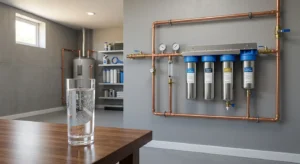
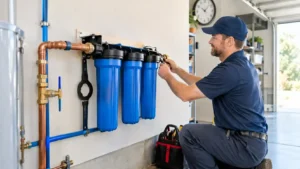
Most household systems run in stages. A sediment filter catches sand, rust, and silt first. Carbon filtration then handles chlorine, taste, and odor. Some systems add a reverse osmosis membrane or UV light after that.
Order matters. Coarse filters go first so they protect the finer ones. It’s like using a colander before a coffee filter. Skip the colander, and the fine filter clogs fast.
What Does Filtered Water Remove?
Filtered water removes physical debris, chemical disinfectants, heavy metals, and emerging synthetic contaminants that slip through municipal water treatment plants.
While public tap water meets federal standards, aging service lines and industrial runoff often introduce pollutants between the water plant and your faucet.
- Disinfectants and Byproducts: Municipalities rely on chlorine to sanitize water. Does filtered water remove chlorine? Yes, activated carbon filters excel at trapping chlorine and its chemical byproducts.
- Heavy Metals: Lead enters drinking water through aging plumbing joints and service lines. Multi-stage filters and reverse osmosis systems reduce lead, copper, and mercury levels significantly.
- Emerging Contaminants: Environmental Protection Agency (EPA) data highlights growing risks from per- and polyfluoroalkyl substances (PFAS). High-quality carbon block and reverse osmosis systems reduce these “forever chemicals” below critical health advisories.
- Sediment and Microplastics: Physical media trap microplastics, silt, and rust flakes, protecting your health and preventing plumbing wear.
Filtered vs. Purified vs. Distilled Water: Key Differences
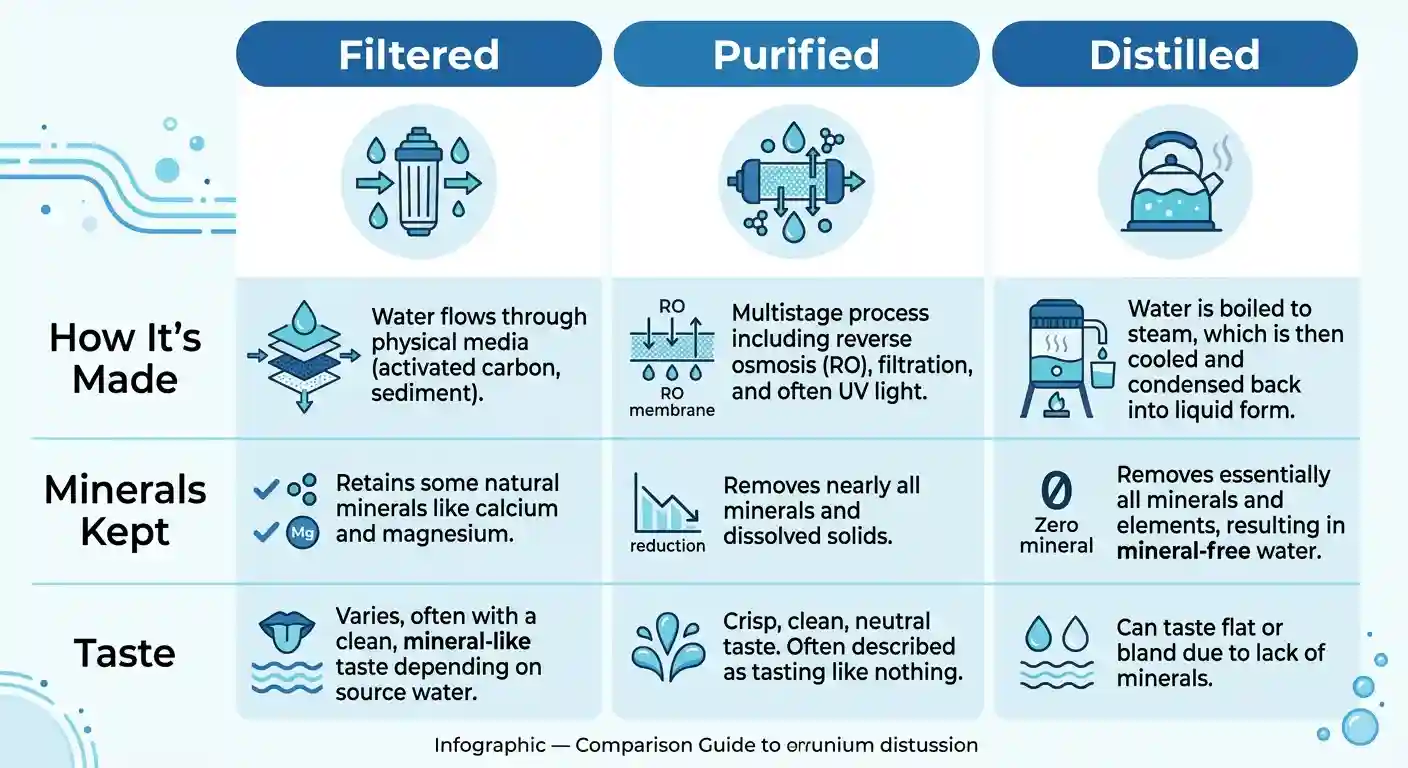
Filtered, purified, and distilled water differ primarily in their processing methods, final purity levels, and mineral content.
To see how these options compare side-by-side, look at their core traits:
| Water Type | Purity Level | Mineral Retention | Primary Treatment Method | Best Use Case |
| Filtered Water | Moderate to High | Retains beneficial minerals (calcium, magnesium) | Activated carbon, sediment, or micron filters | Everyday household drinking and cooking |
| Purified Water | Extremely High (<10 PPM TDS) | Varies; often remineralized for taste | Multi-stage RO, deionization, UV light | High-purity hydration, baby formula |
| Distilled Water | Near-Absolute Purity | Zero minerals remaining | Boiling steam condensation | Medical devices, steam irons, CPAP machines |
| Standard Tap Water | Variable (EPA Compliant) | Retains natural minerals | Municipal sand filtration and chlorination | General utility, washing, gardening |
Filtered Water vs. Purified Water
Purified water goes a step further. The FDA describes purified bottled water as water made by distillation, deionization, reverse osmosis, or a similar process. Filtered water can come from a simple carbon filter. So purified water has been filtered in some way, but filtered water isn’t always purified.
Filtered Water vs. Tap Water
Your utility treats and tests tap water before it reaches you. Filtered water starts as that same water and gets another round of treatment at home. The utility handles germs at the plant. Your filter handles taste, odor, and what the water picks up on the way.
Picture a glass that passed every city test. Your home was built before the mid-1980s, and lead solder sits in the plumbing. The utility did its job, but the last few feet of pipe still matter. A certified filter at the tap covers that gap. Tap water costs less per glass, though.
Filtered Water vs. Distilled Water
Distilled water is boiled into steam, then cooled back into liquid. Minerals and most solids stay behind. That makes it very pure and noticeably flat. Some volatile compounds can carry over with the steam.
Distilled water suits appliances and medical devices. For daily drinking, filtered water keeps more flavor.
How Water Is Filtered: Main Types of Filtration Media
Water filters use different technologies to clean water, with each media targeting specific pollutants.
1. Activated Carbon and Carbon Block
Carbon media work through adsorption. Chemicals stick to the vast surface area of porous carbon as water flows through. Carbon blocks lower chlorine taste and odor, organic chemicals, and volatile organic compounds (VOCs).
2. Reverse Osmosis (RO) Membranes
RO systems use high pressure to push water through a dense, semi-permeable membrane with pores as small as 0.0001 microns. They pull out dissolved salts, heavy metals, fluoride, and PFAS. Many home RO units include a remineralization stage to restore healthy trace calcium and magnesium for better taste.
3. Sediment and Micron Filters
Sediment cartridges act as the first line of defense. They catch larger floating particles like sand, scale, and rust, preventing downstream carbon media and delicate RO membranes from clogging prematurely.
What Is TDS (Total Dissolved Solids) in Filtered Water?
Total Dissolved Solids (TDS) measures the combined volume of inorganic salts and organic matter dissolved in water, expressed in parts per million (PPM).
A common misconception is that high TDS automatically means water is unsafe. In reality, a TDS meter measures everything dissolved in liquid—including beneficial minerals like calcium, potassium, and magnesium alongside unwanted salts.
While reverse osmosis lowers TDS dramatically by stripping out dissolved materials, a standard carbon household water filter leaves minerals intact. That means your water filter can deliver clean, safer drinking water without driving the TDS reading down to zero.
Is Filtered Water Safe and Healthier?
Filtered water is safe to drink when you maintain the filter and match it to your water. A certified filter can lower contaminants such as lead, chlorine, and some chemicals. It isn’t a medical treatment, and an old, unchanged filter can lose effectiveness.
So, is filtered water healthy? It lowers your exposure to certain contaminants, and that’s a real benefit. It isn’t magic, though. Any safe water hydrates you, and most U.S. tap water meets EPA standards. Knowing what is filtered water, and what it can’t do, keeps your expectations honest. A filter adds the most value when your water has a specific issue or a taste you dislike.
One caution. Filters can collect bacteria if they sit past their change date. Replace cartridges on schedule and flush new ones before use. If someone in your home has a weakened immune system, ask their doctor what level of filtration they need.
Benefits of Drinking Filtered Water Daily
The benefits are practical, not miraculous. Filtered water won’t detox your body. It does a few useful things:
- Better taste and smell: Without chlorine, water tastes cleaner. Many people drink more of it as a result.
- Lower exposure to certain contaminants: A certified filter can cut lead, chlorine byproducts, and some chemicals.
- Cleaner coffee, tea, soup, and ice: Water is the main ingredient, so it shows.
- Less bottled water: A home filter often costs less per gallon and creates less plastic waste.
- Convenience: Clean drinking water comes straight from your tap.
Taste is the sleeper benefit. If water tastes good, you reach for it. That habit does more for your health than any label.
How to Choose a Water Filter
Choosing the right filter comes down to matching your local water quality with your budget and space.
- Test Your Tap Water: Obtain a Consumer Confidence Report from your local water utility or use an accredited lab to test private well water.
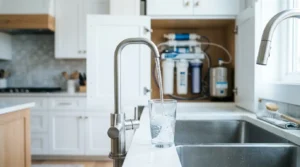
- Determine Your Purity Goals: If you only want to remove chlorine odor, a simple pitcher filter works well. If you need to remove lead, nitrates, or PFAS, opt for a certified under-sink RO system.
- Calculate Maintenance Costs: Factor in the price and frequency of replacement cartridges. A filter that isn’t changed on schedule loses effectiveness and can harbor bacteria buildup.
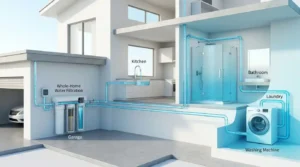
If you need professional guidance or a complete home setup, exploring specialized Water Filtration Installation Services in Tracy, CA can help you select and maintain the right system for your home. Companies like RO Water Filter System offer tailored point-of-use solutions designed for regional tap water conditions.
Final Thoughts
Understanding your tap water quality is the first step toward better health and better-tasting drinks at home. Whether you start with a simple carbon pitcher or install a full multi-stage reverse osmosis unit, filtering your water offers an easy, reliable way to protect your household from unseen contaminants.
Ready to upgrade your home’s drinking water? Feel free to Contact us to schedule a water quality test and find the perfect filtration setup for your space.
Frequently Asked Questions
What does filtered water mean?
Filtered water refers to water that has passed through a physical or chemical filter media to reduce impurities like sediment, chlorine, heavy metals, and synthetic pollutants, resulting in cleaner, better-tasting drinking water.
Does boiling water filter it?
Boiling water sanitizes it by killing biological organisms like bacteria, viruses, and parasites, but it does not filter the water. Boiling actually concentrates heavy metals, microplastics, and dissolved chemicals as pure water evaporates away.
Does filtered water remove beneficial minerals?
Standard carbon filtration preserves healthy natural minerals like calcium and magnesium while removing chemical contaminants. Reverse osmosis systems do strip away minerals, but many modern units add a remineralization stage to restore them before drinking.
Is Filtered Water Better Than Bottled Water?
Not always. Bottled water can be municipal tap water that has been filtered or treated, so it isn’t automatically cleaner than what a good home filter produces. A certified home filter often costs less per gallon and creates less plastic waste. Check bottle labels for the source and treatment.
Do I Need a Water Test Before Buying a Filter?
Yes. A test tells you what’s actually in your water, so you buy a filter that targets it. City customers can start with the annual Consumer Confidence Report. Private well owners should use a state-certified lab, since EPA rules don’t cover private wells.