Most homeowners in Tracy install a reverse osmosis system and forget about it. That works for a while. But eventually the water starts tasting flat, the flow slows to a trickle and the filters are running years past their service life. If you want clean, great-tasting water year after year, you need to know how to maintain a reverse osmosis system properly.
RO Water Filter Sytem guide covers everything: filter schedules, membrane care, tank pressure, sanitization, and the signs that something’s wrong before it becomes expensive. Whether you’ve had your system for six months or six years, there’s something here you can use.
Why RO Maintenance Actually Matters
Tracy’s water comes from the San Joaquin Delta and local groundwater blends. It’s treated and safe to drink, but it carries dissolved minerals, chloramines, and sediment that wear down your filters faster than you’d expect. Consistent reverse osmosis system maintenance isn’t optional in this area.
Hard water is a real factor here. Tracy sits in a region with noticeably high mineral content. That mineral load stresses your pre-filters and can cause RO membrane fouling earlier than the manufacturer’s typical estimate. If you’re not on a consistent reverse osmosis maintenance schedule, you’re essentially running your system on borrowed time.
How to Maintain a Reverse Osmosis System: The Core Schedule
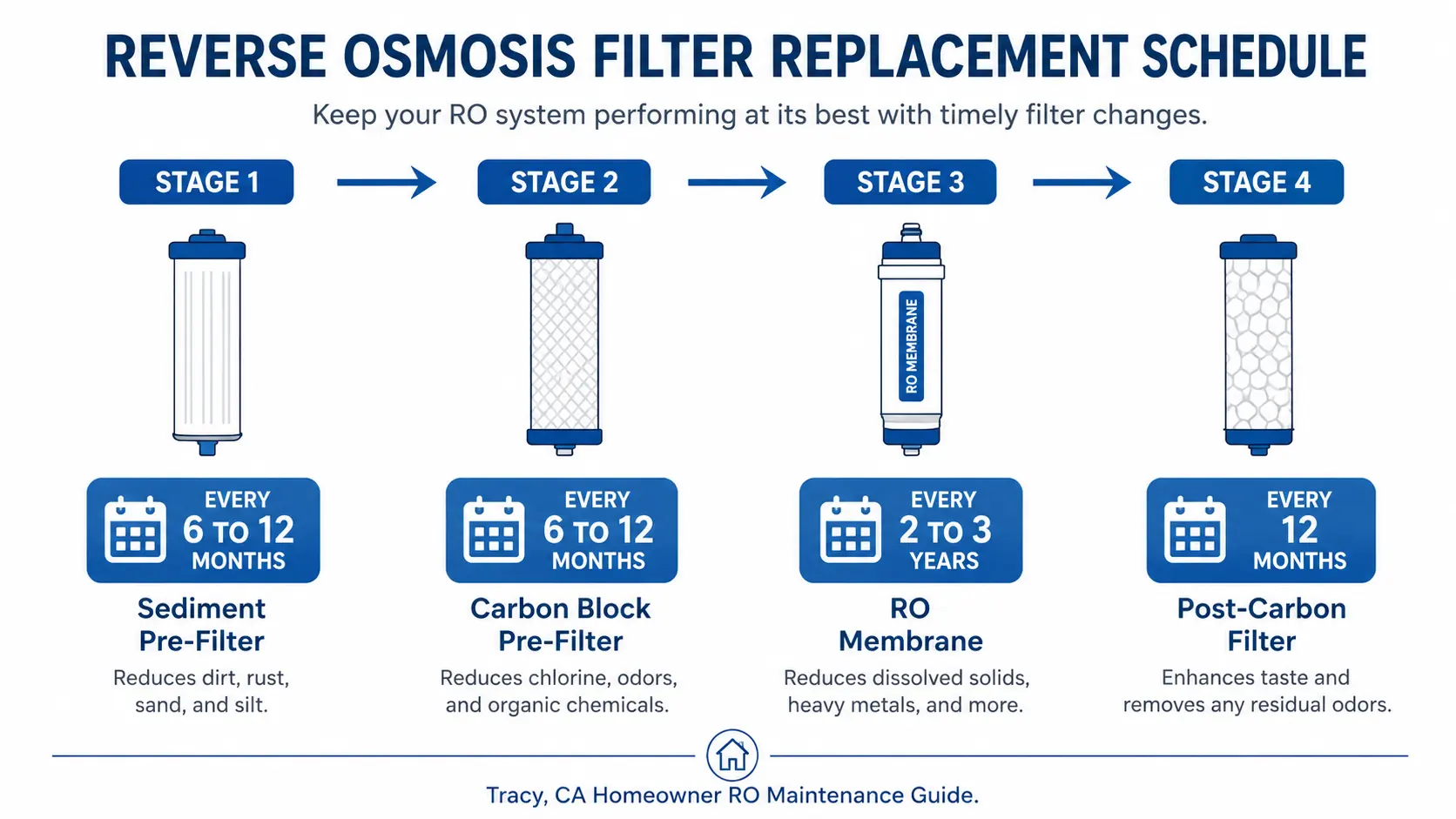
Pre-filters do the heavy lifting. They catch sediment, chlorine, and chloramines before water ever reaches the membrane. Post-carbon filters polish the taste at the final stage.
Pre-Filter and Post-Filter Replacement
Here’s a realistic RO filter maintenance schedule for Tracy-area homes:
- Sediment pre-filter: Every 6 to 12 months
- Carbon block pre-filter: Every 6 to 12 months
- Post-carbon filter: Every 12 months
- RO membrane: Every 2 to 3 years with good pre-filtration
These timelines shift based on your water usage. A family of five will burn through pre-filters faster than a couple living alone. The honest truth is that most homeowners wait too long. Clogged pre-filters force your membrane to work harder, which shortens its lifespan significantly.
RO Membrane Care
The membrane is the most expensive part of your system. It’s also the part people neglect most.
RO membrane fouling happens when minerals, biofilm, or organic matter build up on the membrane surface. You won’t always see it coming. But you’ll notice the symptoms:
- Slower flow from the RO tap
- TDS rejection rate dropping below 85 to 90 percent
- Water tasting different even with fresh filters
Check your TDS rejection rate every few months with a basic TDS meter. Compare your tap water reading against the purified output. If rejection drops significantly, the membrane may need replacement or the system needs full sanitization.
System Sanitization: The Step Most People Skip
Sanitizing your RO system is not the same as replacing filters. Filters catch contaminants. Sanitization cleans the internal surfaces, tanks, and tubing where biofilm and bacteria can slowly build up over time.
When to Sanitize
- Once a year as standard ro water filter maintenance
- Any time the system sits unused for more than two weeks
- After a boil-water advisory or water main break
- When you notice an off-taste that new filters don’t fix
How to Do a Basic RO System Sanitization
This is manageable as a DIY job if you’re comfortable working under your sink.
- Turn off the feed water valve and let the storage tank drain completely.
- Remove all filters and the membrane. Set the membrane aside carefully.
- Add food-grade hydrogen peroxide (about half a cup for most standard systems) to the first filter housing.
- Reassemble the housings without filters and run water through the system until the tank fills.
- Let it sit for 30 minutes, then drain the tank fully.
- Reinstall fresh filters and the membrane, refill the tank, and discard the first two full tanks before drinking.
If you’re not comfortable doing this yourself, it’s worth having a pro handle it during your annual filter swap.
Checking Tank Air Pressure: The Overlooked Variable
Your RO storage tank uses air pressure to push water to the faucet. Most tanks are pre-charged to around 7 to 8 PSI at the factory. Over time, that pressure drops. When it does, flow gets weak even with a fresh membrane and clean filters.
How to Check and Adjust PSI
- Make sure the tank is empty before checking (a full tank gives a false reading).
- Use a standard tire gauge on the Schrader valve on the side or bottom of the tank.
- If pressure is below 6 PSI, add air with a bicycle pump until it reads 7 to 8 PSI.
- Never check pressure with water in the tank or the reading will be inaccurate.
This one step fixes a lot of “slow water” complaints. We’ve seen homeowners replace their entire system when all they needed was to top off the tank pressure.
Signs Your RO System Needs Attention Now
Don’t wait for a full failure. These are the early warning signs that your reverse osmosis filtration system needs attention:
- Slow flow from the RO tap (tank pressure or clogged pre-filters)
- Water tastes like chlorine (exhausted post-carbon filter)
- Water tastes flat or slightly off (membrane degradation or biofilm in the tank)
- Constant draining sound (membrane may be failing, causing continuous drain flow)
- TDS rejection below 85 percent (time to test and likely replace the membrane)
The constant drain issue is worth catching early. A damaged membrane can’t hold back pressure, so the system keeps trying to purify water and continuously sends it to drain. That wastes water and accelerates wear on every other component.
RO Maintenance for First-Time System Owners
If you just bought your first system, here’s what to focus on in year one.
Set a reminder now for filter changes at six months. Don’t rely on memory. Pull out the filters and look at them. A dark brown sediment filter at six months tells you a lot about your local water quality and helps you dial in your future schedule.
Keep the original filter housing wrench somewhere accessible. Losing it means struggling with stuck housings later. A little plumber’s grease on the O-rings at each filter change prevents leaks and makes the next swap much easier.
And if you’re connected to a Reverse Osmosis System for Homes that includes a permeate pump or booster pump, check the manufacturer’s notes for any pump-specific maintenance. Those components need occasional inspection too, especially in hard water areas like Tracy.
Common Mistakes That Shorten RO System Life
These come up constantly with homeowners who call after their system starts underperforming.
- Going too long between pre-filter changes. Sediment filter clogging is the number one cause of early membrane failure.
- Ignoring the constant drain. If your system is always draining, something is wrong. Don’t just let it run.
- Skipping annual sanitization. Filters catch particles. Sanitization removes what filters miss.
- Never checking TDS. You won’t know your membrane is failing until you measure it.
- Checking tank pressure with water still in the tank. Always drain first or the reading is useless.
At RO Water Filter System, the most common service call we get is from homeowners who have never changed a filter since installation. It’s fixable, but it costs more to recover than it would have to prevent.
When to Call a Professional for RO System Maintenance
Honestly, most routine ro filter maintenance described here is DIY-friendly. But some situations genuinely need a professional.
Call a pro if:
- You’re seeing water puddles under the sink that don’t clear up
- The system keeps running and won’t stop draining
- You’ve replaced everything and the TDS rejection is still low
- The storage tank is several years old and pressure won’t hold after recharging
If you’re in Tracy or a nearby community and need a professional inspection, the team at Reverse Osmosis Water Filter Tracy, CA handles full system checkups, membrane testing, and sanitization services. If your system is beyond saving, Professional RO System Installation in Tracy, CA can get you set up with a new, properly sized unit.
Conclusion
Keeping a reverse osmosis system running well isn’t complicated. It takes a consistent filter replacement schedule, an annual sanitization, and occasional checks on tank pressure and TDS. That’s it. Do those things, and most systems will give you clean, great-tasting water for ten years or more.
If you’ve been putting off maintenance or you’re not sure where your system stands right now, don’t guess. A quick check with a TDS meter and a look at your filter housings will tell you a lot. And if you’d rather have someone who knows these systems handle it for you, reach out to RO Water Filter System in Tracy. We’ll make sure your system is clean, properly pressurized, and ready to keep performing. Knowing how to maintain a reverse osmosis system is valuable. Having a trusted local team to back you up is even better.
FAQs
How often should reverse osmosis filters be replaced?
Most sediment and carbon filters should be replaced every 6 to 12 months. The exact timing depends on your water quality, household size, and daily water usage. Homes in Tracy with harder water may need more frequent reverse osmosis maintenance.
Can I clean and reuse an RO membrane?
In most residential systems, RO membranes are replaced rather than cleaned. Once membrane fouling becomes severe, cleaning usually doesn’t restore full system performance. Regular maintenance helps extend membrane lifespan.
Why is my RO system producing water slowly?
Slow production often means clogged filters, low tank air pressure, or a failing membrane. Hard water scaling can also reduce efficiency over time. Checking the filter replacement schedule is usually the first step.
Does an RO system need professional servicing every year?
Not always. Many homeowners handle basic ro filter maintenance themselves, including filter changes and sanitization. Professional service becomes more important when dealing with pressure problems, leaks, or membrane replacement.
Is reverse osmosis enough for hard water in Tracy?
Reverse osmosis improves drinking water quality, but it doesn’t fully protect plumbing from hard water minerals throughout the home. Many Tracy homeowners combine a water softener with their reverse osmosis filtration system for better overall protection.