
You bought a reverse osmosis system to protect your family from lead, fluoride, chlorine, and other contaminants in your tap water. But here is the part most people overlook: the system only works as well as its filters. When those filters are overdue for a change, your water quality drops, sometimes without any obvious warning signs. Staying on top of reverse osmosis water filter replacement is the single most important maintenance task for RO Water Filter System.
Most other tutorials on this subject offer you a broad timetable and leave it at that. They don’t explain what really occurs when a filter becomes blocked, why Tracy’s water conditions are important, or how to prevent the blunders that make your system last less long. This book accomplishes all of that and provides you with a clear, doable strategy you can start using right now.
Why Reverse Osmosis Water Filter Replacement Is Not Optional
An RO system contains many steps that filter the water in order. Every stage captures something else. When one step quits working, the others have to work harder, and the things you were filtering out start to get through again. Your sediment pre-filter is like the first line of defense. It prevents dirt, corrosion, and other small particles from getting to the sensitive RO membrane.
If that pre-filter clogs and you ignore it, water pressure drops across the whole system. Your RO membrane, which is the most expensive component, has to work harder. Over time, it degrades faster than it should. This makes timely ro filter replacement especially important for households here. A filter schedule designed for average water conditions may not be enough in this area.
Understanding What Each Filter Stage Does

Before you can reverse osmosis water filter replacement correctly, it helps to understand what each one does and why it wears out.
Sediment Pre-Filter (Stage 1) This filter removes physical particles: sand, silt, rust, and dirt. It protects every stage that follows. Because it takes the heaviest initial hit, it wears out fastest.
Carbon Block Pre-Filter (Stage 2 and sometimes Stage 3) Activated carbon removes chlorine, chloramine, volatile organic compounds (VOCs), and bad taste and odor. This is critical in Tracy because chloramine in municipal water will actively damage your RO membrane if carbon filtration is not doing its job.
RO Membrane (Core Stage) The membrane is the heart of the system. It pushes water through a semi-permeable barrier under pressure, blocking up to 99% of dissolved contaminants including lead, fluoride, arsenic, nitrates, and total dissolved solids (TDS). The membrane does not physically clog like a carbon filter, it degrades chemically and loses rejection efficiency over time.
Post-Carbon Filter (Final Stage) After filtered water sits in the storage tank, a post-carbon or post-filter polishes it one final time before it reaches your faucet. This removes any residual taste or odor picked up during storage.
If your system is a 6-Stage Water Filtration System, you may also have an additional remineralization or alkaline stage. That stage typically uses a mineral cartridge that needs replacement roughly once a year, depending on your water usage.
The Realistic Replacement Schedule for RO Filters
Here is a clear reference table for how often each filter stage should be replaced under typical residential conditions:
| Filter Stage | What It Removes | Replacement Interval |
| Sediment Pre-Filter | Dirt, rust, silt | Every 6 to 12 months |
| Carbon Block Pre-Filter | Chlorine, chloramine, VOCs | Every 6 to 12 months |
| RO Membrane | Lead, fluoride, TDS, arsenic | Every 2 to 3 years |
| Post-Carbon Filter | Residual taste and odor | Every 12 months |
| Remineralization Cartridge | Adds minerals back to water | Every 12 months |
Important note for Tracy homeowners: If your home uses more water than average, if you have a large household, or if your incoming water has high TDS or heavy sediment, move toward the shorter end of these intervals. High sediment loads are common in parts of the Central Valley, and they will exhaust your pre-filters faster than the general schedule suggests.
Warning Signs That Your Filters Need Changing Now

Keep an eye on your system in case something seems off before its scheduled date arrives your system could warn of problems even before that.
Watch for these signs:
- Slow water flows from the RO faucet. An optimal RO system should fill a glass within 30 seconds; otherwise, its filters or membrane may have become compromised and is no longer functioning as intended. If this takes any longer, your pre-filters may have become blocked up with debris, and membrane degradation could be to blame.
- Unpleasant taste or odor. If water starts tasting flat, musty, or slightly chemical again, your carbon pre-filter or post-filter is likely exhausted.
- Rising TDS readings. With an inexpensive TDS meter in hand, readings on your filtered water should be significantly lower than its source water any shrinkage indicates your RO membrane’s efficiency has diminished and needs repair.
- Cloudy or discolored water. This can indicate a failed sediment filter or a compromised membrane.
- The tank fills very slowly or not at all. A badly clogged pre-filter starves the membrane of inlet pressure, causing the tank to take hours to refill.
How to Change RO Filters: Step-by-Step

Most homeowners in Tracy can handle this as a DIY job. You do not need a plumber. You do need the right reverse osmosis water filter replacement cartridges for your specific system and about 30 minutes.
What you will need:
- Replacement filter cartridges (matched to your system)
- Filter housing wrench (usually included with your system)
- A bucket or towels
- A clean cloth or paper towels
Step 1: Turn off the water supply. Close the dedicated cold water supply valve that feeds your RO system. This is usually a saddle valve or ball valve on the cold supply line under the sink.
Step 2: Close the storage tank valve. There is a small valve on the top of the storage tank. Turn it off to stop water from flowing back through the system while you work.
Step 3: Open the RO faucet to release pressure. Turn on your dedicated RO faucet and allow it to run until water stops flowing out, to depressurize its filter housings safely and open easily. This should decompress them.
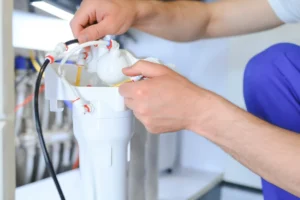
Step 4: Remove the filter housings. Use the housing wrench to unscrew each canister. Place a bucket or towels underneath, there will be some residual water. Twist the housing counterclockwise to remove it.
Step 5: Pull out the old filters and discard them. Remove used cartridges for disposal. Take note if your sediment filter appears dark brown or is heavily loaded; this could indicate it needs replacing more frequently than expected.
Step 6: Rinse the housings before reinstalling. Wipe the inside of each housing with a clean damp cloth. Do not use soap. Debris or residue inside the housing can contaminate your new filter immediately.
Step 7: Install the new filters. Seat each new cartridge securely before tightening back the housings – hand tight is usually sufficient, followed by quarter turns with your wrench – but don’t overdo it as this may damage either the housings or O-ring seal, leading to leakage issues.
Step 8: Reopen the water supply and tank valve. Turn both back on and let the system pressurize. Check every housing connection for drips. Tighten slightly if needed.
Step 9: Flush the system before drinking. Open the RO faucet and let the first one to two tank fills drain completely. New carbon filters, especially, release harmless carbon fines that can make water look gray. Flushing clears this before you start drinking.
For the RO membrane specifically, the process is slightly different, the membrane sits in a separate housing and typically has a longer life span. If you are not confident replacing the membrane yourself, a professional visit from RO Water Filter System ensures it is seated and sealed correctly.
A poorly installed membrane will not filter effectively, regardless of its condition. If you need a full walkthrough on your first installation or replacement, our guide on How to Install Reverse Osmosis Water Filter covers the complete process.
Choosing the Right Replacement Filters
Not all reverse osmosis water filter replacement cartridges are equal. Here is what matters when buying filters for your Reverse Osmosis Water Filter system:
Match the size and micron rating. A standard under-sink RO uses 10-inch housings and specific micron ratings for each stage. Using the wrong micron rating can allow contaminants through or restrict flow unnecessarily.
Check for NSF certification. NSF/ANSI Standard 58 covers RO membranes. NSF/ANSI 42 and 53 cover carbon and sediment filtration. These certifications mean the product has been independently tested to do what it claims.
Stick with compatible brands. Off-brand cartridges might have slightly differing dimensions, resulting in faulty sealing. When in doubt, use the cartridges advised for your particular system model.
Do not buy in bulk without testing shelf life. Unused carbon cartridges can absorb ambient odors over time. Buy what you will use within a year.
A Simple Annual Maintenance Routine
Keeping a basic maintenance log takes the guesswork out of ro system filter change timing. Write down the date every time you replace a filter. Set a calendar reminder for the next interval. Check the following once a year even if no obvious problems appear:
- Test TDS before and after filtration
- Inspect O-rings on all housing caps for cracking or compression
- Check the storage tank pressure (should be 6 to 8 PSI when empty, tested via the Schrader valve on the tank)
- Inspect supply and drain line connections for any slow drips
This takes under 20 minutes and can prevent costly membrane damage or system failures.
Conclusion
Reverse osmosis water filter replacement can be one of the best investments a homeowner can make to increase drinking water quality, yet they only work properly when regularly maintained and effectively serviced. Replacing filters regularly protects you from lead, fluoride, and other contaminants that people assume their systems already filter out.
Tracy or surrounding residents in need of professional guidance regarding which reverse osmosis filter to purchase and a replacement schedule are offered or hands-on support with your next ro filter change, the team at RO Water Filter System is ready to help. Reach out today and get straightforward answers from people who work with these systems every day.
FAQs
How do I know if my ro filter replacement is overdue if I never tracked the date?
Start by testing your water with a basic TDS meter. If your filtered water TDS is within 10 to 15 percent of your unfiltered source water, the membrane is likely degraded.
Can I just change ro filters one stage at a time, or do they all need to change together?
Each filter stage has its own lifespan and can technically be replaced independently. In practice, many homeowners change all pre-filters at the same service interval, since they wear on a similar schedule and opening the housings twice costs more time than once.
Does the type of water in Tracy, CA affect how often I need to change my filters?
Yes, it does. Tracy receives treated municipal water that contains chloramine, which degrades activated carbon media faster than standard chlorine. Sediment levels can also vary by season and supply source. Homeowners in Tracy should lean toward six-month intervals for pre-filters rather than waiting the full twelve months, especially during summer when source water quality tends to shift.
What happens if I skip the post-filter replacement?
The post-filter is the last stage before water reaches your glass. A saturated post-filter no longer removes residual odors picked up during tank storage, and in some cases it can start releasing previously captured compounds back into the water.
Is it worth hiring a professional to change ro filters, or is this always a DIY job?
For pre-filter and post-filter replacement, most homeowners can manage it themselves once they have done it once. For RO membrane replacement, a professional visit is worth considering because a misaligned or improperly seated membrane looks functional but does not filter correctly.